



News & Blogs
By Meenjet Application Engineering Team | November 12, 2026
Executive Summary
Elevator and escalator maintenance involves compliance marks, safety component traceability, and work in confined spaces—three challenges that general asset marking does not face. Components are installed, often inaccessible, and made of mixed materials. A handheld fiber laser can handle these conditions, but only if the laser is matched to the material and the compliance requirement is understood.
This guide explains how to solve compliance marking, confined space access, and mixed-material marking in elevator and escalator maintenance, and how the Meenjet L4 series is built for these conditions.
???? For Elevator & Escalator Maintenance Managers
Question | Answer |
What is a handheld laser used for in elevator maintenance? | Marking compliance tags, safety component IDs, and maintenance records on installed parts without disassembly. |
Which materials can it mark? | Stainless steel, carbon steel, galvanized steel, cast iron, and anodized aluminum. For plastic panels, use the L4 Ultra. |
Can it mark in confined spaces like the hoistway or pit? | Yes. The lightweight head and 1.75 m cable allow access to confined spaces. The optional battery supports work without a nearby outlet. |
Does it meet compliance marking requirements? | It supports the physical marking step. Compliance also requires the correct content, location, and record-keeping per local regulations. |
Can it mark wire ropes? | Not reliably. Wire ropes have a curved surface and continuous wear during operation. Marking is typically applied to the end fitting or a nearby plate, not the rope itself. |
Does it require consumables? | No. Fiber laser marking uses no ink, no solvent, and no ribbons. |
Which Meenjet model for metal components? | L4 MAX. Fiber laser for stainless steel, carbon steel, galvanized steel, and cast iron. |
Which Meenjet model for plastic panels? | L4 Ultra. Semiconductor laser for plastic buttons, display panels, and coated surfaces. |
Glossary:
Compliance mark: A mark required by regulation or standard, such as an inspection tag, maintenance date, or safety component ID.
Hoistway: The vertical shaft in which the elevator car travels.
Pit: The space below the elevator car at the bottom of the hoistway.
Wire rope: The steel rope used for suspension in elevators; it has a curved, wearing surface.
Fiber laser: A laser using a doped optical fiber as the gain medium, typically at 1,064 nm, suited to metals.
Semiconductor laser: A laser using a semiconductor gain medium, typically at 450 nm, suited to plastics and coated surfaces.
1. Why Elevator Marking Is Different from General Asset Marking
General asset marking happens on accessible, stationary, single-material parts. Elevator and escalator marking happens on installed, confined, mixed-material components under regulatory oversight.
Factor | General Asset Marking | Elevator & Escalator |
Access | Accessible | Hoistway, car top, pit, machine room |
Part position | Can be moved | Installed, often cannot be removed |
Material | Usually one material | Stainless steel, galvanized steel, cast iron, plastic |
Compliance | Internal tracking | Regulatory inspection, safety component traceability |
Consequence of failure | Tracking error | Inspection failure, safety risk, regulatory fine |
Key insight: An unreadable compliance mark on a safety component is not just a marking error. It can fail an inspection and delay the elevator from returning to service.
2. Challenge 1: Compliance and Inspection Marks
Elevator and escalator maintenance requires marks that satisfy inspection and record-keeping requirements.
What Needs to Be Marked
Inspection tags: Date of inspection, inspector ID, next inspection date.
Maintenance records: Service date, technician ID, parts replaced.
Safety component IDs: Serial numbers on brakes, governors, safety gears, and buffers.
Wire rope certificates: Rope ID and installation date, typically marked on the end fitting or a nearby plate.
What the Laser Can and Cannot Do
The laser can produce a permanent, legible mark on metal components. It cannot replace the compliance process itself. The mark must contain the correct content, be placed in the correct location, and be recorded in the maintenance system. Local regulations may specify font size, mark location, or mark durability.
Key insight: The laser is the marking tool, not the compliance system. The mark is only compliant if the content, location, and record-keeping meet the local requirement.
3. Challenge 2: Confined Spaces and Inaccessible Components
Elevator and escalator work often happens in spaces that are difficult to access and impossible to bring a benchtop laser into.
Hoistway and Car Top
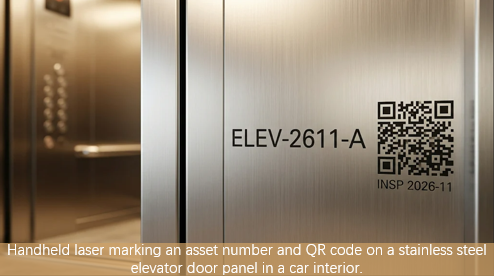
The hoistway is narrow, vertical, and often dark. The car top provides limited standing space. A handheld laser with a lightweight head and a long cable allows the technician to mark components in place.
Pit and Machine Room
The pit is below the car, often with limited headroom. The machine room may be separate or compact. A portable laser with an optional battery avoids the need for a nearby power outlet.
Escalator Truss and Step Chains
Escalator maintenance requires access to the truss, step chains, and handrail drive. These components are installed and difficult to remove. A handheld laser marks them in place.
Key insight: In elevator and escalator maintenance, the tool must go to the component, not the other way around. Handheld laser eliminates the need for disassembly, which is often the longest step in field marking. Portability and cable length determine whether the job can be done at all.
4. Challenge 3: Mixed Materials and Surface Preparation
Elevator and escalator components use a wide range of materials. The laser must be matched to the material.
Metals (L4 MAX, Fiber Laser)
Stainless steel: High-contrast mark, permanent. Common on door panels and car interiors.
Carbon steel and galvanized steel: Permanent mark. Galvanized surfaces may require parameter tuning due to the zinc coating.
Cast iron: Common on brake components and machine room equipment. Permanent mark, may require higher power.
Anodized aluminum: High-contrast black mark through controlled annealing.
Plastics and Coated Surfaces (L4 Ultra, Semiconductor Laser)
Plastic buttons and display panels: Semiconductor laser at 450 nm produces a clean mark without melting.
Coated metal panels: The mark affects the coating; test before production.
Wire Ropes: A Special Case
Wire ropes have a curved surface and continuous wear during operation. Marking directly on the rope is not reliable—the mark may be worn away or distorted by the rope's curvature. In practice, the rope ID is marked on the end fitting or on a nearby plate, not on the rope itself.
Key insight: Match the laser to the material. For wire ropes, mark the fitting or plate, not the rope.
When a Handheld Laser Is Not the Right Tool
A handheld laser is not a universal solution. It is the wrong choice when:
High-volume production: If the manufacturer marks thousands of identical components per shift, an inline laser is faster and more consistent.
Deep VIN-style marks: If the regulation requires a deep, permanent mark with a specified depth, a pneumatic dot peen or high-power fiber laser may be required.
Fully automated traceability: If the mark must be integrated with an automated MES or inspection system, an inline laser with MES integration is the better choice.
5. Meet the L4 Series
For elevator and escalator maintenance, the tool must be portable, reliable, and able to mark the materials found on site. The Meenjet L4 series covers two material groups.
L4 MAX: 1,064 nm fiber laser, up to 50W. Marks stainless steel, carbon steel, galvanized steel, cast iron, and anodized aluminum. Optional 11,600 mAh battery for work without a nearby outlet.
L4 Ultra: 450 nm semiconductor laser. Marks plastic buttons, display panels, coated surfaces, and other non-metals that the fiber laser cannot mark reliably.
For full specifications, see the L4 MAX product page and the L4 Ultra product page.
Frequently Asked Questions (FAQ)
Q1: Can a handheld laser mark wire ropes?
A: Not reliably. Mark the end fitting or a nearby plate instead of the rope itself.
Q2: Does the L4 MAX require a power outlet?
A: The standard configuration requires an external power supply. For confined spaces without an outlet, the optional 11,600 mAh battery is recommended.
Q3: Can it mark galvanized steel?
A: Yes, with parameter tuning. The zinc coating may affect contrast and adhesion. Test before production.
Q4: What is the difference between L4 MAX and L4 Ultra?
A: L4 MAX is a fiber laser for metals. L4 Ultra is a semiconductor laser for plastics, coated surfaces, and other non-metals.
Q5: What is the minimum order for a free sample test?
A: No minimum. Send us your component samples, and our engineers will test the L4 series and recommend the right configuration.
???? Request a Free Sample Test
Send us your component samples. Our engineers will:
Test the L4 MAX or L4 Ultra on your specific metals, plastics, and coated surfaces
Recommend the right model and parameters for your components
Provide a cost and configuration proposal
No obligation. Report delivered within 5 business days.
???? Request a Free Sample Test
Related Technical Resources
About the Author
Meenjet Application Engineering Team — Over 15 years of combined field experience supporting handheld fiber laser, semiconductor laser, flying laser, CIJ, and TIJ installations across elevator maintenance, manufacturing, and field service.
Reviewed by: Senior Application Engineer, Meenjet
Last Updated: November 12, 2026