



News & Blogs
By Meenjet Application Engineering Team | November 2, 2026
Executive Summary
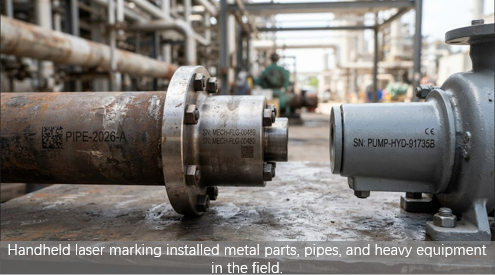
In MRO and field repair, the biggest challenge is marking installed parts, pipes, and heavy equipment that cannot be moved to a workshop. Parts are often covered in oil, rust, or protective coatings, and the surface may be curved or difficult to access.
This guide explains where a handheld laser fits in MRO workflows, how to handle contaminated surfaces, and how to choose the right model from the Meenjet L4 series based on your material.
???? For Maintenance & Reliability Managers
Question | Answer |
What is a handheld fiber laser used for in MRO? | Marking serial numbers, asset IDs, and QR codes on installed parts, pipes, and heavy equipment without disassembly. |
Which metals can it mark? | Stainless steel, carbon steel, aluminum, copper, iron, and cemented carbide. |
Can it mark through oil or rust? | Not reliably. Heavy oil, scale, or rust must be removed before marking. Light surface oil can sometimes be marked with parameter tuning. |
Does it require consumables? | No. Laser marking uses no ink, no solvent, and no ribbons. |
Can it run without a power outlet? | Yes, with the optional 11,600 mAh battery. The standard configuration requires an external power supply. |
Can it mark plastic parts? | Yes. The L4 MAX handles several hard engineering plastics (HDPE, ABS, PVC, PES). For softer non-metals, the L4 Ultra is the better fit. |
Does it support ISO 55000 traceability? | It supports the physical marking step. Full traceability also requires system-level data integration. |
Glossary:
MRO: Maintenance, Repair, and Operations — the ongoing upkeep of industrial assets.
Field repair: Maintenance performed on installed equipment, outside a workshop.
Fiber laser: A laser using a doped optical fiber as the gain medium, typically at 1,064 nm.
Semiconductor laser: A laser using a semiconductor gain medium, typically at 450 nm, suited to non-metals and coated surfaces.
Surface preparation: Cleaning or treating a surface before marking to ensure adhesion or contrast.
1. Why MRO Marking Is Different from Production Marking
Production marking happens on clean, new parts in a controlled environment. MRO marking happens on installed equipment in the field.
Factor | Production Marking | MRO Marking |
Part position | Fixed on a line | Installed, often difficult to access |
Surface condition | Clean and consistent | Oily, rusty, painted, or coated |
Volume | High, continuous | Low, on demand |
Environment | Factory floor | Outdoor, offshore, plant floor, or confined space |
Power supply | Fixed outlet | Often no outlet nearby |
Downtime tolerance | Minutes | Hours or days if the part must be removed |
Key insight: In MRO, the cost of disassembly often exceeds the cost of the marking tool. A handheld laser that works on installed parts avoids the downtime, labor, and risk of removing equipment.
2. Where It Fits: Installed Parts, Pipes, and Heavy Equipment
Installed Parts and Assemblies
Pumps, motors, gearboxes, and valves are often marked in place while still connected to the system. A handheld laser marks the housing or flange without disassembly.
Pipes and Pipeline Components
Pipeline flanges, fittings, and weld joints require traceability marks for inspection and maintenance records. A handheld laser reaches the pipe surface in place, including curved and overhead sections.
Heavy Equipment and Structural Steel
Excavators, cranes, and structural beams cannot be moved to a bench. A handheld laser marks the chassis, boom, or beam directly on site.
Rework and Repair
When a part is repaired or refurbished, the original mark may be removed or damaged. A handheld laser restores the serial number or adds a repair code without sending the part back to the workshop.
Key insight: A handheld laser is the right tool when the part cannot be moved, the surface is metal or hard plastic, and the mark must be permanent.
A Note on Plastic Parts in MRO
MRO sites also contain plastic components: pump housings, cable sheaths, and control boxes. The L4 series covers a wide material range. The L4 MAX (fiber laser) handles metals and several hard engineering plastics, including HDPE, ABS, PVC, and PES. For non-metal components that the fiber laser cannot mark reliably—such as leather, wood, glass, rubber, coated surfaces, or dark acrylic—the L4 Ultra (semiconductor laser) is the better fit. Because plastic formulations vary widely, we recommend a sample test before specifying the laser type.
3. Surface Preparation and Oil Contamination
MRO surfaces are rarely clean. Oil, rust, scale, and coatings affect mark quality and contrast.
Surface Condition | Works? | Notes |
Clean bare metal | ✅ Excellent | High-contrast permanent mark |
Light surface oil | ???? Depends | Test parameter tuning; heavy oil blocks the laser |
Heavy oil or grease | ❌ No | Clean the surface first |
Rust and scale | ???? Limited | Remove loose rust; deep scale reduces contrast |
Painted or coated metal | ???? Depends | The mark affects the coating; test first |
Anodized aluminum | ✅ Excellent | High-contrast mark on the anodized layer |
Key insight: Surface preparation is not optional in MRO. A quick wipe or wire brush before marking can be the difference between a readable code and a failed traceability record.
4. Meet the L4 Series
For MRO field work, the tool must be portable, reliable, and able to mark the materials found on site. The Meenjet L4 series covers a wide material range.
The L4 MAX uses a 1,064 nm fiber laser and supports up to 50W power. It marks bare metal, painted metal, anodized aluminum, and several engineering plastics (HDPE, ABS, PVC, PES). An optional 11,600 mAh battery supports field work where no power outlet is available.
The L4 Ultra uses a 450 nm semiconductor laser. It extends coverage to non-metal materials that the fiber laser cannot mark reliably: leather, wood, glass, rubber, coated surfaces, and dark acrylic.
For full specifications, see the L4 MAX product page and the L4 Ultra product page.
5. Cost & Maintenance Reality
Handheld laser marking has no consumables, but field work introduces other cost factors.
Consumable Cost
No ink, solvent, or ribbon.
No cartridge replacement.
The main operating cost is electricity and occasional lens cleaning.
Maintenance
Keep the lens clean; oil and dust reduce marking quality.
Check the battery level before field work if using the optional battery.
The laser source has a long service life and no wearing parts.
Total Cost of Ownership
Factor | Handheld Laser | Offline Marking | Labels |
Upfront cost | High | Low (but high labor) | Low |
Consumables | None | None | Label stock |
Disassembly required | No | Yes | No |
Downtime | Low | High | Low |
Mark durability | Permanent | Permanent | 1–3 years |
Best for | Installed metal parts, field repair | Workshop-based repair | Short-term tagging |
Rule of thumb: If the part is installed, the surface is metal or hard plastic, and the mark must last the life of the asset, a handheld laser is the most economical choice when you factor in avoided disassembly and downtime.
Frequently Asked Questions (FAQ)
Q1: Can a handheld laser mark through oil or rust?
A: Not reliably. Heavy oil, grease, or loose rust blocks the laser and reduces mark quality. Clean the surface with a wipe or wire brush before marking. Light surface oil may work with parameter tuning.
Q2: Does the L4 series support plastic parts?
A: Yes. The L4 MAX fiber laser marks several hard engineering plastics (HDPE, ABS, PVC, PES) as well as metals. For softer or more heat-sensitive non-metals—leather, wood, glass, rubber, coated surfaces—the L4 Ultra semiconductor laser is the better fit. Send a sample for testing before selecting the model.
Q3: Does the L4 MAX require a power outlet?
A: The standard configuration requires an external power supply. For field work without a nearby outlet, the optional 11,600 mAh battery is recommended.
Q4: Can it mark curved pipes and overhead structures?
A: Yes. The lightweight handheld head and 1.75 m cable allow access to curved, overhead, and confined spaces.
Q5: Does it support asset traceability standards?
A: It supports the physical marking step for asset IDs and QR codes. Full traceability, such as ISO 55000 series asset management, also requires data integration at the system level.
Q6: What is the minimum order for a free sample test?
A: No minimum. Send us your parts and surface samples, and our engineers will test the L4 series and recommend the right model.
???? Request a Free Sample Test
Send us your parts and surface samples. Our engineers will:
Test the L4 series on your specific metals and plastics
Compare marking quality, speed, and durability
Recommend the right model for your field conditions
No obligation. Report delivered within 5 business days.
???? Request a Free Sample Test
Related Technical Resources
Industrial Asset Marking: Handheld Laser vs Handheld TIJ vs Labels
Fiber Laser Black Annealing on Stainless Steel: Achieving Permanent High-Contrast Marks (MOPA Guide)
About the Author
Meenjet Application Engineering Team — Over 15 years of combined field experience supporting handheld fiber laser, semiconductor laser, flying laser, CIJ, and TIJ installations across manufacturing, MRO, and field service.
Reviewed by: Senior Application Engineer, Meenjet
Last Updated: November 2, 2026