




News & Blogs
By Meenjet Application Engineering Team | October 21, 2026
Executive Summary
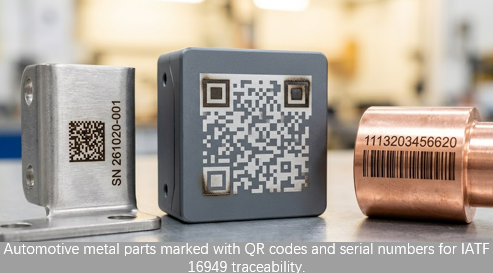
Automotive parts marking is not optional. IATF 16949 requires serialized identification and traceability for parts supplied to the automotive industry. Most of this marking happens on automated lines, but not all of it can.
This guide explains where a handheld fiber laser fits in automotive parts marking, where it does not, and how the Meenjet L4 MAX handles the metal surfaces most common in automotive components.
???? For Automotive Quality & Maintenance Managers
Question | Answer |
What is a handheld fiber laser used for in automotive? | Permanent marking on large metal parts, rework, field service, and low-volume production. |
Can it support IATF 16949 traceability? | It supports the physical marking step by printing serial numbers and 1D/2D codes. Full traceability also requires MES integration, code verification, and data logging. |
Which metals does it mark? | Stainless steel, carbon steel, anodized aluminum, copper, iron, and cemented carbide. |
Does it need consumables? | No. Fiber laser marking uses no ink, no solvent, and no ribbons. |
Can it mark on painted or coated metal? | Yes, but the mark affects the coating. For coated surfaces, test before production. |
Can it replace an inline laser on a high-volume line? | No. Handheld is for flexibility, not line speed. |
What about VIN codes? | VIN marking often has depth and font requirements defined by the OEM. Verify the L4 MAX meets the specific standard before use. |
Glossary:
IATF 16949: The quality management standard for automotive supply chains, including traceability requirements.
Fiber laser: A laser using a doped optical fiber as the gain medium, typically at 1,064 nm.
Rework: Reproducing or repairing a part outside the main production line.
MES: Manufacturing Execution System, used to track production and traceability data.
1. Why Automotive Parts Marking Is Different
Automotive parts marking is driven by traceability and recall requirements, not by branding.
Factor | General Asset Marking | Automotive Parts Marking |
Driver | Internal asset tracking | IATF 16949 and OEM traceability requirements |
Mark content | Asset ID, maintenance date | Serial number, 1D/2D code, production data |
Durability required | Life of the asset | Life of the vehicle, often 15+ years |
Environment | Factory floor | Oil, coolant, heat, vibration, washdown |
Verification | Visual check | Scanner-based, often automated |
Data integration | CMMS | MES and traceability databases |
Key insight: Automotive marking is a compliance activity. The mark must survive the life of the vehicle and remain readable by automated scanners. This makes fiber laser the preferred technology for metal parts.
For more on IATF 16949 traceability requirements, see the IATF official website.
2. Where Handheld Fiber Laser Fits
Handheld fiber laser is not a replacement for inline laser. It is a flexible complement for scenarios where the part cannot go to the machine.
Large Parts and Frames
Chassis, frames, and large castings cannot be moved to a benchtop laser. A handheld laser marks them in place.
Rework and Repair
When a part is reworked or repaired, the original mark may be removed or damaged. A handheld laser restores the serial number without sending the part back to the line.
Field Service and Supplier Sites
When a part is installed at a customer site or needs to be marked after delivery, a portable laser is the only practical option.
Low-Volume and High-Mix Production
For small batches and multiple part variants, a handheld laser avoids fixture costs and setup time.
Key insight: Handheld fiber laser is the right tool when the part is large, already installed, or produced in small batches. It is not the right tool for high-volume line marking.
3. Where It Doesn’t Fit
Scenario | Why Handheld Is Not the Best Choice | Better Option |
High-volume inline marking (pistons, rods, bearings) | Cycle time below 3 seconds or output above 5,000 parts/day | Inline fiber laser |
Small precision parts (connectors, sensors) | Part size below 20 mm or marking area below 5×5 mm | Benchtop laser or UV laser |
VIN marking with OEM-defined depth | Depth above 0.1 mm or font per OEM specification | Pneumatic dot peen or high-power fiber laser |
Fully automated MES-driven marking | Handheld requires manual operation | Inline laser with MES integration |
High-temperature or coated surfaces | Coating may be damaged by the laser | Test first, or use a different technology |
Key insight: Handheld fiber laser is a flexible tool, not a universal solution. For high-volume, small-part, or fully automated marking, inline laser or dot peen is usually better.
4. Metal Surfaces It Handles
Material | Works? | Notes |
Stainless steel | ✅ Excellent | High-contrast mark, permanent |
Carbon steel | ✅ Good | Permanent mark, may require parameter tuning |
Anodized aluminum | ✅ Excellent | High-contrast mark on the anodized layer |
Bare aluminum | ✅ Good | Permanent mark, contrast depends on surface finish |
Copper and alloys | ✅ Good | Requires higher power for good contrast |
Iron and cemented carbide | ✅ Good | Permanent mark, suitable for tooling and wear parts |
Engineering plastics (HDPE, ABS, PVC, PES) | ???? Depends | Some plastics mark well, others char; test first |
Stone and coated materials | ???? Depends | Test before production |
Key insight: Fiber laser is strongest on metals. For plastics, verify the material before production.
5. Field Notes: What We See in Automotive Sample Tests
As mentioned in Section 2, large chassis brackets are a typical handheld use case. Here is how the L4 MAX performed on them and other automotive parts in recent sample tests. These observations are not guarantees, but they show real production surface results.
Part | Material | Mark | Result |
Fastener bracket | Oiled carbon steel | 12×12 mm DataMatrix | Remained readable after 200 hours of oil immersion; ISO/IEC 15415 Grade B verified under controlled conditions |
Sensor housing | Anodized aluminum | 8×8 mm QR code | High contrast, readable after 500 washdown cycles |
Chassis bracket | Bare aluminum | Serial number + 1D code | Permanent, contrast lower than anodized; parameter tuning recommended |
Connector shell | PES plastic | 6×6 mm DataMatrix | Clean mark at 20W; higher power caused edge charring |
What this means for your line: For oiled carbon steel and anodized aluminum, the L4 MAX produces scanner-grade marks without post-treatment. For bare aluminum and engineering plastics, run a sample test before production.
These results come from internal sample testing. Actual performance depends on material grade, surface condition, and marking parameters.
6. Meet the L4 MAX
The L4 MAX is a portable fiber laser marker designed for precision marking in demanding environments. For automotive traceability, four features matter most:
High precision: ±0.003 mm repeat positioning accuracy for dense 2D codes (QR, DataMatrix).
Portable power: Optional 11,600 mAh battery for on-site marking and rework without a power outlet.
Wide material range: Marks stainless steel, carbon steel, anodized aluminum, copper, iron, cemented carbide, and engineering plastics.
No consumables: Fiber laser marking requires no ink, solvent, or ribbons.
The L4 MAX ships with a 1-year warranty and lifetime technical support.
For full technical specifications, see the L4 MAX product page.
7. Durability & Cost Comparison
Factor | Handheld Fiber Laser | Inline Fiber Laser | Pneumatic Dot Peen |
Expected lifespan | 10+ years | 10+ years | 10+ years |
Flexibility | High | Low | Medium |
Line speed | Manual pace | High | Medium |
Consumables | None | None | Stylus wear |
Cost per mark | Very low | Very low at high volume | Low |
Part size | Any size, in place | Limited by line fixture | Limited by fixture |
Best for | Large parts, rework, field service | High-volume inline marking | VIN and deep marks |
Rule of thumb: If the part is large, already installed, or produced in small batches, handheld fiber laser is the most flexible choice. If the part is small and produced in high volume, inline laser is more efficient. If the OEM requires a deep VIN mark, dot peen may still be required.
Frequently Asked Questions (FAQ)
Q1: Can a handheld fiber laser mark automotive metal parts permanently?
A: Yes. Fiber laser marks are fused into the metal surface and will not fade, peel, or wash off under normal automotive operating conditions. However, if the part undergoes subsequent surface treatments (like powder coating or electroplating), the mark will be covered. Always verify process sequencing.
Q2: Does it support IATF 16949 traceability?
A: It supports the physical marking step by printing serial numbers and 1D/2D codes. However, IATF 16949 traceability is proven by the data chain—sequence reservation, in-line code verification, and MES logging—not by the marked part alone. Full traceability requires system-level integration.
Q3: Can it replace an inline laser on a high-volume line?
A: No. Handheld is for flexibility, not line speed. For high-volume production, inline laser is the right choice.
Q4: Can it mark VIN codes?
A: VIN marking often has depth and font requirements defined by the OEM. Verify that the L4 MAX meets the specific standard before use. In some cases, pneumatic dot peen may still be required.
Q5: What is the minimum order for a free sample test?
A: No minimum. Send us your automotive parts, and our engineers will test the L4 MAX and recommend the right configuration.
???? Request a Free Sample Test
Send us your automotive parts. Our engineers will:
Test the L4 MAX on your specific metal surfaces
Compare marking quality, speed, and durability
Recommend the right configuration for your traceability requirements
No obligation. Report delivered within 5 business days.
???? Request a Free Sample Test
Related Technical Resources
Industrial Asset Marking: Handheld Laser vs Handheld TIJ vs Labels
Flying Fiber Laser Marking Machine: How to Choose 20W, 30W, or 50W
Fiber Laser Black Annealing on Stainless Steel: Achieving Permanent High-Contrast Marks (MOPA Guide)
About the Author
Meenjet Application Engineering Team — Over 15 years of combined field experience supporting handheld fiber laser, flying laser, CIJ, and TIJ installations across automotive, manufacturing, and logistics. Our team has resolved hundreds of material compatibility and traceability marking challenges.
Reviewed by: Senior Application Engineer, Meenjet
Last Updated: October 21, 2026