


News & Blogs
By Meenjet Application Engineering Team | November 10, 2026
Executive Summary
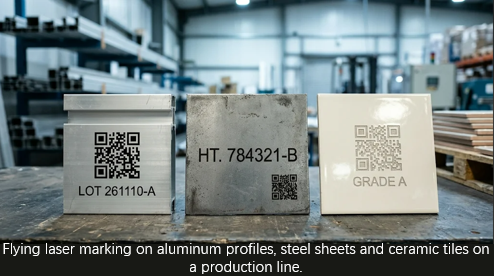
Building materials production lines present coding challenges that packaging lines do not: long, heavy workpieces that cannot stop for marking, mixed materials on the same line, and permanent traceability requirements that must survive outdoor exposure. Flying laser marking—synchronized with the conveyor and triggered by a photocell—can handle these conditions, but only if the wavelength and power are matched to the material.
This guide explains how to solve high-speed synchronization, mixed-material wavelength selection, and permanent traceability on aluminum profiles, steel sheets, and ceramic tiles, and how the Meenjet MFF and MCF series are built for these lines.
???? For Building Materials Production Managers
Question | Answer |
Which laser for aluminum profiles and steel sheets? | Fiber laser (MFF series). 1,064 nm wavelength is absorbed by metals, producing permanent high-contrast marks. For highly reflective bare aluminum, higher power (30W/50W) or MOPA pulse tuning is recommended. |
Which laser for ceramic tiles? | CO₂ laser (MCF series). 10.6 μm wavelength interacts with the glaze layer, producing a visible mark through controlled surface frosting. |
Can one laser handle both metal and ceramic? | Not reliably. Fiber laser does not produce a reliable, high-contrast mark on glazed ceramic; CO₂ laser performs poorly on bare metal. Match the wavelength to the material. |
What line speed can flying laser handle? | Up to 12,000 mm/s marking speed, synchronized with conveyor speed via encoder. For high-speed QR codes, verify galvo response and trigger latency. |
Does the laser need consumables? | Fiber laser: none. CO₂ laser: sealed RF tube with 20,000–45,000+ hour lifespan, no daily gas refill. |
Can it mark long profiles without stopping the line? | Yes. Photocell triggers marking at the correct position; encoder keeps the mark synchronized with line speed. |
Which Meenjet model for standard metal lines? | MFF-30. 30W fiber laser for high-speed aluminum and steel marking. |
Which Meenjet model for ceramic tiles? | MCF-30 or MCF-40. CO₂ laser for glazed ceramic surfaces. |
Glossary:
Flying laser: A laser system synchronized with a moving conveyor, marking without stopping the line.
Fiber laser: A laser using a doped optical fiber as the gain medium, typically at 1,064 nm, suited to metals.
CO₂ laser: A laser using a gas mixture as the gain medium, typically at 10.6 μm, suited to non-metals and glazed surfaces.
Encoder: A sensor that tracks line speed and keeps the laser synchronized with the workpiece.
Photocell: A sensor that triggers marking when a workpiece passes.
Air Purge: Compressed air directed across the lens to prevent dust and fumes from contaminating the optical path.
1. Why Building Materials Coding Is Different
Packaging coding happens on small, lightweight items that can be stopped or diverted. Building materials coding happens on long, heavy workpieces moving at speed.
Factor | Packaging | Building Materials |
Workpiece size | Small, lightweight | Long profiles, heavy sheets, large tiles |
Line speed | Moderate to high | High, continuous |
Workpiece handling | Can stop or divert | Cannot stop for marking |
Material | Paper, film, plastic | Aluminum, steel, ceramic, coated metal |
Environment | Indoor | Indoor or covered outdoor, dust, vibration |
Code content | Date, batch, QR | Heat number, batch, grade, traceability code |
Durability required | Weeks to months | Life of the building component (10+ years) |
Key insight: Building materials cannot be stopped for marking. The laser must mark while the workpiece moves, at the correct position, without affecting line speed.
2. Challenge 1: High-Speed, Long-Length Production
Aluminum extrusion lines, steel coil processing lines, and ceramic tile lines run continuously. Stopping for marking is not an option.
Encoder Synchronization
The laser must know exactly where the workpiece is at all times. A shaft encoder tracks line speed and sends position data to the laser controller. Without it, the mark position drifts as line speed changes.
Photocell Triggering
A photocell detects the leading edge of each workpiece and triggers the marking cycle. The laser fires at the programmed delay, placing the mark at the correct position on the profile or sheet.
Preventing Distortion at High Line Speeds
At high line speeds (e.g., above 30 m/min), the galvo scanner must respond quickly enough to prevent QR codes from stretching into ellipses. Ensure the encoder resolution is matched to the line speed, the trigger-to-laser latency is compensated, and the galvo has sufficient speed headroom. Validate sample scans at both the fastest and slowest line speeds.
Marking Area vs. Workpiece Length
The standard marking area is 110 × 110 mm (optional up to 300 × 300 mm). For long profiles, the mark is placed at a fixed position relative to the leading edge. For large sheets, multiple marks or a larger marking area may be required.
Key insight: The laser is not limited by workpiece length. It is limited by marking area and synchronization accuracy.
3. Challenge 2: Mixed Materials on One Line
Building materials lines often process different materials. The laser wavelength must match the material.
Aluminum Profiles and Steel Sheets (Fiber Laser)
Fiber laser at 1,064 nm is absorbed by metals. It produces permanent marks on:
Anodized aluminum: High-contrast black mark through controlled annealing.
Bare aluminum: Lower initial absorption due to high reflectivity; 30W/50W power or MOPA pulse tuning is recommended for optimal contrast.
Carbon steel and stainless steel: Permanent, high-contrast marks.
The MFF series (20W/30W/50W) is designed for these materials. Power selection depends on line speed and mark depth:
MFF-20: Standard line speeds, fine surface marking on steel and anodized aluminum.
MFF-30: High-speed lines, general metal marking, including bare aluminum with parameter tuning.
MFF-50: Ultra-high-speed lines, deep engraving, and high-reflectivity bare aluminum.
Ceramic Tiles (CO₂ Laser)
Glazed ceramic tiles have a glass-like surface layer. Fiber laser does not produce a reliable, high-contrast mark on glazed ceramic. CO₂ laser at 10.6 μm interacts with the glaze, producing a visible mark through controlled surface frosting (not deep micro-cracking).
The MCF series (30W/40W/60W) is designed for non-metallic materials including architectural ceramics:
MCF-30: Standard tile lines.
MCF-40: High-speed tile lines.
MCF-60: Ultra-high-speed lines, deep marking.
Key insight: A single laser cannot reliably mark both bare metal and glazed ceramic. Match the wavelength to the material, or use two laser heads on the same line.
4. Challenge 3: Permanent Traceability and Anti-Counterfeiting
Building materials require permanent traceability for quality records, safety compliance, and anti-counterfeiting.
Heat Numbers and Batch Codes
Steel sheets and aluminum profiles require heat numbers or batch codes that link the material to mill certificates. The laser marks these codes directly on the surface, where they survive handling, storage, and outdoor exposure.
QR Codes for Digital Traceability
2D codes (QR, Data Matrix) link the component to digital records. The MFF and MCF series support QR and Data Matrix codes at high resolution, readable by handheld scanners and smartphones. For high-speed lines, verify that the galvo response and trigger latency are correctly configured to prevent code distortion.
Anti-Counterfeiting Marks
Permanent laser marks are difficult to remove or replicate. For high-value materials, a laser-marked serial number or logo provides a visible anti-counterfeiting measure.
Key insight: A laser mark on building materials is not a label. It is part of the material surface, and it survives as long as the material does.
5. Meet the MFF and MCF Series
MFF Series: Flying Fiber Laser for Metals
The MFF series is designed for metal marking on high-speed lines. For anodized aluminum and steel, the MFF-30 covers most standard and high-speed lines. For bare aluminum with high reflectivity, or for deep engraving on thick steel, the MFF-50 is the better choice. The MFF-20 is the economical option for lower line speeds and fine surface marking.
All MFF models use a 1,064 nm fiber laser, air cooling, and support marking speeds up to 12,000 mm/s. Compatible materials include stainless steel, carbon steel, anodized aluminum, bare aluminum (with parameter tuning), copper, and titanium.
For full specifications, see the MFF product page.
MCF Series: Flying CO₂ Laser for Ceramics
The MCF series is designed for glazed ceramic tiles and other non-metallic materials. For standard tile lines, the MCF-30 is sufficient. For high-speed lines, the MCF-40 provides more power headroom. For ultra-high-speed lines or deep marking, the MCF-60 is the right choice.
All MCF models use a sealed RF metal tube with a lifespan of 20,000–45,000+ hours and no daily gas refill. Compatible materials include architectural ceramics, glass, wood, leather, paper, and plastics.
For full specifications, see the MCF product page.
6. Cost & Maintenance Reality
Flying laser marking has no daily consumables, but the equipment cost and integration requirements differ from ink-based systems.
Equipment Cost
Fiber laser (MFF): Higher upfront cost than inkjet, but zero consumables.
CO₂ laser (MCF): Sealed RF metal tube with long lifespan. No daily gas refill or consumable ink.
Maintenance
No wearing parts, no nozzles, no ink.
Lens cleaning and air purge protection are critical. Ceramic and metal marking generate fine dust and fumes. An air purge window (compressed air across the lens) and a fume extractor are required to prevent dust from contaminating the field lens and causing power loss or lens damage.
CO₂ laser tube: Sealed RF metal tube, typically 20,000–45,000+ hours. Replacement or refurbishment is required only at end of life, not as a routine maintenance item.
Total Cost of Ownership
Factor | Flying Laser | CIJ | TIJ |
Upfront cost | High | High | Moderate |
Consumables | None (sealed RF tube, no daily refill) | Ink, solvent, make-up | Ink cartridges |
Maintenance | Low (lens cleaning, air purge) | High | Low |
Mark durability | Permanent | 3–5 years | 3–5 years |
Metal marking | ✅ Best choice | ???? Poor adhesion | ???? Poor adhesion |
Ceramic marking | ✅ Best choice (CO₂) | ???? Ink may smear | ???? Ink may smear |
Best for | Permanent traceability, metal and ceramic | High-speed ink coding | Flat packaging, low volume |
Rule of thumb: If the material is metal or glazed ceramic and the mark must last the life of the component, flying laser is the most reliable choice. If the material is paper, film, or plastic and the mark is variable data, TIJ or CIJ is more economical.
Frequently Asked Questions (FAQ)
Q1: Can one flying laser mark both aluminum and ceramic tiles?
A: Not reliably. Fiber laser is for metals; CO₂ laser is for glazed ceramic. Match the wavelength to the material, or use two laser heads.
Q2: Does flying laser require consumables?
A: No daily consumables. Fiber laser uses none; CO₂ laser uses a sealed RF metal tube (20,000–45,000+ hours) with no routine gas refill.
Q3: Can flying laser mark long profiles without stopping the line?
A: Yes. Photocell triggers the mark; encoder keeps it synchronized with line speed.
Q4: What line speed can flying laser handle?
A: Up to 12,000 mm/s marking speed. For high-speed QR codes, verify galvo response and trigger latency to prevent distortion.
Q5: What is the minimum order for a free line audit?
A: No minimum. Send us your material samples and line details, and our engineers will recommend the right laser and configuration.
???? Request a Free Line Audit
Send us your material samples. Our engineers will:
Test the MFF or MCF series on your specific metals and ceramics
Recommend the right wavelength and power for your line speed
Provide a cost and configuration proposal
No obligation. Report delivered within 5 business days.
???? Request a Free Line Audit
Related Technical Resources
Flying Fiber Laser Marking Machine: How to Choose 20W, 30W, or 50W
CO₂ or Fiber Laser: Which Flying Laser Marker for High-Speed PET Lines?
Fiber Laser Black Annealing on Stainless Steel: Achieving Permanent High-Contrast Marks (MOPA Guide)
About the Author
Meenjet Application Engineering Team — Over 15 years of combined field experience supporting flying fiber laser, flying CO₂ laser, CIJ, and TIJ installations across building materials, packaging, and manufacturing.
Reviewed by: Senior Application Engineer, Meenjet
Last Updated: November 10, 2026