



News & Blogs
By Meenjet Application Engineering Team | October 14, 2026
Executive Summary
Industrial facilities and warehouses maintain thousands of assets: pumps, valves, pipes, electrical panels, tools, spare parts, and fixtures. Each needs a durable identification mark—asset number, maintenance date, or QR code for tracking.
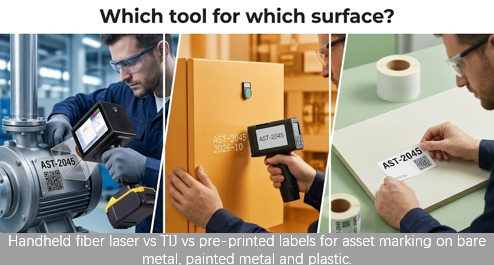
Three marking methods dominate this application: handheld laser markers, handheld Thermal Inkjet (TIJ) printers, and pre-printed adhesive asset labels. Each works on different surfaces and delivers different durability. Choosing the wrong one leads to faded codes, peeling labels, or unnecessary cost.
???? For Maintenance & Asset Managers
Question | Answer |
Which method works on bare metal? | Handheld fiber laser. TIJ and labels are unreliable on bare metal. |
Which method works on painted metal? | All three methods work. TIJ is fastest; laser is most durable; labels are simplest. |
Which lasts the longest? | Handheld fiber laser on bare metal (permanent, 10+ years). TIJ: 3–5 years. Labels: 1–3 years. Semiconductor laser on painted surfaces: coating-dependent (depends on paint or coating durability). |
Which costs least upfront? | Labels. TIJ is mid-range. Laser has the highest upfront cost but zero consumables. |
Which is best for high-mix, low-volume marking? | Handheld laser or TIJ. Labels require pre-printing and inventory. |
Which integrates with a CMMS or asset system? | TIJ (M9 model with WiFi and barcode scanning) or laser with database input. |
Glossary:
CMMS: Computerized Maintenance Management System—software used to track asset maintenance history, schedules, and spare parts.
Dyne pen: A testing tool that measures surface energy. A reading of 38 dyn/cm or higher indicates the surface will accept ink.
1. Why Asset Marking Is Different from Packaging Coding
Factor | Packaging Coding | Asset Marking |
Surface | Cartons, film, labels | Painted metal, bare metal, plastic, anodized aluminum |
Durability required | Weeks to months | 3–10+ years |
Environment | Warehouse, retail | Factory floor: oil, coolant, heat, washdown (high-pressure cleaning) |
Marking frequency | High volume, continuous | Low volume, on demand |
Reader | Vision system, handheld scanner | Maintenance technician, scanner, CMMS |
Key insight: Packaging codes only need to survive until the product is sold. Asset codes must survive the entire life of the equipment—often 10+ years. For regulated industries, asset identification also supports ISO 55000 series asset management requirements.
The three methods at a glance:
Method | How It Works | Consumables |
Handheld Laser | Laser modifies the surface (annealing, oxidation, or ablation) | None |
Handheld TIJ | Ink droplets bond to the surface | Ink cartridges |
Adhesive Labels | Pre-printed label applied to the surface | Label stock, printer ribbon |
Laser types explained: Semiconductor lasers (450 nm) work best on painted metal, stainless steel, and non-metals. Fiber lasers (1064 nm) are required for bare metals such as carbon steel, aluminum, copper, and cemented carbide.
Asset Marking vs Date/Batch Coding
Asset marking is often confused with date coding and batch coding. They are related but different:
Asset marking: permanent ID for equipment, tools, and fixtures—asset number, QR code, maintenance date.
Date coding: expiry date, manufacturing date, or best-before date on products and packaging.
Batch coding: batch number, lot code, or traceability code for production runs.
Handheld TIJ printers are widely used for date and batch coding on painted metal, plastic, and packaging. Fiber lasers are preferred for permanent asset marking on bare metal.
2. Surface-by-Surface Selection Guide
The following guide is organized by surface type. For each surface, we compare all three methods and give a direct recommendation.
Surface 1: Bare Metal (Steel, Aluminum, Stainless)
Method | Works? | Notes |
Handheld Laser (Fiber) | ✅ Best choice | Permanent, abrasion-resistant mark; no coating needed |
Handheld TIJ | ❌ Not reliable | Ink beads up, wears off |
Adhesive Labels | ???? Works short-term | Adhesive degrades under oil, heat, washdown |
Recommendation: Use a fiber laser marker (L4 MAX). This is the most reliable method for producing a permanent, durable mark on bare metal.
Surface 2: Painted Metal (Panels, Frames, Enclosures)
Method | Works? | Notes |
Handheld Laser (Semiconductor) | ✅ Good | Marks the paint layer; not the metal beneath |
Handheld TIJ | ✅ Fastest, most flexible | Solvent ink bonds to paint; multi-color options |
Adhesive Labels | ✅ Simplest | Adhesive degrades over time in oily environments |
Recommendation: For speed and flexibility, use a handheld thermal inkjet printer (M6/M7/M9). For maximum durability, use a semiconductor laser marker (L4 PRO / L4 Ultra).
Surface 3: Anodized Aluminum (Nameplates, Panels)
Method | Works? | Notes |
Handheld Laser | ✅ Excellent | Produces high-contrast mark on anodized layer |
Handheld TIJ | ✅ Good | Ink absorbs into the anodized pores |
Adhesive Labels | ???? Acceptable | May peel at edges over time |
Recommendation: Both laser and TIJ work well. Choose based on durability requirement and available budget.
Surface 4: Plastic Housings (ABS, PC, PVC)
Method | Works? | Notes |
Handheld Laser | ???? Depends on plastic | Some plastics mark well; others char |
Handheld TIJ | ✅ Best choice | Solvent ink bonds well to most industrial plastics |
Adhesive Labels | ✅ Works | Standard solution for smooth plastic |
Recommendation: Handheld TIJ is the fastest and most flexible for plastic surfaces. Verify surface energy with a Dyne pen (target 38 dyn/cm or higher) before production.
Surface 5: Composite Panels & Specialty Coatings
Method | Works? | Notes |
Handheld Laser | ???? Test required | Composite materials vary widely |
Handheld TIJ | ???? Test required | Some coatings repel ink |
Adhesive Labels | ✅ Reliable | Works on most flat composite surfaces |
Recommendation: Test all three methods on your specific composite before committing.
Additional scenarios:
High-temperature equipment: For metal assets above 150°C, fiber laser is typically the only suitable method; verify with a sample test.
Short-term or project-based tagging: Adhesive labels are sufficient.
3. Durability & Cost Comparison
Durability and cost are the two factors that most often decide the final choice. The table below compares all three methods side by side.
Factor | Handheld Laser | Handheld TIJ | Adhesive Labels |
Expected lifespan | 10+ years (fiber on bare metal); coating-dependent (semiconductor on painted surfaces) | 3–5 years | 1–3 years |
Oil / coolant resistance | ✅ Resistant | ✅ Resistant (solvent ink) | ❌ Adhesive fails |
Washdown resistance | ✅ Resistant | ???? Moderate | ❌ Peels |
UV / sunlight resistance | ✅ Permanent | ???? May fade | ???? Fades |
Equipment cost | Higher | Moderate | Low |
Consumables | None | Ink cartridges | Labels, ribbon |
Cost per mark | Almost no consumable cost per mark | Low | Moderate |
Setup time | Moderate | Fast | Slow (pre-print) |
Suitable volume | Low to high volume; best TCO at high volume | Low to medium | High volume, standard sizes |
Rule of thumb: If the asset will be exposed to oil, coolant, or washdown for more than 3 years, choose a fiber or semiconductor laser. If the asset is indoors with light handling, TIJ is sufficient.
Break-even analysis: For 10,000+ marks per year, laser typically has the lowest total cost of ownership. For under 2,000 marks per year, labels or TIJ may be more economical.
4. Meenjet's Asset Marking Portfolio
Product Line | Models | Best For |
Handheld Fiber Laser | L4 MAX | Bare metal, steel, aluminum, copper, cemented carbide |
Handheld Semiconductor Laser | L4 PRO, L4 Ultra | Painted metal, stainless steel, wood, leather, dark acrylic |
Handheld TIJ | M6, M7, M9 | Painted metal, anodized aluminum, plastic, composite |
L4 MAX key specifications:
Fiber laser, 1064 nm
Power: ≥10W / 20W / 30W / 50W
Marking area: 110 × 110 mm
Marking speed: ≤12,000 mm/s
M-series key specifications:
300 DPI resolution
Print height: 1–12.7 mm
Print distance: 2–5 mm
2600 mAh battery
IP54 protection
Technical boundary: Final method selection depends on your specific asset surface, durability requirement, and production volume. We recommend a free sample test before purchase.
Laser safety: Always wear laser safety glasses and use the supplied safety shroud when operating handheld laser markers. Follow local laser safety regulations.
For complete specifications:
Frequently Asked Questions (FAQ)
Q1: Can handheld TIJ mark bare metal?
A: Not reliably. Bare metal is non-porous, and ink adhesion is poor. Use a fiber laser for bare metal.
Q2: How long does a laser asset mark last?
A: Fiber laser marks on bare metal are permanent. They survive oil, coolant, washdown, and UV exposure for 10+ years.
Q3: What is the best method for plastic housings?
A: Handheld TIJ. Verify surface energy with a Dyne pen before production.
Q4: What is the minimum order for a free sample test?
A: No minimum. Send us your asset samples, and our engineers will test all three methods and recommend the optimal solution.
Q5: Can the same handheld printer be used for asset marking and date coding?
A: Handheld TIJ printers can print both asset IDs and date/batch codes on painted metal, plastic, and packaging. For bare metal asset marking, a fiber laser is required.
???? Send Us Your Asset Samples for a Free Comparison Test
Send us your equipment samples. Our engineers will:
Test handheld laser, handheld TIJ, and label adhesion on your surfaces
Compare durability, cost, and workflow
Recommend the right method for your asset management operation
No obligation. Report delivered within 5 business days.
???? Request a Free Comparison Test
Related Technical Resources
How to Choose a Fiber Laser Marking Machine for Metal and Plastic
Fiber Laser Black Annealing on Stainless Steel: Achieving Permanent High-Contrast Marks (MOPA Guide)
About the Author
Meenjet Application Engineering Team — Over 15 years of combined field experience supporting handheld laser and handheld TIJ installations across manufacturing, logistics, and field service operations. Our team has resolved hundreds of surface compatibility and marking method selection challenges.
Reviewed by: Senior Application Engineer, Meenjet
Last Updated: October 14, 2026