



News & Blogs
By Meenjet Application Engineering Team | October 29, 2026
Executive Summary
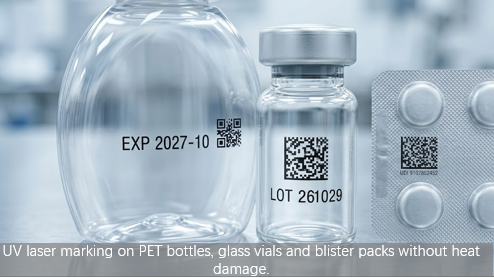
Heat-sensitive packaging is difficult to code. Fibre and CO₂ lasers can burn, deform, or crack thin plastic, glass, and foil. Traditional ink-based methods add consumables and maintenance. For PET bottles, pharmaceutical vials, and blister packs, a flying UV laser offers a third option: a cold 355 nm beam that marks the surface without thermal damage.
This guide explains where UV laser fits, which substrates it handles, and how the Meenjet MUF series is built for these applications.
???? For Packaging & Production Managers
Question | Answer |
What is a flying UV laser used for? | Permanent, burn-free marking on heat-sensitive materials like PET bottles, glass vials, and blister packs. |
Why not use a fibre or CO₂ laser? | Fibre and CO₂ lasers generate heat, which can deform or crack thin plastics, glass, and pharmaceutical foil. UV uses a cold 355 nm beam. |
Which materials does UV laser handle? | PET, HDPE, PP, PS, PC, ABS, PVC, glass, coated metals, blister foil, and flexible printed circuits. |
Can it print high-density 2D codes? | Yes. The MUF series supports QR and Data Matrix codes with high contrast and no heat damage. |
Does it require consumables? | No. UV laser marking uses no ink, no solvent, and no ribbons. |
What maintenance does it need? | The water chiller requires periodic checks. The optical head is sealed (IP65) and the controller is IP55-rated. |
Which Meenjet model fits? | MUF-5 (5W) for standard speeds; MUF-10 (10W) for ultra-high speeds and dense 2D codes. |
Glossary:
UV laser: Ultraviolet laser, typically at 355 nm, that breaks molecular bonds without generating heat.
Cold marking: A marking process that does not rely on thermal ablation or burning.
Flying laser: A laser system synchronized with a moving conveyor.
Blister pack: A packaging format with a plastic cavity and a foil backing, commonly used for pills and capsules.
1. Why Heat-Sensitive Packaging Needs UV Laser
Fibre and CO₂ lasers work by delivering heat to the surface. On metal and thick plastic, this is acceptable. On thin film, PET bottles, and glass vials, heat causes deformation, cracking, or charring.
Factor | Fibre / CO₂ Laser | UV Laser |
Wavelength | 1,064 nm / 10.6 μm | 355 nm |
Marking mechanism | Thermal (melting, ablation) | Photochemical (molecular bond breaking) |
Heat damage risk | High on thin plastics, glass and foil | Low |
PET bottles | ???? Risk of deformation | ✅ Burn-free |
Glass vials | ???? Risk of micro-cracks | ✅ Clean mark |
Blister foil | ???? Risk of wrinkling/burn | ✅ Flat, clean mark |
Coated metals | ✅ Works | ✅ Works |
Key insight: UV laser is not a replacement for fibre or CO₂ in all cases. It is the right tool when heat damage is the limiting factor. For metal and thick plastic, fibre or CO₂ remains more economical.
2. Substrate Selection Guide
PET Bottles
PET is heat-sensitive. Fibre and CO₂ lasers can distort the bottle surface or produce uneven marks. UV laser at 355 nm marks PET without heat stress, producing a clean, permanent code.
Recommendation: MUF-5 for standard bottling speeds. Test the mark after filling and capping to confirm readability.
Glass Vials and Containers
Glass is brittle under thermal stress. CO₂ lasers can create micro-cracks that weaken the vial or cause breakage during sterilization. UV laser marks the surface without heat stress.
Recommendation: MUF-5 for standard vials. MUF-10 for high-speed pharmaceutical lines with dense 2D codes.
Blister Packs and Pharmaceutical Foil
Blister packs use a PVC cavity with an aluminum foil backing. PVC is heat-sensitive and can shrink or warp under fibre or CO₂ laser marking. Aluminum foil can wrinkle or burn. UV laser at 355 nm marks the foil surface without thermal deformation, producing a clean UDI or Data Matrix code for pharmaceutical traceability.
Recommendation: MUF-5 for standard blister lines. Test readability after the sealing and cutting process, as some foil coatings may require parameter tuning.
Coated Metals and Flexible PCBs
UV laser also works on anodized aluminium, painted steel, coated foils, and flexible printed circuits. These substrates are common in electronics and automotive components.
Recommendation: MUF-5 for standard coding. MUF-10 for high-density Data Matrix on small components.
3. UV Laser vs CIJ vs TIJ for Heat-Sensitive Materials
Factor | UV Laser | CIJ | TIJ |
Print quality | High, permanent | Medium | High (up to 1,200 DPI) |
Speed | Up to 12,000 mm/s marking speed | Very high | Up to 240 m/min (MXPro) |
Maintenance | Low, chiller check | High, solvent handling | Low, cartridge swap |
Consumables | None | Ink, solvent, make-up | Ink cartridges |
Heat damage | None | None | None |
PET and glass | ✅ Best choice | ✅ Works | ???? Ink adhesion issues |
Blister foil | ✅ Best choice | ???? Poor ink adhesion | ???? Slow drying, may rub off |
Permanent mark | Yes | No | No |
Key insight: For heat-sensitive materials, UV laser offers a permanent mark with zero consumables. CIJ and TIJ can also code PET and blister foil, but the mark is ink-based and may fade or rub off. UV laser is the only option that combines a permanent mark with no consumables on these substrates.
4. Meet the MUF Series
For heat-sensitive packaging, the print engine needs a cold beam, high resolution, and reliable line integration. The Meenjet MUF series is built for this role.
Both models use a 355 nm UV laser source and a water-cooled optical system, with IP55-rated controllers and IP65-rated optical heads to withstand dust and washdown environments. The MUF-5 is the standard choice for PET bottles, glass vials, and blister packs at typical line speeds. The MUF-10 provides higher power for ultra-high-speed lines and dense 2D codes on small components.
Both models support QR codes, Data Matrix, barcodes, text, and variable data, and integrate with conveyor sensors, encoders, and Ethernet-based MES systems.
For full specifications, see the MUF product page.
5. Cost & Maintenance Reality
UV laser has no consumables, but the water chiller and optics require attention.
Consumable Cost
No ink, solvent, or ribbon.
No cartridge replacement.
The main operating cost is electricity and chiller maintenance.
Maintenance
Check the water chiller level and temperature regularly.
Keep the optical head clean (IP65-rated, but dust can affect focus).
The laser source has a long service life, but the chiller is a mechanical component that requires periodic inspection.
Total Cost of Ownership
Factor | UV Laser | CIJ | TIJ |
Upfront cost | High | High | Moderate |
Consumables | None | Ink, solvent, make-up | Ink cartridges |
Maintenance | Low (chiller check) | High | Low |
Downtime risk | Low | Medium to high | Low |
Best for | Heat-sensitive, permanent marks | High-speed ink coding | Flat surfaces, low volume |
Rule of thumb: If the substrate is heat-sensitive and the mark must be permanent, UV laser is the best choice. For standard cartons and paper, TIJ or CIJ is more economical.
Frequently Asked Questions (FAQ)
Q1: Can UV laser mark PET bottles without deformation?
A: Yes. The 355 nm cold beam breaks molecular bonds without generating heat. PET bottles remain undistorted, and the mark is permanent.
Q2: Does UV laser work on glass vials?
A: Yes. Unlike CO₂ lasers, UV laser does not create micro-cracks. It produces a clean mark that survives sterilization and washing.
Q3: Does UV laser work on blister packs?
A: Yes. UV laser marks the aluminum foil backing without heat wrinkles or burn-through. It is suitable for UDI and Data Matrix codes in pharmaceutical packaging.
Q4: What is the difference between MUF-5 and MUF-10?
A: MUF-5 is for standard bottling, vial, and blister lines. MUF-10 provides higher power for ultra-high-speed lines and dense 2D codes on small components.
Q5: Does UV laser require consumables?
A: No. There is no ink, solvent, or ribbon. The main maintenance item is the water chiller.
Q6: What is the minimum order for a free sample test?
A: No minimum. Send us your substrates, and our engineers will test the MUF series and recommend the right configuration.
???? Request a Free Sample Test
Send us your substrates. Our engineers will:
Test the MUF series on your specific materials
Compare marking quality, speed, and durability
Recommend the right configuration for your line
No obligation. Report delivered within 5 business days.
???? Request a Free Sample Test
Related Technical Resources
Flying Fiber Laser Marking Machine: How to Choose 20W, 30W, or 50W
CO₂ or Fiber Laser: Which Flying Laser Marker for High-Speed PET Lines?
Fiber Laser Black Annealing on Stainless Steel: Achieving Permanent High-Contrast Marks (MOPA Guide)
About the Author
Meenjet Application Engineering Team — Over 15 years of combined field experience supporting flying UV, fibre, and CO₂ laser installations across packaging, pharmaceutical, and electronics manufacturing.
Reviewed by: Senior Application Engineer, Meenjet
Last Updated: October 29, 2026