




News & Blogs
By Meenjet Application Engineering Team | September 20, 2026
Executive Summary
Stainless steel is one of the most widely marked industrial materials—but achieving a permanent, high-contrast black mark without damaging the corrosion-resistant surface is a precise engineering challenge. Traditional engraving cuts into the metal, exposing raw iron and creating corrosion sites. Traditional Q-switched fiber lasers produce gray, inconsistent marks with no control over the thermal process.
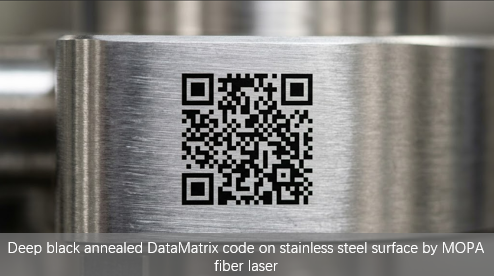
MOPA fiber lasers solve this by enabling black annealing: a controlled thermal oxidation process that grows a dense oxide layer beneath the surface, producing a deep matte black mark that passes ASTM A967 passivation and survives 1,000+ autoclave cycles.
This guide covers the physics, the three controlling parameters, and the tuning protocol for the Meenjet MFF series.
????
 Stainless Steel Black Annealing Parameter Matrix-net.pdf
???? For Procurement & Project Managers
Question | Answer |
What is this for? | Permanent black marks on 304/316/430 stainless steel for medical, automotive, and industrial traceability. |
Why MOPA instead of standard fiber? | Standard fiber lasers produce gray or inconsistent marks. MOPA's adjustable pulse width (2–500 ns) enables precise thermal control. |
Why not engraving? | Engraving removes the chromium oxide layer, exposing raw iron. This causes rust after passivation and creates crevices that trap residue. |
What's the ROI? | Annealed marks survive passivation, autoclaving, and chemical exposure. No post-processing required. |
How fast? | Annealing is slower than engraving—typically 80–200 mm/s, depending on material and desired contrast. |
Before specifying, confirm these five points with your supplier:
# | Question to Ask | Why It Matters |
1 | Will the mark survive ASTM A967 passivation? | If not, the part will rust in the field. |
2 | Can you provide a passivation test report on my actual alloy? | 304, 316, 430, and 17-4 PH behave differently. |
3 | Does the laser support MOPA pulse control? | Standard Q-switched lasers cannot achieve consistent black annealing. |
4 | What is the expected rejection rate after tuning? | A well-tuned MOPA system should achieve <1% rejection. |
5 | Is there a free sample test before purchase? | Always validate on your own parts before committing. |
Meenjet satisfies all five requirements as standard—including a free passivation test report (ASTM A967) on your actual alloy. See how the MFF series handles this →
Why Black Annealing Is Different from Engraving
Three laser processes can mark stainless steel, but only one preserves corrosion resistance:
Process | Mechanism | Surface Effect | Corrosion Risk |
Engraving | Material vaporization | Removes metal, creates depth | High—exposes raw iron |
Etching | Shallow material removal | Slightly raised edges | Moderate |
Annealing | Controlled oxidation | No material removal, oxide layer grows | None—preserves passive film |
Key insight: Annealing heats the stainless steel surface to 200–300°C, triggering a controlled oxidation reaction. The resulting oxide layer is only a few micrometers deep—but it is chemically bonded to the surface, making it permanent and corrosion-resistant.
Industry Terminology Note: The term "annealing" is technically imprecise here, as the process does not involve the crystallographic changes of true annealing. IPG Photonics suggests "dark marking" as a more accurate term—but "annealing" remains the industry-standard search term, so this guide uses it throughout.
Practical note for procurement: When communicating with suppliers, both terms are understood. "Black annealing" is more common in North America; "dark marking" is more common in Europe.
The Three Parameters That Control Black Annealing Quality
MOPA fiber lasers allow independent control over pulse width, frequency, and marking speed. These three parameters determine the oxide layer thickness—and therefore the mark's color and contrast.
Parameter | Range for Black Annealing | Effect | Engineering Rule |
Pulse Width | 10–50 ns | Thin oxide → gold/blue tones; thick oxide → gray or melting | Start at 20–40 ns for 304/316 |
Frequency | 50–200 kHz | Lower = darker but slower; higher = lighter but faster | Use 50–150 kHz for black annealing |
Marking Speed | 80–200 mm/s | Faster = lighter; slower = darker but risk of heat damage | Start at 100 mm/s |
Note: Annealing speeds (80–200 mm/s) are significantly slower than engraving speeds (500–2000 mm/s). This is the trade-off for corrosion-resistant marks.
MOPA Parameter Tuning Matrix for Stainless Steel
Stainless Steel Grade | Pulse Width | Frequency | Speed | Expected Result |
304 | 20–30 ns | 80–120 kHz | 100–150 mm/s | Deep black, passivation-resistant |
316 | 20–30 ns | 80–120 kHz | 100–150 mm/s | Deep black, best passivation resistance |
430 | 10–20 ns | 100–150 kHz | 80–120 mm/s | Dark gray to black (lighter than 304/316) |
17-4 PH | 20–40 ns | 60–100 kHz | 80–120 mm/s | Deep black, may require additional tuning |
Note: Results vary by alloy composition, surface finish, and laser configuration. Always run a test grid before production.
Field Case: Medical Instrument Manufacturer Achieves Passivation-Resistant Black Marks
A mid-sized medical instrument manufacturer in Southeast Asia (approximately 50,000 surgical forceps per month) was marking 316 stainless steel with a standard Q-switched fiber laser. The marks appeared black after laser processing—but turned brown and developed micro-rust after citric acid passivation (ASTM A967). The rejection rate reached 12%.
After upgrading to a Meenjet MFF-30 MOPA fiber laser with optimized annealing parameters (25 ns pulse width, 100 kHz frequency, 120 mm/s speed):
Metric | Before (Q-Switched) | After (MOPA Annealing) |
Passivation test pass rate | 88% | 99.7% |
Mark contrast (Symbol Contrast) | 52% | 78% |
Autoclave cycles survived | ~200 | 1,000+ |
Rejection rate | 12% | 0.3% |
Key takeaway: The shift from Q-switched engraving to MOPA annealing eliminated the passivation failure entirely. The oxide layer grows beneath the surface, so the chromium passive film remains intact.
This manufacturer has since standardized on Meenjet MFF-30 units across three production lines.
Achieving ISO/IEC 15415 Grade A DataMatrix
Black annealing must produce machine-readable codes. For Grade A, the following thresholds apply:
Parameter | Grade A Threshold |
Symbol Contrast (SC) | ≥ 70% |
Modulation (MOD) | ≥ 0.60 |
Axial Nonuniformity (AN) | ≤ 0.06 |
Grid Nonuniformity (GNU) | ≤ 0.38 |
Tuning for Grade A: Slower speed (80–120 mm/s) and lower frequency (60–100 kHz) produce darker marks with higher SC. Use a defocused beam (move the laser head 2–3 mm further from the surface) to improve modulation.
Meenjet MOPA Fiber Laser Solutions
Model | Best For | Key Specs |
MFF-20 | Standard black annealing, small parts | 20W MOPA, 2–500 ns pulse width, 1–4000 kHz |
MFF-30 | Deep black, high-throughput | 30W MOPA, adjustable pulse width, air-cooled |
MFF-50 | Thick stainless, multi-pass | 50W MOPA, high peak power, fast galvo |
Selection rule: MFF-20 for small parts; MFF-30 for deep black and high-throughput medical/aerospace parts; MFF-50 for thick stainless steel and multi-pass applications.
For complete specifications, visit the MFF Fiber Laser Product Page.
Frequently Asked Questions (FAQ)
Q1: Why does my stainless steel mark look gray instead of black?
A: Gray marks usually indicate insufficient thermal input. Increase pulse width (try 30–40 ns), lower marking speed (try 80–100 mm/s), or reduce frequency to 50–80 kHz to increase peak power.
Q2: Will black annealing survive citric acid passivation?
A: Yes, when properly tuned. Internal application testing and industry benchmarks show that 1200 DPI, single-pass marks on 304 and 316 stainless steel are most resistant to citric acid passivation. 430 stainless steel marks may lighten to gray after passivation.
Q3: Can I achieve black annealing on titanium?
A: Yes. Titanium responds well to MOPA annealing, producing deep black marks via the same oxide-growth mechanism.
Q4: How does MOPA compare to picosecond lasers for black marking?
A: MOPA fiber lasers are the industry standard for black annealing on stainless steel—they offer a balance of cost, speed, and mark quality. Picosecond lasers produce finer surface structures (LIPSS, or laser-induced periodic surface structures) for medical-grade black marking, but at significantly higher cost.
Q5: What is the minimum DataMatrix module size for Grade A on annealed stainless steel?
A: For reliable Grade A, use a minimum module size of 0.2 mm. Smaller modules require higher resolution and more precise tuning.
???? Send Us Your Samples for a Free Annealing Test
Send us your stainless steel components. Our engineers will:
Run a parameter test grid to identify the optimal MOPA settings for your alloy
Mark a Grade A DataMatrix code and verify against ISO/IEC 15415
Provide a passivation test report (ASTM A967) if required
No obligation. Report delivered within 5 business days.
???? Send Us Your Samples
Related Technical Resources
Medical Device Marking: FDA UDI Compliance on Stainless Steel & Titanium
How to Print High-Contrast Barcodes on Anodized Aluminum Components
About the Author
Meenjet Application Engineering Team — Over 15 years of combined field experience supporting fiber laser installations for medical device, automotive, and industrial traceability applications. Our team has resolved hundreds of annealing and passivation-related marking challenges on stainless steel and titanium.
Reviewed by: Senior Fiber Laser Application Engineer, Meenjet
Last Updated: September 20, 2026