




News & Blogs
By Meenjet Application Engineering Team | September 16, 2026
Executive Summary
Flexible packaging lines running at 80–240 m/min present a specific challenge for inline 2D code printing: maintaining Grade A DataMatrix quality while the film moves, stretches, and shifts under tension.
One-line conclusion for decision-makers: If your line runs below 120 m/min with a single lane, choose MX PLUS. If you run above 120 m/min, use multiple lanes, or need direct PLC integration, choose MX PRO.
This guide explains the four failure modes specific to high-speed flexible film coding, the tuning protocol behind them, and the real-world ROI of switching from CIJ to online TIJ.
ISO/IEC 15415 Compliance Reference: Grade A under ISO/IEC 15415 requires ≥70% Symbol Contrast, ≥0.60 Modulation, and ≤0.06 Axial Nonuniformity. All parameter tuning protocols in this guide are validated against GS1 General Specifications.
???? Download the High-Speed Flexible Film TIJ Parameter Matrix (PDF) — One-page reference for line speed, ink type, throw distance, and encoder setup.
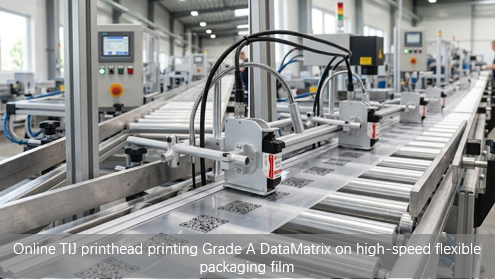
Why High-Speed Flexible Film Is Difficult for 2D Codes
Flexible film is not a rigid surface. It stretches under tension, flutters between rollers, and shifts position as the web moves. On a line running at 240 m/min, the film travels 4 meters every second.
This creates a timing problem that rigid packaging never faces. A 1-millisecond synchronization error—which is far below human perception—shifts the printed code by 4 mm. For a DataMatrix code that must pass Grade A verification, 4 mm is the difference between a successful scan and a rejected batch.
Property | Rigid Packaging | Flexible Film |
Dimensional Stability | Fixed | Stretches under tension (0.5–3%) |
Surface Flatness | Flat | Wrinkles, flutter, web bounce |
Registration Tolerance | ±2 mm | ±0.5 mm |
The Four Failure Modes: Quick Diagnosis
Failure Mode | Visual Symptom | Immediate Action |
Encoder Drift | Stretched or compressed code | Mount encoder on driven roller; calibrate at production speed |
Web Flutter | Fuzzy edges, low contrast | Add web guide roller; set 2–3 mm throw distance |
Ink Smudge | Code smears on rollers | Switch to solvent fast-dry or UV ink |
Placement Error | Printed off-target | Recenter print window; use TCP/IP PLC trigger |
The sections below explain why each failure occurs—and how to fix it at the root, not just the symptom.
1. Encoder Synchronization Drift
What happens: The code appears stretched or compressed along the print direction. Grade verification fails due to Axial Nonuniformity (AN).
Why it happens: The encoder pulse tells the printer exactly when to fire each droplet. On flexible film lines, web tension changes cause slight speed variations. If the encoder cannot track these changes in real time, the timing between droplets drifts—and the code geometry distorts.
How to fix it: Use a high-resolution rotary encoder mounted on the driven roller, not a passive idler. Verify pulse-per-millimeter calibration at production speed, not at low speed. For MX PRO, Modbus-TCP provides direct PLC speed feedback, which is more stable than analog signals.
2. Web Flutter Causing Throw Distance Variation
What happens: Code edges become fuzzy, cell contrast drops, and intermittent no-reads appear.
Why it happens: Film flutter—the vertical movement of the web between rollers—changes the distance between the printhead and the substrate. If this distance exceeds the specified 2–5 mm range, droplets begin to diverge before landing, producing a blurred, low-contrast code.
How to fix it: Install a web guide roller immediately upstream of the printhead. Maintain 2–3 mm throw distance (the lower end of the range) for maximum tolerance. For critical applications, a vacuum platen eliminates flutter entirely.
3. Ink Smudge Before Curing
What happens: The code smears or transfers to the opposite film surface during winding.
Why it happens: At 240 m/min, the film reaches the first downstream roller in under 0.3 seconds. Standard aqueous inks do not cure quickly enough at this speed. The ink is still wet when it contacts the roller—and the code is destroyed.
How to fix it: Use solvent-based fast-dry ink for non-porous films (PE, PP, PET). Above 120 m/min, switch to UV-curable ink with an inline UV lamp. Avoid aqueous ink above 100 m/min unless the film is porous (paper-based).
4. Code Placement Error from Registration Tolerance
What happens: The code is present but positioned outside the designated print area. The vision system rejects the package.
Why it happens: Flexible film stretches and shifts between the printhead and the vision system. If the code is printed at the tolerance edge, downstream verification will fail even though the code itself is technically readable.
How to fix it: Center the code in the available print window, not at the edge. For MX PRO, use TCP/IP feedback to the PLC to trigger print at the exact registration mark. Reduce print speed by 10–15% during startup to establish baseline quality, then ramp up.
Procurement Decision Guide
For procurement and project managers evaluating online TIJ systems, three questions matter most:
1. Which model should I choose?
Choose MX PLUS if your line runs below 120 m/min, uses a single lane, and does not require direct PLC integration.
Choose MX PRO if your line runs above 120 m/min, uses multiple lanes, or requires Modbus-TCP integration with an existing PLC.
2. What is the real cost of ownership?
A pharmaceutical blister line in Southeast Asia ran at 180 m/min with an existing CIJ system, producing 320,000 packs per day. CIJ codes passed Grade A at startup but dropped to Grade C within 2 hours due to phase drift and ink viscosity changes. The line required 4–6 stoppages per week for nozzle cleaning.
After upgrading to MX PRO with four printheads, UV-curable ink, and Modbus-TCP integration, the results after 90 days were:
Grade A pass rate improved from 82% to 99.4%, stable across the entire shift
Line stoppages dropped from 4–6 per week to 0–1
Annual consumable cost fell from ~$48,000 to **~$21,000**
The stability TIJ delivers is structural in nature: TIJ has no charging electrode, no deflection plates, and no recirculation gutter. There is nothing to drift, nothing to clog, and nothing that requires cleaning.
3. How long does deployment take?
Mounting, encoder connection, and calibration are typically completed in under 2 hours. No line modification is required beyond installing the printhead bracket and encoder.
Selection & Tuning Matrix
Parameter | MX PLUS | MX PRO |
Resolution | 50–1,200 DPI | 50–1,200 DPI |
Print Height | 1–25.4 mm (1–2 heads) | 1–50.8 mm (up to 4 heads) |
Max Speed | 120 m/min | 240 m/min |
Communication | RS232 | TCP/IP, RS232, Modbus-TCP |
Interface | USB, DB9, I/O, Encoder, Photocell | Ethernet, USB, DB9, I/O, Encoder, Photocell |
Ink Types | Aqueous / Solvent / UV | Aqueous / Solvent / UV |
Best For | Medium-speed lines, 1–2 lanes | High-speed lines, multi-lane, PLC integration |
Tuning by line speed:
Line Speed | Ink Type | Throw Distance | Encoder Setup |
80–120 m/min | Solvent fast-dry | 2.5–3.5 mm | RS232 encoder |
120–180 m/min | Solvent fast-dry | 2.0–3.0 mm | Modbus-TCP |
180–240 m/min | UV-curable | 2.0–2.5 mm | Modbus-TCP + PLC |
PET film (any speed) | Solvent or UV | 2.0–3.0 mm | High-res encoder + corona if needed |
For complete specifications and ink compatibility, visit the MX PLUS / MX PRO product page.
Standards note: Grade A under ISO/IEC 15415 requires ≥70% Symbol Contrast, ≥0.60 Modulation, and ≤0.06 Axial Nonuniformity. GS1 defines DataMatrix module size and quiet zone. ISO 9001:2015 requires documented inline verification.
Frequently Asked Questions (FAQ)
Q1: What is the minimum module size for Grade A DataMatrix on flexible film?
A: For reliable Grade A at high speed, use a minimum module size of 0.3 mm. Smaller modules require lower line speed or higher resolution (1,200 DPI on MX PLUS/PRO).
Q2: What is the ROI for upgrading from CIJ to online TIJ?
A: Eliminating CIJ ink and solvent costs, plus reducing downtime from nozzle clogging and viscosity drift, typically delivers ROI within 12–18 months on high-speed lines.
Q3: How does online TIJ compare to CIJ for flexible film at high speed?
A: Online TIJ offers stable Grade A 2D codes with no phase drift and no ink misting. CIJ offers higher maximum speed for simple text. For Grade A 2D codes on flexible film, online TIJ is the better choice.
???? Request a Free Sample Marking Test
Send us your flexible film substrate. Our engineers will:
Print a Grade A DataMatrix code on your actual film
Run ISO/IEC 15415 verification and provide the full report
Recommend the optimal MX PLUS or MX PRO configuration for your line speed
No obligation. Report delivered within 5 business days.
???? Request Free Sample Marking Test
Related Technical Resources
Read the Complete Guide on ISO/IEC 15415 Grade A GS1 DataMatrix Tuning
Learn How to Prevent Ink Smudges on High-Speed Flexible Packaging Lines
About the Author
Meenjet Application Engineering Team — Over 15 years of combined field experience supporting online TIJ installations on high-speed packaging lines across food, pharmaceutical, and industrial sectors.
Reviewed by: Senior Online TIJ Application Engineer, Meenjet
Last Updated: September 16, 2026