




News & Blogs
In high-speed flexible packaging operations, maintaining crisp product identification on non-porous substrates like plastic films, pouches, and foils is a constant engineering challenge. Few issues disrupt a packaging line faster than seeing critical code dates smudge or smear before the ink can fully cure.
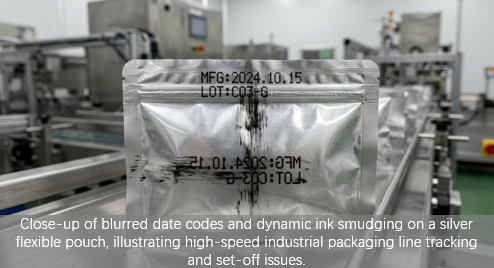
Unlike rigid containers, flexible substrates face immediate mechanical stress. Whether you are using an integrated inline inkjet printer or a specialized Meenjet thermal inkjet printer (TIJ), eliminating ink transfer requires a precise balance of surface chemistry, mechanical synchronization, and parameter optimization.
This guide breaks down the technical root causes of ink smudging on high-speed flexible lines and delivers actionable troubleshooting steps to secure permanent batch marking.
The Dynamic Threat: Rewinding and Stacking Pressures
In flexible packaging, the primary cause of smudging is not just slow drying, but immediate post-print mechanical contact. On continuous vertical form-fill-seal (VFFS) machines or high-speed flow wrappers, the printed film is either immediately tightly wound into a reel (rewinding) or the finished pouches are rapidly dropped and compressed on top of one another (stacking).
If the solvent carrier in your inkjet coder machine does not flash off completely within a fraction of a second, the residual fluid undergoes "set-off"—transferring onto the back of the adjacent layer under winding pressure.
3-Step High-Speed Line Troubleshooting Checklist
1. Audit Substrate Surface Tension (Dyne Levels)
Non-porous films like OPP, BOPP, and PE naturally repel liquid carrier agents due to low surface energy.
The Solution: Ensure your packaging film has undergone proper corona treatment. The film should ideally maintain a surface tension of at least 38 mN/m (Dynes). If the surface energy is correct, you must pair the line with a high-adhesion, solvent-based fast-drying ink cartridge explicitly formulated to bite into low-energy plastics.
2. Synchronize Speed via Encoder Tuning
On a dynamic, fluctuating flexible line, any micro-slippage between the film and the printer tracking system will cause a distorted, smeared image that looks like wet ink smudging.
The Solution: Verify that the measuring wheel of your shaft encoder is making firm, uniform contact with the driving roller. If the print signal from the encoder drops or lags even slightly behind the film speed, the date code printer will miscalculate the firing interval, resulting in structural image dragging.
3. Adjust Resolution and Heat Management
Depositing an excessive volume of ink on a non-porous film slows down the crystallization process, directly inviting smears during stacking.
The Solution: Access your device settings and drop the horizontal resolution from 600 DPI to 300 DPI or 240 DPI. This cuts the physical volume of ink per character while preserving high legibility. Furthermore, decrease the pulse width in your Meenjet device settings to reduce ink volume, or position a localized air knife immediately downstream of the batch coding machine to accelerate solvent evaporation before the film hits the sealing jaws.
Technology Matrix: Flexible Film Coding Solutions
When production speeds outpace your ink chemistry, a re-evaluation of your primary marking solutions may be necessary.
Technology | Mechanism | Smudge Resistance on Film | Best High-Speed Application |
TIJ Inkjet Printer | Non-contact thermal drop-on-demand firing. | High (With specialized quick-drying solvent inks). | Intermittent packaging lines, pouches, pre-formed bags. |
TTO Printer (Thermal Transfer Overprinter) | Thermal printhead melts ribbon wax/resin directly onto film. | Excellent (Instant solid-state cooling). | High-speed continuous VFFS and horizontal flow wrappers. |
Continuous Inkjet Printer (CIJ) | High-pressure continuous stream of MEK solvent inks. | Very High (Flash evaporation under 0.5 seconds). | Ultra-high-speed bagging, round-the-clock industrial lines. |
Securing Permanent Traceability
Resolving ink transfer on flexible lines demands a systematic approach. While a permanent laser coding system or an inkless fiber laser marking machine completely bypasses drying constraints for rigid materials, fluid-based printing remains highly essential for flexible webs.
Ultimately, minimizing ink volume via resolution control and ensuring flawless encoder synchronization with solvent-based chemistry provides the most adaptable, cost-effective framework for achieving crisp, smudge-free codes on flexible packaging. Pairing a reliable Meenjet portable handheld inkjet printer or online coder with high-adhesion fast-dry ink ensures high-speed, permanent traceability.