




News & Blogs
By Meenjet Application Engineering Team | September 14, 2026
Executive Summary
Small construction components—ceramic tiles, natural stone panels, metal fittings, window profiles, and prefabricated brackets—require durable batch codes, production dates, and traceability markings.
Unlike large precast concrete elements (which typically use DOD large-character printers), these components are compact, smooth-surfaced, and often produced in high-mix batches. This makes them ideal for handheld Thermal Inkjet (TIJ) marking.
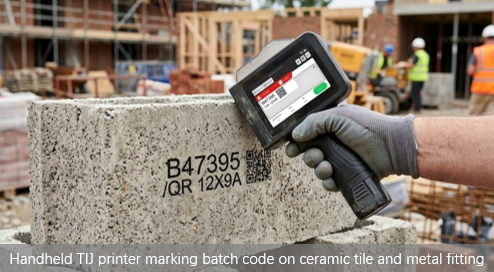
This guide covers the four substrate challenges specific to small construction components, the physical limitations of handheld TIJ on rough surfaces, and a fast-drying ink selection protocol for the Meenjet M6, M7, and M9 series.
???? For Procurement & Project Managers (Short Version)
Question | Answer |
What components does this apply to? | Ceramic tiles, stone panels, metal fittings, window profiles, small prefabricated brackets. |
Why handheld TIJ instead of DOD large-character? | These components are small and smooth. TIJ delivers 600 DPI precision for QR codes and small text—DOD is designed for large, rough surfaces. |
Which product? | M6 (database import), M7 (14 languages, DM codes), M9 (WiFi + barcode scanning). All: 600 DPI, 1–12.7 mm height, 2–5 mm distance. |
What's the ROI? | No line integration. Marking moves to the production floor or warehouse. |
How fast to deploy? | Operator training under 30 minutes. No installation required. |
Understanding the Substrate Challenge on Small Construction Components
Small construction components differ from both packaging and large precast elements:
Property | Packaging (Cartons, Film) | Large Precast (Pipes, Blocks) | Small Components (Tiles, Fittings) |
Surface Roughness | Smooth | Very rough (Ra > 200 μm) | Smooth to semi-smooth (Ra 5–50 μm) |
Component Size | Variable | Large, heavy | Small, manually handled |
Batch Pattern | Continuous | Low-mix, high-volume | High-mix, low-to-medium volume |
Typical Marking | Date, lot, barcode | Large batch numbers | QR codes, batch codes, serial numbers |
Marking Location | Inline | On-site or yard | Production floor or warehouse |
Key insight: Small construction components are closer to packaging substrates than to large precast elements—which is why handheld TIJ is the appropriate technology.
Four Substrate Challenges & Directional Tuning
1. Ceramic Tiles: Glazed vs. Unglazed Surfaces
Glazed tiles: Non-porous, smooth. Ink sits on the surface and must bond chemically.
Unglazed tiles: Semi-porous. Ink penetrates slightly, improving adhesion but reducing edge sharpness.
Directional tuning:
Glazed tiles: Solvent-based fast-dry ink. 600 DPI for crisp QR codes.
Unglazed tiles: High-viscosity ink. Reduce drop volume.
2. Natural Stone: Porosity Varies by Type
Stone Type | Porosity | Marking Behavior |
Granite | Low (<1%) | Ink sits on surface; solvent ink recommended |
Marble | Low-medium (1–3%) | Similar to granite |
Slate | Medium (3–8%) | Ink partially absorbed; high-viscosity ink |
Sandstone | High (10–25%) | Significant absorption; MEK fast-dry ink required |
Directional tuning:
Granite/Marble: Standard solvent ink, 600 DPI.
Slate/Sandstone: High-viscosity MEK ink, reduce drop volume.
3. Metal Fittings: Oil, Grease & Surface Finish
Metal fittings (brackets, hinges, fasteners) often carry residual oil or grease from machining. This creates an anti-adhesion barrier—the same problem seen on HDPE containers.
Directional tuning:
Pre-clean with solvent wipe: Remove oil and grease before marking.
Use high-contrast ink: White or yellow pigmented ink for dark metals.
Verify surface energy: Test with a Dyne pen (target ≥38 dyn/cm).
4. Window Profiles & Prefabricated Brackets: Curved or Stepped Surfaces
PVC and aluminum window profiles often have curved or stepped cross-sections. The printhead must maintain consistent distance across these features.
Directional tuning:
Use a guide rail: For repetitive marking on profiles, mount the printer on a sliding rail.
Maintain 2–5 mm distance: Per M6/M7/M9 official specifications.
Reduce print speed: Slower traverse allows more time for droplet transfer.
Physical Limitations of Handheld TIJ on Rough or Irregular Surfaces
Handheld TIJ printers rely on a synchronization wheel that rolls along the substrate to trigger droplet firing. This mechanism works well on flat, smooth surfaces—but has two physical limitations:
Limitation | Cause | Impact |
Wheel Slippage on Rough Stone | Unpolished stone or rough tile backing has uneven surface profile | Sync wheel loses traction → distorted or stretched characters |
Curved Metal Fittings Below 2 cm | Small bolts, pipe fittings, or large-curvature surfaces | Sync wheel cannot roll smoothly → character deformation |
Solutions:
For rough stone/tile: Use a guide rail to maintain constant traverse speed, or switch to a desktop semi-automatic marking station for higher consistency.
For small metal fittings (<2 cm): Use a positioning plate or fixture to stabilize the component during marking.
For high-curvature fittings: Consider a rotary axis attachment or switch to a desktop TIJ system with fixed printhead positioning.
Fast-Drying Ink Selection for Tiles, Stone & Metal
Substrate-specific ink selection is critical for adhesion and drying speed:
Substrate | Recommended Ink | Drying Time | Why |
Glazed ceramic tile | Solvent-based fast-dry (MEK) | <0.5 sec | Non-porous surface; ink must bond chemically |
Polished stone | Solvent-based fast-dry | <1.0 sec | Smooth, low-porosity; prevents smearing |
Rough stone/sandstone | High-viscosity MEK | <1.5 sec | Limits capillary absorption |
Metal fittings (dark) | White/yellow pigmented | <1.0 sec | High contrast on dark surfaces |
Metal fittings (polished) | High-adhesion solvent | <0.5 sec | Prevents rub-off during handling |
Window profiles (PVC) | Standard solvent | <1.0 sec | Compatible with PVC surface |
Key principle: The rougher or more non-porous the surface, the faster the ink must dry. MEK-based formulations are the industry standard for these substrates.
Handheld TIJ Parameter Tuning Matrix by Component
Component | Ink Type | Print Distance | Print Speed | Key Adjustment |
Glazed ceramic tile | Solvent fast-dry | 2.0–3.0 mm | Fast | 600 DPI |
Unglazed tile | High-viscosity | 2.0–4.0 mm | Medium | Reduce drop volume |
Granite / Marble | Standard solvent | 2.0–3.0 mm | Fast | Pre-clean surface |
Slate / Sandstone | MEK fast-dry | 3.0–5.0 mm | Medium | Increase viscosity |
Metal fittings | High-contrast pigment | 2.0–3.0 mm | Fast | Solvent wipe first |
Window profiles | Standard solvent | 2.0–4.0 mm | Medium | Guide rail |
Prefab brackets | Standard solvent | 2.0–3.0 mm | Fast | Verify surface |
Meenjet Handheld TIJ Solutions
Model | Best For | Key Specs |
M6 | Simple marking, database import | 600 DPI, 1–12.7 mm height, USB (Excel/TXT) |
M7 | Multi-language, complex variable data | 600 DPI, 1–12.7 mm height, 2–5 mm distance, 14 languages |
M9 | Connected lines, barcode scanning | 600 DPI, 1–12.7 mm height, WiFi + HTTP, barcode scan (UPC/EAN/QR/DM) |
All three share the same core platform: HP TIJ2.5 print technology, 2600 mAh battery, and 2–5 mm print distance—making them suitable for the full range of small construction components covered in this guide.
For complete specifications and ink compatibility, visit the M6/M7/M9 product page.
Compliance & Traceability Standards
Standard | Requirement | Impact on Marking |
ISO 9001:2015 | Quality management traceability | Documented marking process |
EN 14411 (Ceramic Tiles) | Product classification and marking | Batch codes on tile packaging or surface |
EN 12004 (Adhesives) | Component identification | Traceable batch numbers |
Local building codes | Component identification | Codes surviving handling and storage |
Frequently Asked Questions (FAQ)
Q1: Can handheld TIJ mark ceramic tiles without damaging the glaze?
A: Yes. TIJ is a non-contact process. The ink sits on the glaze surface and bonds chemically. For glazed tiles, use solvent-based fast-dry ink at 600 DPI.
Q2: Why not use a DOD large-character printer for these components?
A: DOD printers are designed for large, rough surfaces (precast concrete, pipes) where character heights of 50–100 mm are required. For small components like tiles and fittings, TIJ's 600 DPI precision is needed for QR codes and small text.
Q3: How do I mark metal fittings that have residual oil?
A: Pre-clean with a solvent wipe. Then use high-contrast pigmented ink (white or yellow) for dark metals. Verify surface energy with a Dyne pen if marking is critical.
Q4: What is the best ink for stone components?
A: It depends on porosity. Granite and marble: standard solvent ink. Slate and sandstone: high-viscosity MEK fast-dry ink.
Q5: How does handheld TIJ compare to laser for small construction components?
A: TIJ offers lower upfront cost and works on heat-sensitive or coated surfaces. Laser provides permanent marks but requires higher investment and may damage glazed or coated surfaces.
Q6: What is the total cost of ownership?
A: No line integration cost. Consumables typically $0.001–$0.003 per mark. For 5,000 components/day, annual consumable cost is under $3,000.
Q7: What if my component is too small or too curved for the sync wheel?
A: For components below 2 cm or with high curvature, use a positioning plate or fixture to stabilize the part during marking. Alternatively, a desktop semi-automatic TIJ station provides fixed printhead positioning for consistent results.
???? Need Help Selecting the Right Handheld TIJ?
Send us:
A photo of your component surface
Your marking requirements (text height, lines, daily volume)
Environmental conditions (dust, moisture, temperature)
Our engineers will recommend the optimal configuration within 4 business hours.
???? Contact Meenjet Handheld TIJ Team
Related Technical Resources
About the Author
Meenjet Application Engineering Team — Over 15 years of combined field experience supporting handheld TIJ installations across manufacturing, logistics, and construction component production. Our team has resolved hundreds of adhesion and print quality issues on smooth and semi-porous substrates.
Reviewed by: Senior TIJ Application Engineer, Meenjet
Last Updated: September 14, 2026