




News & Blogs
In regulated industries such as pharmaceuticals (UDI compliance), automotive components, and high-end electronics, printing a scannable GS1 DataMatrix barcode is only half the battle. Global supply chain mandates require these codes to undergo strict optical verification based on the ISO/IEC 15415 standard, consistently reaching Grade A (4.0/4.0) or Grade B quality ratings.
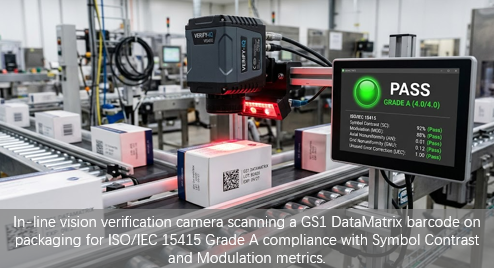
However, achieving Grade A quality on fast-moving packaging lines depends heavily on choosing the right coding technology—and tuning it correctly. Whether you use Thermal Inkjet (TIJ), Continuous Inkjet (CIJ), or Laser Marking Systems, physical print dynamics like ink misting, phase drift, belt vibration, or thermal contrast dictate your final score.
This comprehensive guide compares TIJ vs. CIJ vs. Laser technologies under ISO/IEC 15415 parameters, helping you select, tune, and optimize your industrial coding equipment to guarantee 100% Grade A compliance.
Understanding ISO/IEC 15415 Verification Metrics for Industrial Printers
The ISO/IEC 15415 standard evaluates two-dimensional printed barcodes across several critical optical parameters. To achieve an overall Grade A, every single parameter must individually score Grade A.
Symbol Contrast (SC): Measures the difference in reflectance between the light background and the dark printed modules. Low contrast occurs when ink opacity is insufficient, when dark or transparent substrates absorb light, or when laser power settings are poorly calibrated.
Modulation (MOD): Evaluates the consistency of dark and light modules across the entire matrix. Modulation drops when ink bleeds into adjacent cells or when micro-satellites (overspray) create cloudy halos around code edges.
Axial Nonuniformity (AN): Measures geometric distortion along the X and Y axes. If a square DataMatrix code becomes stretched into a rectangle, AN scores plummet. This is directly caused by mismatched line encoder signals or unstable conveyor belt speeds.
Grid Nonuniformity (GNU): Checks how far cell centers deviate from an ideal grid. Structural vibration, printhead movement, or curved packaging surfaces cause grid warping.
ISO/IEC 15415 Grade A Parameter Thresholds
Verification Parameter | Grade A Threshold | What It Measures |
Symbol Contrast (SC) | >= 70% | Reflectance difference between light/dark cells |
Modulation (MOD) | >= 0.60 | Uniformity of cell darkness/lightness |
Axial Nonuniformity (AN) | <= 0.06 | X/Y geometric distortion |
Grid Nonuniformity (GNU) | <= 0.38 | Grid center deviation |
Note: All four parameters must individually pass Grade A thresholds for an overall Grade A rating.
Print Technology Comparison Matrix for ISO/IEC 15415 Grade A Compliance
Technology | Grade A Pass Rate | Max Line Speed for Grade A | Optimal Throw Distance | Primary Failure Mechanism |
TIJ (Thermal Inkjet) | Extremely High (98%+ with proper cartridge selection & throw distance <2mm) | Up to 90 m/min | < 2.0 mm | Excessive throw distance causing ink misting |
CIJ (Continuous Inkjet) | Moderate (70-85% achievable; requires active phase/viscosity tuning) | Up to 300 m/min | 5.0 – 10.0 mm | Phase drift (ghosting) and overspray (satellites) |
Laser (Fiber / UV / CO2) | Exceptionally High (99%+ with correct focal alignment & material absorption) | Unlimited (Static/On-the-Fly) | Focal Point Specific | Material color-change contrast limitations |
Equipment Tuning Protocols by Marking Technology
Tuning TIJ (Thermal Inkjet) Printers for Grade A Codes:
Control Throw Distance: Keep the cartridge nozzle strictly within 1.0 to 2.0 mm of the packaging surface. Excessive throw distance allows flying micro-droplets to diverge, destroying Modulation scores.
Resolution & Pulse Width: Utilize high-resolution TIJ systems supporting up to 600 DPI. Set printing resolution to 300 x 300 DPI or 600 x 300 DPI. Fine-tune cartridge pulse firing widths to ensure crisp cell boundaries without ink bleeding.
Substrate Matching: Use solvent-based fast-drying inks for non-porous plastics (PET, HDPE). On highly transparent PET or dark substrates, apply a high-contrast white basecoat or use high-opacity white inks to secure Symbol Contrast scores.
Tuning CIJ (Continuous Inkjet) Printers for Grade A Codes:
Encoder Synchronization: Install a high-resolution rotary shaft encoder. Any speed fluctuation on high-speed cables or pipes will cause Axial Nonuniformity failure.
Phase & Viscosity Calibration: Verify viscosity readings and perform Auto-Phase calibration to eliminate character ghosting and trailing shadows. (Refer to our detailed CIJ Ghosting & Overspray Troubleshooting Guide for step-by-step phase calibration).
Anti-Static Control: Ground the extrusion line or conveyor to prevent electrostatic charge from attracting satellite droplets into the code matrix.
Tuning Laser Marking Systems (Fiber / UV / CO2) for Grade A Codes:
Precise Focal Alignment: Ensure the laser galvo head is focused exactly at the target focal distance. Out-of-focus laser beams increase spot diameter, blurring matrix cell edges.
Directional Parameter Tuning by Substrate Type:
Plastics (ABS, PC, PET): Increase Q-switch frequency (>40 kHz) and marking speed to minimize heat accumulation and prevent edge charring.
Metals (Stainless Steel, Titanium): Lower Q-switch frequency (20–40 kHz) with shorter pulse widths (4–10 ns MOPA) to achieve deep black annealing without vaporizing the surface.
Anodized Aluminum: Use ultra-high frequency (200–500 kHz) with fast galvo speed to bleach pigments without fracturing the oxide layer.
ISO/IEC 15415 Failure Mapping & Immediate Fixes
Verification Failure | Primary Hardware Root Cause | Immediate Corrective Action |
Symbol Contrast Fail (Grade F) | Low ink density / Transparent or dark substrate | Increase ink volume / Pre-apply basecoat / Upgrade to UV Laser or pigmented ink |
Modulation Fail (Grade C/D) | Ink overspray / Satellite droplets / Edge bleeding | Reduce CIJ/TIJ throw distance; install anti-static bar; clean charge slot |
Axial Nonuniformity Fail | Speed mismatch between conveyor and printer | Re-align encoder wheel; calibrate pulse-per-millimeter printer settings |
Grid Nonuniformity Fail | Mechanical vibration or distorted substrate surface | Rigidity-bracket the printhead; use guide rails to stabilize moving packages |
Pro Tip for UDI Medical Device Marking: When printing 2D DataMatrix codes on small metallic or flexible medical packaging, UV Laser marking is often superior to inkjet. UV lasers utilize "cold marking" photochemical degradation, creating ultra-crisp, high-contrast marks at 5-micron tolerances without altering surface texture or risking chemical ink leaching.
Alternative Technology: Upgrading to High-Resolution TIJ or UV Laser
If high maintenance demands, ink viscosity instability, or line vibration on your existing CIJ line consistently prevent you from passing ISO/IEC 15415 Grade A audits, upgrading to a 600 DPI Thermal Inkjet (TIJ) system or a Zero-Maintenance UV Laser Coder eliminates mechanical ink-spreading variables entirely.
Frequently Asked Questions (FAQ)
Q1: What is the main difference between ISO/IEC 15415 and ISO/IEC 15416?
A: ISO/IEC 15415 is the optical verification standard for two-dimensional (2D) matrix codes like GS1 DataMatrix and QR codes. ISO/IEC 15416 applies strictly to one-dimensional (1D) linear barcodes.
Q2: Why does my GS1 DataMatrix code scan easily on a smartphone but fail ISO/IEC 15415 verification?
A: Consumer smartphones and standard barcode readers use aggressive error-correction algorithms to reconstruct damaged or blurry codes. Industrial verifiers, however, measure absolute physical and optical quality. A code that scans on a phone may still fail audit compliance and be rejected by automated pharmaceutical or automotive supply chains.
Q3: Can a CIJ printer consistently achieve ISO/IEC 15415 Grade A on high-speed lines?
A: Yes, provided the printer is equipped with a high-resolution encoder, accurate phase calibration, clean charge electrodes, and proper static elimination. However, for ultra-small code sizes (< 5x5 mm), High-Resolution TIJ or Fiber/UV Lasers are recommended due to higher native resolution.
Q4: What is the practical difference between Grade A and Grade B for my supply chain?
A: While both Grade A and Grade B are considered "passing" under most regulatory frameworks (FDA UDI, EU MDR, automotive IATF 16949), the real-world difference is readability margin:
Grade A: Maximum tolerance for future wear, abrasion, or packaging deformation. Codes will reliably scan even after 12+ months of storage or multiple sterilization cycles.
Grade B: Passing today, but with reduced margin. Any additional degradation—scratches, ink fading, or autoclave cycles—may push the code into Grade C/D failure. Bottom Line: Grade A is the safe investment for regulated industries to prevent costly field recalls and customer complaints during shelf-life testing.
Related Industrial Coding & Marking Guides
CIJ Troubleshooting: How to Stop CIJ Ghosting & Overspray on Extrusion Lines
Medical UDI Compliance: FDA UDI Marking on Stainless Steel & Titanium Surgical Tools
Substrate Selection: HDPE vs. PET Laser Marking Setup Guide
Film Marking: QR Code Scannability on Flexible Packaging Films