


News & Blogs
By Meenjet Application Engineering Team | November 20, 2026
Executive Summary
Plastic pipe and profile extrusion lines run continuously. The pipe leaves the die, passes through cooling and sizing, and moves at a constant speed toward the winder or cutter. The coding station must print a legible, durable mark on a moving, often curved or textured surface, at the same speed as the line, without touching the product.
Online thermal inkjet (TIJ) is a practical fit for plastic pipe and profile coding—but only when the print head is synchronized to the line speed, the ink is matched to the polymer surface, and the model is sized to the line configuration. This guide covers the technical and commercial variables that decide whether an online TIJ installation works on a plastic extrusion line: line synchronization, ink adhesion, print head positioning, and total cost of ownership (TCO) compared to CIJ.
A note on scope: this article covers plastic pipe and profile. Aluminum profiles and other metal sections are a different case—the reflective surface and the requirement for a permanent mark make flying laser the appropriate technology there, not TIJ.
???? For Plastic Pipe & Profile Production Managers
Question | Answer |
Can online TIJ print on a moving plastic pipe without touching it? | Yes. Online TIJ is non-contact. The print head is mounted at a fixed distance from the pipe surface, and printing is triggered by a photocell and synchronized with an encoder. |
What line speed can online TIJ handle on an extrusion line? | MXPlus supports up to 120 m/min; MXPRO supports up to 240 m/min. The practical limit depends on character height, ink drying, and line configuration. |
Which ink works on PE, PP, and PVC pipe surfaces? | Fast-dry solvent inks are required for non-porous plastic surfaces. PE and PP have low surface energy and need an ink formulated for them. PVC accepts solvent inks more readily. |
How is the print head positioned on a curved pipe? | The head is mounted on a bracket at a fixed throw distance. For large-diameter pipe, the bracket is aligned to the pipe’s tangent so the distance stays constant across the print zone. |
What happens if the line speed changes? | The encoder feeds the actual line speed to the printer, and the print timing adjusts automatically. Without encoder synchronization, the code stretches or compresses. |
Is CIJ or TIJ more cost-effective for pipe extrusion? | For 24/7 high-speed lines, CIJ may have a lower cost per character. But for intermittent lines or frequent batch changes, TIJ eliminates solvent and maintenance costs, offering a lower TCO. |
Does online TIJ work on aluminum profiles? | No. Aluminum profiles are reflective and usually require a permanent mark. Flying laser is the appropriate technology for metal profiles. |
1. Why Extrusion Line Coding Is a Synchronization Problem First
On an extrusion line, the product never stops. The coding station has a fraction of a second to print a legible code on a surface moving at line speed. If the print timing does not match the line speed, the code stretches, compresses, or lands in the wrong position.
The Three Synchronization Elements
Photocell trigger: Detects the leading edge of the product and tells the printer when to start.
Encoder: Reports the actual line speed so the printer can adjust the print timing continuously.
Print head distance: The gap between the head and the pipe surface must stay within the ink’s throw distance. On a curved pipe, this means aligning the bracket to the pipe tangent.
Key insight: On an extrusion line, the printer is only as good as its synchronization. A high-resolution print head without encoder feedback will produce codes that drift as the line speed changes.
2. Challenge 1: Ink Adhesion on PE, PP, and PVC Pipe Surfaces
Plastic pipe is not a single surface. PE, PP, and PVC behave differently with ink, and a formulation that works on one may fail on another.
Ink Selection by Polymer
PE and PP: Low surface energy. Standard inks bead up or rub off. Fast-dry solvent inks formulated for low-energy surfaces are required. In some cases, surface pretreatment improves adhesion, but this adds a process step and is usually avoided if the right ink is available.
PVC: Higher surface energy than PE and PP. Solvent inks adhere more readily. Still, the ink must be compatible with the plasticizer in the PVC compound, or the mark may migrate or fade.
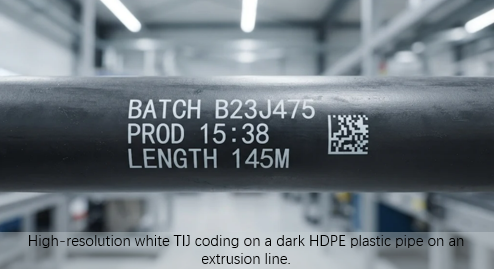
Dark pipe: Black pipe or dark-colored compound requires white or yellow pigment ink for contrast. Standard black ink on a dark pipe is unreadable.
Print Position on the Pipe
Print on a straight section after cooling, away from the sizing sleeve and the cutter. The surface should be dry and free of cooling water. On large-diameter pipe, the top or side of the pipe is easier to access than the underside.
Key insight: On plastic pipe, the ink is the variable that decides whether the mark survives handling, outdoor storage, and installation. A printer with the wrong ink will produce a code that fails before the pipe leaves the yard.
3. Challenge 2: Print Head Positioning on Curved and Textured Surfaces
Pipe is round. Profile is often textured or has a complex cross-section. The print head must maintain a consistent distance from the surface across the print zone, or the code will be uneven.
Positioning on Round Pipe
Small-diameter pipe: The curvature is tight. The print head is mounted close to the pipe, and the throw distance is set at the low end of the ink’s range.
Large-diameter pipe: The print zone is flatter relative to the head. The bracket is aligned to the pipe tangent so the distance stays constant across the width of the code.
Profile with texture: A textured surface can cause the ink to land unevenly. Test the print on a sample profile before production, and adjust the throw distance and ink volume if needed.
Key insight: On a curved or textured surface, the print head bracket is part of the coding system, not an accessory. A poorly aligned bracket produces a code that looks like an ink problem but is actually a positioning problem.
4. TCO and Flexibility: Why Online TIJ Outperforms on Intermittent Lines
While continuous inkjet (CIJ) remains a strong choice for high-speed, 24/7 extrusion lines with large character requirements, online TIJ offers a compelling total cost of ownership (TCO) advantage for many pipe and profile manufacturers. The value of TIJ is not in the cost per single ink cartridge, but in the elimination of hidden operational costs.
Zero Maintenance and No Solvents: TIJ systems have no pumps, filters, or fluid recirculation systems. There is no solvent to handle, and no daily nozzle cleaning routine. Replacing a cartridge is effectively replacing the print head. If your production line is not running 24/7, or if you want to avoid the labor cost of a dedicated CIJ technician, the savings in maintenance and downtime can easily outweigh the difference in consumable pricing.
Instant Start-Up and Reduced Downtime: CIJ printers require a start-up cycle to purge and stabilize the ink stream. Every time the line stops and restarts—or when batches change frequently—CIJ incurs downtime and ink waste. Online TIJ is immediately ready to print. For intermittent production runs or facilities that frequently switch pipe diameters and batch codes, this operational efficiency significantly boosts overall line utilization.
High-Resolution for Data-Rich Codes: If your pipe marking requires dense QR codes, DataMatrix, or fine text for digital traceability, TIJ’s high resolution (up to 300-600 DPI) produces sharp, solid characters. CIJ typically produces dot-matrix characters, which are harder for automated vision systems to read. In applications where a rejected code stops the shipment, the higher first-read rate of TIJ directly reduces waste and rework costs.
Key insight: For a high-speed, 24/7 line running a single product, CIJ's low per-character cost may win. But for medium-speed lines with frequent changes, limited maintenance resources, or data-rich traceability requirements, online TIJ delivers a lower total cost of ownership and greater operational flexibility.
5. Decision Guide: Matching the Model to Your Extrusion Line
Two Meenjet online TIJ models cover plastic pipe and profile extrusion. Instead of comparing full specification sheets, the decision on an extrusion line comes down to three practical variables: how high the code needs to be, how fast the line runs, and how many lines the printer must cover.
Decision Variable | MXPlus | MXPRO |
Max Print Height | 25.4 mm | 50.8 mm |
Max Line Speed | 120 m/min | 240 m/min |
Print Head Configuration | 1–2 heads | 1–4 heads |
Best For | Single pipe line, standard batch/length codes | High-speed lines, wide profiles, or multi-line coverage |
How to apply this to your line:
If you run a single standard pipe line at moderate speed (under 120 m/min) and need a code height of 25.4 mm or less (typical for batch, length, or standard marks), the MXPlus is sufficient. You do not need to pay for the extra speed and head capacity of the MXPRO.
If your line runs at high speed (up to 240 m/min), or if you need to cover a wide profile, or if you want to split one printer across multiple parallel pipe lines to save floor space, the MXPRO is the correct configuration. Its 4-head capacity allows a single controller to manage multiple print points.
If your production involves frequent diameter changes, the deciding factor is not the printer model, but the mounting bracket. Both models require a bracket that allows quick throw-distance adjustment.
Key insight: The choice between MXPlus and MXPRO is a line configuration decision, not a print quality decision. Both use the same TIJ technology. You are choosing based on line speed and physical coverage.
6. When Not to Use Online TIJ: The Metal Profile Boundary
A critical part of choosing online TIJ for pipe is knowing where it stops. Online TIJ is intended for plastic pipe and profile. If your extrusion line runs aluminum profiles or other metal sections, online TIJ is the wrong technology.
Metal profiles are highly reflective, which reduces the contrast of ink codes. More importantly, the metal profile market typically requires a permanent mark that survives anodizing, coating, and long-term outdoor exposure. Ink—even solvent-based TIJ ink—sits on the surface and can be abraded or chemically removed.
For aluminum and metal profiles, flying laser marking is the appropriate technology.
Key insight: TIJ and laser do not compete on the same surface; they serve different materials. Matching the technology to the substrate must happen before you look at the printer model. If your factory runs both plastic and aluminum extrusion lines, you will likely need both a TIJ system and a flying laser system.
Frequently Asked Questions (FAQ)
Q1: Can online TIJ print on pipe that is still wet from the cooling bath?
A: The pipe surface should be dry at the print position. If residual cooling water is present, the ink may not adhere, and the code may smear. Position the print head after the drying stage, or use an air knife to remove surface water before coding.
Q2: What happens if the pipe diameter changes during a production run?
A: The print head bracket must be adjusted to maintain the correct throw distance. For lines that switch between pipe diameters frequently, a bracket with quick adjustment or a sliding mount reduces changeover time.
Q3: Can MXPlus or MXPRO be integrated with an existing extrusion line control system?
A: Both models support photocell and encoder synchronization and can be triggered by the line's existing sensors. Integration details depend on the line controller; Meenjet's application team can review the line configuration and recommend the wiring and trigger setup.
Q4: Do I need a dedicated technician to maintain an online TIJ printer?
A: No. Unlike CIJ printers that require regular nozzle cleaning and solvent handling, online TIJ printers are virtually maintenance-free. Replacing the ink cartridge replaces the print head, so operators can manage the machine with minimal training.
???? Request a Free Line Audit
Send us your pipe or profile samples and line details—polymer type, diameter or profile cross-section, line speed, and code content. Our engineers will:
Test the appropriate ink on your actual pipe or profile surface
Recommend MXPlus or MXPRO based on line speed and coverage
Provide a cost and configuration proposal
No obligation. Report delivered within 5 business days.
???? Request a Free Line Audit
Related Technical Resources
About the Author
Meenjet Application Engineering Team — Over 15 years of combined field experience supporting CIJ, TIJ, and laser installations across plastic extrusion, pipe and profile, packaging, and chemical manufacturing.
Reviewed by: Senior Application Engineer, Meenjet
Last Updated: November 20, 2026