



News & Blogs
By Meenjet Application Engineering Team | October 19, 2026
Executive Summary
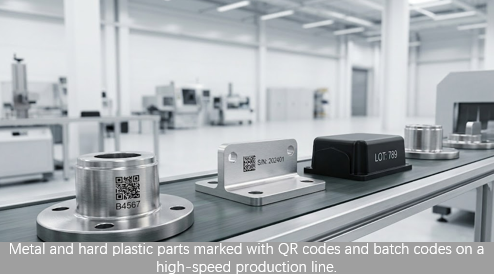
Flying fiber laser marking machines are used on high-speed production lines to mark metal and hard plastic parts without stopping the conveyor. Meenjet offers three power options: 20W, 30W, and 50W. Each is built on the same 1,064 nm fiber laser platform, with up to 100,000 hours of laser life and marking speeds up to 12,000 mm/s.
This guide explains how the three power levels differ, which materials and industries each one suits, and how to choose the right configuration for your line.
???? For Production & Packaging Managers
Question | Answer |
What is a flying fiber laser used for? | Permanent, high-contrast marking on metal and hard plastic parts on a moving conveyor. |
Which power for standard line speeds? | 20W (MFF-20). |
Which power for high-speed packaging lines? | 30W (MFF-30). |
Which power for ultra-high-speed lines or deep engraving? | 50W (MFF-50). |
Does it need consumables? | No. Fiber laser marking uses no ink, no solvent, and no ribbons. |
What is the laser lifespan? | Up to 100,000 hours. |
Does it integrate with a conveyor? | Yes. Photocell and encoder inputs keep the laser synchronized with line speed. |
Can it mark QR codes and DataMatrix? | Yes. It supports text, dates, barcodes, QR codes, DataMatrix, and dynamic database content. |
Glossary:
Flying laser: A laser marking system synchronized with a moving conveyor.
Fiber laser: A laser using a doped optical fiber as the gain medium, typically at 1,064 nm.
MOPA: A fiber laser configuration that allows pulse width control for better marking on stainless steel and coated materials.
Encoder: A sensor that tracks line speed and keeps the laser synchronized with the product.
Photocell: A sensor that triggers marking when a product passes.
1. What Is a Flying Fiber Laser Marking Machine?
A flying fiber laser marking machine is a laser system mounted above or beside a conveyor. It marks products while they move, without stopping the line.
Factor | Static Fiber Laser | Flying Fiber Laser |
Product position | Stationary | Moving on conveyor |
Integration | Standalone workstation | Inline with production line |
Speed | Limited by operator | Up to 12,000 mm/s marking speed |
Trigger | Manual or foot pedal | Photocell and encoder |
Use case | Batch marking, offline | High-speed production lines |
Consumables | None | None |
Key insight: Static fiber laser is a workstation tool. Flying fiber laser is a production system. Both use the same laser source, but serve different workflows.
2. 20W vs 30W vs 50W: Power Selection Guide
Factor | MFF-20 | MFF-30 | MFF-50 |
Output power | ≥20W | ≥30W | ≥50W |
Laser wavelength | 1,064 nm | 1,064 nm | 1,064 nm |
Marking speed | ≤12,000 mm/s | ≤12,000 mm/s | ≤12,000 mm/s |
Laser lifespan | Up to 100,000 hours | Up to 100,000 hours | Up to 100,000 hours |
Cooling | Air | Air | Air |
Best for | Standard line speeds, thin metal, fine surface marking | High-speed lines, general metal marking, most packaging and industrial applications | Ultra-high line speeds, deep engraving, thick metal, high-contrast marks on hard materials |
Typical industries | Hardware, electronics, medical devices | Auto parts, FMCG packaging, cables | Heavy machinery, aerospace, thick metal |
How to choose:
20W (MFF-20): Best for standard line speeds, thin metal, fine surface marking, and small characters.
30W (MFF-30): Best for high-speed lines, general metal marking, and most packaging and industrial applications.
50W (MFF-50): Best for ultra-high line speeds, deep engraving, thick metal, and high-contrast marks on hard materials.
Rule of thumb: If you are unsure, start with 30W. It covers most metal and hard plastic applications and can be upgraded to 50W if line speed or mark depth becomes a constraint.
3. Compatible Materials and Industries
Metals and Alloys
Stainless steel, carbon steel
Anodized and bare aluminum
Copper, brass, titanium
Gold, silver, electroplated metals
Engineering Plastics
ABS, PVC, HDPE, PC
PEEK, dark PP/PE, nylon blends
Ceramics and Composites
Alumina, zirconia, glazed ceramics
Carbon fiber, Kevlar, glass-filled composites
Coated and Dark Materials
Anodized surfaces
Coated glass
Dark or coated wood
Natural leather
Granite and slate
Typical Industries
Auto parts and components
Electronic components and integrated circuits
Hardware tools
Wire and cable
Medical devices
FMCG packaging
Household appliances
Luxury goods
Aerospace and defense components
Key insight: Fiber laser is the best choice for metals and hard plastics. For paper, glass, wood, and organic materials, a CO₂ laser is usually better. For PET and heat-sensitive plastics, a UV laser is usually better.
4. Line Integration: Photocell, Encoder, Ethernet, Vision
A flying fiber laser is only as good as its integration with the production line. The MFF series supports:
Feature | Purpose |
Photocell sensor | Triggers marking when a product passes |
Shaft encoder | Keeps marking synchronized with line speed |
Dual red-light positioning | Fast alignment during setup |
Ethernet | Remote control and data streaming |
Vision system integration | Verifies code quality on the fly |
I/O and serial ports | Connects alarm beacons, emergency stops, and external devices |
Key insight: For high-speed lines, the encoder is not optional. Without it, mark position drifts as line speed changes.
5. Durability & Cost Comparison
Factor | Flying Fiber Laser | CIJ | TIJ |
Expected lifespan | Up to 100,000 hours laser life; 10+ years system life | 7–10 years | 5–8 years |
Maintenance | Low, no consumables | High, nozzle cleaning, solvent handling | Low, no wearing parts |
Consumables | None | Ink, solvent, make-up | Ink cartridges |
Cost per mark | Very low at high volume | Medium | Low |
Downtime risk | Low | Medium to high | Low |
Print quality | High, permanent | Medium | High |
Permanent mark | Yes | No | No |
Typical line speed | Up to 12,000 mm/s marking speed | Very high | Up to 240 m/min |
Rule of thumb: If the mark must be permanent, flying fiber laser is usually the best choice. At high volume, it also has the lowest TCO. If the mark is variable data on cartons or film at low to medium volume, TIJ is more economical. CIJ remains the choice for very high-speed ink-based coding.
Break-even analysis: For lines running 8 hours per day, flying fiber laser typically pays back the equipment cost within 18–24 months compared with CIJ, due to zero consumables and lower maintenance.
6. Meet the MFF Series
The MFF series is available in three power levels. All models share the same 1,064 nm fiber laser platform, dual red-light positioning, air cooling, and embedded Linux control.
Parameter | MFF-20 | MFF-30 | MFF-50 |
Output power | ≥20W | ≥30W | ≥50W |
Marking speed | ≤12,000 mm/s | ≤12,000 mm/s | ≤12,000 mm/s |
Laser lifespan | Up to 100,000 hours | Up to 100,000 hours | Up to 100,000 hours |
Cooling | Air | Air | Air |
Marking area | 110×110 mm (optional 150×150 / 300×300 mm) | Same | Same |
Best for | Standard line speeds, fine marking | High-speed packaging lines | Ultra-high-speed production, deep engraving |
Each system ships with the laser host, touch screen controller, mounting bracket, photocell, encoder, cables, and tool kit. 1-year warranty and lifetime technical support are included.
For full specifications, see the MFF Series product page.
Frequently Asked Questions (FAQ)
Q1: Can a flying fiber laser mark bare metal?
A: Yes. Fiber laser is the best choice for bare metal, including stainless steel, aluminum, copper, and titanium. It produces a permanent, high-contrast mark without consumables.
Q2: Do I need an encoder for a flying fiber laser?
A: Yes, for high-speed lines. The encoder keeps the mark synchronized with line speed. Without it, mark position drifts as the line speeds up or slows down.
Q3: Which power should I choose for thin metal?
A: 20W is usually sufficient for thin metal and fine surface marking. Choose 30W for high-speed lines and 50W for deep engraving or thick metal.
Q4: Can a flying fiber laser mark QR codes and DataMatrix?
A: Yes. The MFF series supports text, dates, barcodes, QR codes, DataMatrix, and dynamic database content.
Q5: What is the minimum order for a free line audit?
A: No minimum. Send us your line details and product samples, and our engineers will recommend the right configuration.
???? Request a Free Line Audit
Send us your line details. Our engineers will:
Review your line speed, material, and marking requirements
Recommend 20W, 30W, or 50W flying fiber laser
Provide a cost and configuration proposal
No obligation. Report delivered within 5 business days.
???? Request a Free Line Audit
Related Technical Resources
Online TIJ vs CIJ vs Laser: Which for Cartons, Bottles, and Film?
Fiber Laser Black Annealing on Stainless Steel: Achieving Permanent High-Contrast Marks (MOPA Guide)
CO₂ or Fiber Laser: Which Flying Laser Marker for High-Speed PET Lines?
About the Author
Meenjet Application Engineering Team — Over 15 years of combined field experience supporting flying fiber laser, CO₂ laser, UV laser, CIJ, and TIJ installations across manufacturing, packaging, and logistics. Our team has resolved hundreds of substrate compatibility and line integration challenges.
Reviewed by: Senior Application Engineer, Meenjet
Last Updated: October 19, 2026