



News & Blogs
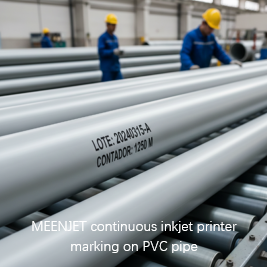
In pipe extrusion, maintaining legible traceability at high velocities is a significant technical challenge. Whether producing PVC, PE, or HDPE piping, manufacturers require marking solutions that offer both micro-second precision and extreme durability. Achieving this requires an integration of high-speed sensors and specialized coding marking hardware.
High-Speed In-line Marking Technology
1. Continuous Inkjet (CIJ) Systems
The Continuous Inkjet Printer is the industry standard for high-speed lines. An industrial inkjet coder must utilize advanced encoder synchronization to ensure that code dates and meter marks remain accurate, even during line speed fluctuations.
Ink Adhesion & Fast Drying: A critical factor is the ink's ability to resist smudging when the pipe enters the cooling water bath immediately after the batch marking process. Specialized inkjet printer white ink and pigmented systems from providers like Meenjet are formulated to provide high contrast on dark substrates while drying in milliseconds.
Non-contact Coding: The distance-adaptive nature of CIJ allows the inkjet coder machine to mark curved surfaces without physical contact, preventing any deformation of the soft, newly extruded plastic.
2. Flying Laser Marking Solutions
For a permanent, consumable-free alternative, a flying laser marking machine is often the superior choice. These systems code "on-the-fly" using high-speed galvo scanners.
CO2 Laser Marking Machine: Ideal for PVC, this technology triggers a photochemical color change on the material surface rather than deep ablation.
UV Laser Marking: Known as "Cold Marking," Meenjet UV laser systems are preferred for high-spec telecommunication pipes. They provide high-contrast laser coding without creating thermal stress points that could compromise the pipe’s pressure rating.
3. Portable & Offline Versatility
While in-line systems handle the bulk of production, a portable marking machine is vital for quality control or warehouse logging.
Handheld Inkjet Printer: A portable handheld inkjet printer allows for manual batch marking on large-diameter pipes or off-line inventory.
Handheld Laser Marking: For permanent field-marking, a portable laser marker delivers factory-grade results in a mobile handheld coding machine format.
Technical Integration Factors
When evaluating an inkjet marking machine or a laser marking machine manufacturer, the focus should be on:
Synchronization: Real-time feedback loops between the extruder and the batch coder.
Substrate Compatibility: Selecting wavelengths or inks tailored for PP, PE, or PVC.
Environmental Protection: Ensuring the coding printer can withstand the dust and moisture typical of extrusion facilities.
Conclusion
From an automatic batch coding machine to a handheld expiry date printer, the right technology ensures product compliance and brand integrity. By implementing advanced systems, such as those developed by Meenjet, manufacturers can achieve reliable, high-speed marking without sacrificing clarity or structural safety.