



News & Blogs
In high-speed beverage bottling, deploying the wrong laser wavelength can instantly trigger costly packaging failures. While purchasing teams often look for a universal product marking solution, the physics of laser-substrate interaction dictates otherwise.
For production lines dedicated to polyethylene terephthalate (PET) containers, the engineering decision narrows down to a CO2 laser marking machine versus a fiber laser marking machine.
Using the incorrect system on a fast-moving conveyor results in either invisible codes or physically punctured bottles. Here is the technical analysis of why one wavelength reigns supreme for automated PET lines.
The Physics of PET: Why Wavelength Matters
The fundamental difference between these technologies lies in their wavelength and how clear plastic absorbs that specific light energy.
Fiber Lasers (1,064 nm): A flying fiber laser marking machine operates in the near-infrared spectrum. Clear PET plastic is nearly transparent to this wavelength. The laser beam passes straight through the container walls without leaving a mark. Turning up the power to force contrast creates localized melting, distortion, or punctures thin-walled bottles.
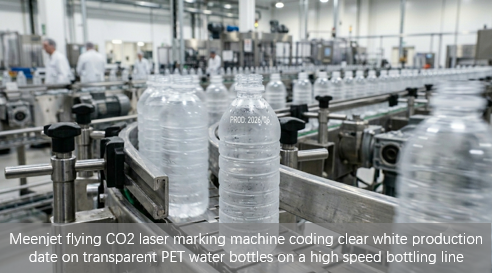
CO2 Lasers (9.3 μm vs. 10.6 μm): Gas-based CO2 systems emit mid-infrared light. PET plastic has an exceptionally high absorption rate for this energy. The surface absorbs the beam instantly, triggering a clean, frosted, high-contrast white code date without structurally weakening the plastic.
???? Technical Standard: While standard 10.6 \mum lasers work across general packaging, a dedicated 9.3 \mum CO2 laser is the industry benchmark for PET. It matches the molecular absorption band of PET perfectly, allowing manufacturers like Meenjet to achieve maximum marking speeds at lower power settings.
Technical Matchup: Wavelength vs. Material
Technical Parameter | CO2 Flying Laser (9.3 \mum) | Flying Fiber Laser (1,064 nm) |
PET Surface Contrast | High-contrast, frosted white mark | Invisible / Poor |
Structural Safety | Safe; alters only the outer surface layer | High risk of melting or burn-through |
Line Speed on PET | Matches 100,000+ BPH production lines | Inefficient; causes dangerous power spikes |
Primary Applications | PET water/soda bottles, glass, carton | Aluminum cans, metal caps, steel kegs |
Line Integration: Optimizing for High-Speed Bottling
Upgrading a high-speed bottling plant from traditional continuous inkjet printers to maintenance-free flying lasers requires robust hardware synergy.
To prevent character stretching or skipping on non-stop conveyors, advanced industrial systems—such as Meenjet’s flying laser series—utilize high-speed digital galvanometers. These scanning mirrors execute precise vector characters "on the fly" at extreme velocities.
Furthermore, cold-filling beverage lines generate heavy surface condensation. Leading laser marking machine manufacturers solve this by enclosing the internal optics in IP54 or IP65 sealed structures. This protection shields components during washdown cycles, ensuring the laser seamlessly processes real-time data from the plant's centralized batch coding system.
Final Verdict
For high-speed clear PET lines, a co2 laser marking machine is the definitive choice. It delivers the contrast, structural safety, and rapid pacing required to maximize line OEE without ongoing fluid costs.
Save the fiber laser marking machine for your aluminum canning lines or crown caps, where its shorter wavelength acts as an elite metal marking machine.
By deploying specialized hardware, such as Meenjet's PET-optimized flying CO2 lasers, packaging facilities can secure unalterable traceability, eliminate scheduled downtime, and reduce their long-term coding TCO to zero.