



News & Blogs
By Meenjet Application Engineering Team | November 17, 2026
Executive Summary
Wire and cable is normally coded at the extrusion line, where the printer is fixed and the cable runs past it at speed. However, based on feedback from our field engineering projects worldwide, a large share of cable coding happens after the cable leaves the factory: cutting to length on site, terminating and splicing, re-labeling spools during inventory, or marking field-installed cable trays and conduits. These jobs cannot go back onto an extrusion line, and handwritten tags or adhesive labels frequently fail under UV exposure, moisture, and mechanical abrasion.
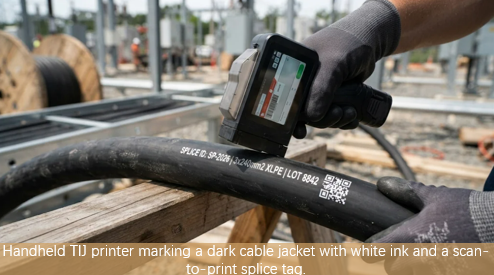
This guide covers handheld thermal inkjet (TIJ) coding for wire and cable outside the factory—field splicing tags, spool and inventory marking, and on-site asset identification using a portable wire and cable marking machine. It focuses on three practical variables: substrate diversity on cable jackets, field conditions, and the need for a portable tool that an electrician or contractor can carry and operate without extensive training.
???? For Cable Contractors & Field Engineers
Question | Answer |
Can a handheld TIJ printer mark directly on cable jackets? | Yes. Handheld TIJ prints on PVC, XLPE, rubber, and coated cable surfaces. Fast-dry solvent inks are required for non-porous jackets. |
What code content is typically printed on site? | Cable size and type, length markers, splice or termination tags, asset IDs, QR codes, and contractor or project codes. |
Is a handheld printer suitable for large cable spools? | Yes. The handheld form factor allows the operator to walk to the spool, print on the jacket or drum flange, and move to the next one without setting up a line. |
Can the printer scan an existing cable code and print a new tag? | The M9 model includes a built-in scanner. Scan the existing QR or barcode on the cable, then print the new splice or termination tag in one operation. |
Do handheld TIJ printers work outdoors? | Yes, within the operating range of 0–45 °C and 40–60% RH. For high-humidity or dusty sites, the nozzle protection cover on the M9 and the drop-resistant ABS+PC housing help. |
How long does the battery last in field use? | Both the M6 and M9 use a 2,600 mAh removable battery rated for up to 10 hours of continuous printing and 20 hours standby. |
Can I print in white or yellow on dark cable jackets? | Yes. White, yellow, red, blue, green, and black ink options are available. Opaque pigment inks are recommended for dark PVC and rubber. |
1. Why Cable Coding Does Not End at the Factory
Extrusion-line coding covers the cable as it is manufactured. It does not cover what happens next.
Cable is cut, spliced, terminated, coiled, stored, and installed in the field. Each of those steps can require a new mark: a length marker after cutting, a splice tag after joining two runs, an asset ID after installation, or a spool label after inventory transfer. Adhesive labels peel under UV and moisture. Handwriting fades or smears. A portable cable marking machine closes that gap.
Factor | Factory Coding (Extrusion Line) | Field Coding (Handheld TIJ) |
Cable position | Running at line speed | Static, on a spool or in a tray |
Substrate | Single jacket type per run | Mixed: PVC, XLPE, rubber, coated metal |
Code content | Length, batch, standard | Splice ID, asset ID, length, QR |
Environment | Controlled | Outdoor, dusty, humid, cold |
Tool requirement | Fixed CIJ or laser | Portable, battery-powered, no setup |
Key insight: A cable that is coded at the factory is not fully traceable until the field marks are added. The handheld printer is the tool that closes the traceability chain at the point of installation, meeting the durability expectations set by industrial marking standards such as UL 969 in North America and EN 50334 in European markets.
2. Challenge 1: Substrate Diversity on Cable Jackets
Cable jackets are not a single material. PVC, XLPE, rubber, and coated metal all behave differently with ink.
Ink Selection for Cable Jackets
PVC and XLPE: Non-porous surfaces. Fast-dry solvent inks are required for adhesion. Standard water-based inks sit on the surface and rub off.
Rubber and EPDM: The surface energy is low. Solvent inks with a tailored formulation are needed. Test adhesion on a sample jacket before field use.
Coated metal (armored cable, conduit): Opaque pigment inks in white or yellow produce visible marks on dark or galvanized surfaces.
Dark jackets: Black ink on a black or dark grey jacket is unreadable. White or yellow pigment ink is the practical choice.
Print Position on Cable
Print on a straight section of the jacket, away from bends and connector transitions. On spools, the drum flange is often a better print surface than the cable jacket because it is flat and does not flex.
Key insight: On cable, the ink is the variable that decides whether the mark survives. Field marks on cable are expected to resist mechanical abrasion, moisture, and solvents—a handheld wire marking machine loaded with the wrong ink will produce a mark that fails at the first pull or the first rain.
3. Challenge 2: Field Conditions and Portability
Field coding happens on construction sites, in cable yards, on rooftops, and in tunnels. The tool must be carried, operated with one hand, and survive drops.
What the Field Requires
Battery life: A full shift without recharging. Both the M6 and M9 use a 2,600 mAh removable battery (up to 10 hours continuous printing / 20 hours standby).
Weight: Lightweight ergonomics designed for one-handed operation over a full shift (M6: 0.82 kg; M9: 0.72 kg).
Durability: ABS+PC housing, drop-resistant and impact-resistant. The M9 adds a nozzle protection cover for short breaks and dust isolation.
Operating range: 0–45 °C, 40–60% RH. For cold-weather work, the battery should be kept warm between uses.
Printing at Any Angle (Operational Flexibility)
Cable in a tray or on a spool is rarely presented at a convenient angle. Both the M6 and M9 feature anti-leakage ink systems that print at any orientation—vertical, horizontal, or overhead—without ink starvation or leakage.
Key insight: The field tool must fit the way the cable is actually presented, not the way a production line presents it. Portability and angle flexibility are not conveniences—they are the difference between a mark that gets made and a mark that gets skipped.
4. Challenge 3: Splice Tags and the Scan-to-Print Workflow
Splicing and termination are the highest-risk points in cable traceability. When two cable runs are joined, the new splice needs its own identifier that links back to both original runs. Handwriting this tag is error-prone, and adhesive labels fail at the joint.
The Scan-to-Print Workflow (M9)
The M9 handheld printer includes a built-in scanner that reads QR codes and barcodes (UPC, EAN, Code 39, Code 128, ITF-14, Data Matrix, and others). As observed in multiple electrical contractor deployments, field operators eliminate manual transcription errors by executing a streamlined three-step workflow:
Scan the existing code on the cable jacket or the drum flange.
Transfer: The scanner passes the original code to the printer automatically.
Print the new splice tag combining the original code with the new splice ID.
Variable Data for Project Codes
For contractors working on multiple projects, the M9 supports WiFi connection for Excel/TXT variable printing and integrated software (such as MES) via HTTP protocol. Project codes and asset IDs can be loaded in advance and printed on site without retyping.
Key insight: At a splice, the traceability chain is only as strong as the tag that links the two runs. A scan-to-print workflow removes the human transcription step that breaks that chain.
5. Which Handheld Model for Cable Work
Two Meenjet handheld TIJ models cover field cable coding. The choice depends on the code content and the workflow:
Meenjet M6: 1–12.7 mm print height, 1–5 lines, up to 300 DPI, 4.3-inch touch screen, black/white/red/yellow/blue/green/invisible ink options. Best for straightforward field marks: cable size, length, and batch codes on mixed jackets.
Meenjet M9: 1–12.7 mm print height, up to 300 DPI, built-in scanner (UPC, EAN, Code 39, Code 128, ITF-14, QR, Data Matrix), WiFi for Excel/TXT variable printing, nozzle protection cover. Best for scan-to-print splice tags and digital traceability workflows.
Both models support photocell and encoder synchronization (for inline use with an optional bracket), USB data interface, and multi-language operation. For full specifications, explore the M6 handheld cable marking machine product page and the M9 smart handheld printer product page.
Frequently Asked Questions (FAQ)
Q1: Can a handheld TIJ printer mark cable outdoors in rain or high humidity?
A: The printers operate within 0–45 °C and 40–60% RH. For high-humidity sites, the M9 nozzle protection cover isolates dust during short breaks. Print in a sheltered area if possible, and allow the fast-dry solvent ink to cure before handling the cable.
Q2: What ink color should I use on black or dark grey cable jackets?
A: White or yellow opaque pigment ink. Black ink on a dark jacket is unreadable at a distance, which defeats the purpose of an asset or splice tag.
Q3: Can I use a handheld printer as an inline printer on a cable line?
A: Both the M6 and M9 support an optional bracket and sensor that convert the handheld unit into an inline printer. This is useful for low-volume cable runs where a full CIJ or laser line is not justified.
???? Request a Free Sample Test
Send us a sample of your cable jacket—PVC, XLPE, rubber, or coated metal—along with the code content you need to print. Our engineers will:
Test the appropriate handheld model and ink on your actual cable jacket.
Recommend the right ink for adhesion, abrasion resistance, and contrast.
Provide a cost and configuration proposal.
No obligation. Report delivered within 5 business days.
???? Request a Free Sample Test
Related Technical Resources
About the Author
Meenjet Application Engineering Team — Over 15 years of combined field experience supporting CIJ, TIJ, and laser installations across wire and cable, chemical, food and beverage, and packaging manufacturing.
Reviewed by: Senior Application Engineer, Meenjet
Last Updated: November 17, 2026