




News & Blogs
A Complete Technical Guide to FDA/MDR UDI Compliance, Corrosion-Free Black Annealing, Picosecond Lasers, and ASTM A967 Passivation Protocols
⚡ Executive Summary
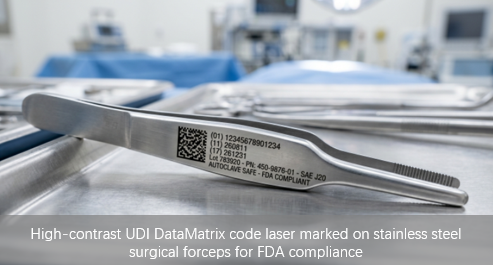
Struggling with UDI codes fading after autoclaving or causing micro-rust after citric/nitric acid passivation on surgical tools?
Standard Fiber Lasers (Q-switched): Thermal heat disrupts the chromium oxide passivation layer, causing micro-pitting and rust during citric/nitric acid passivation baths.
MOPA Fiber Lasers ( pulse widths): Allow precise control over thermal input to achieve high-contrast "Dark Annealing" on 316L/420 stainless steel without vaporizing the protective chromium oxide layer.
Ultrafast Picosecond / Femtosecond Lasers (The Gold Standard): Utilize non-thermal "Cold Ablation" to modify surfaces at the nanometer scale, ensuring 100% passivation resistance, zero corrosion after 1,000+ autoclave cycles, and ISO/IEC 15415 Grade A scannability.
???? Who Should Read This Guide:
Quality / Compliance Managers: Focus on Section 1 (FDA/MDR Regulatory Summary) and Section 5 (ASTM A967 Passivation Protocols).
Manufacturing / Process Engineers: Focus on Section 3 (MOPA vs. Picosecond Technical Comparison) and Section 6 (Process Parameters).
Procurement & R&D Leads: Focus on Section 4 (Technology Selection Matrix) and CapEx vs. long-term reliability trade-offs.
1. UDI Regulatory Overview: What Medical Device Marking Requires
Before selecting a marking technology, medical device manufacturers (MDMs) must understand the global legal framework driving direct part marking (DPM) requirements:
FDA UDI System (US, 21 CFR Part 830): Requires a Unique Device Identifier (UDI) on the device label and, for reusable devices, a permanent direct part marking (DPM) that remains legible and scannable after every reprocessing cycle (cleaning, disinfection, and sterilization).
EU MDR 2017/745 (Europe): Mandates UDI carriers on all implantable, reusable, and Class III devices, enforcing strict DPM rules where physical surface space allows.
IMDRF UDI Guidance: An international harmonization framework adopted by regulators in Australia (TGA), Canada (Health Canada), Japan (PMDA), and Singapore (HSA)—critical for global exporters.
???? Key Takeaway for Compliance Teams:
Global regulations do not mandate a specific laser technology—they mandate the outcome: a permanent, high-contrast mark that remains 100% readable without altering the device's structural integrity, biocompatibility, or corrosion resistance.
2. The Compliance Dilemma: Why Marking Surgical Metals Is Hard
Marking surgical-grade metals like 316L / 17-4PH / 420 Stainless Steel, Titanium (Ti-6Al-4V), and Nitinol introduces a critical engineering hurdle:
Passivation Breakdown: Stainless steel relies on a microscopic chromium oxide passive film for corrosion resistance. Traditional thermal laser engraving melts and vaporizes this layer, exposing raw iron to moisture and acid baths.
Autoclave Fading & Discoloration: Reusable tools undergo repeated high-pressure steam sterilization ( autoclave cycles). Poorly annealed marks oxidise further over time, turning brown or yellow and failing vision inspection.
Micro-Cavities & Bio-Burden Risks: Deep laser engraving creates microscopic pits and burrs where bacteria and prions can shelter, failing hospital infection control audits.
3. Technical Solutions: MOPA Annealing vs. Picosecond Cold Marking
To achieve a permanent, non-destructive, and high-contrast mark on medical instruments, two primary laser technologies are deployed:
Option A: MOPA Laser Dark Annealing (Controlled Thermal Oxidation)
How It Works: MOPA (Master Oscillator Power Amplifier) fiber lasers offer adjustable pulse durations (from to ). By applying ultra-short pulse widths at high frequencies, energy is delivered so rapidly that an oxide layer grows underneath the surface without vaporizing or removing base metal.
Result on Titanium: Produces vibrant, non-fading structural colors (black, gold, blue) via optical interference without adding pigment.
Best Used For: Medium-to-high volume reusable surgical tools, retractors, and tray handles.
Option B: Ultrafast Picosecond/Femtosecond Lasers (Cold Laser Ablation)
How It Works: Ultrafast lasers deliver pulse durations in the picosecond range. The energy delivery is faster than the thermal diffusion time of the metal lattice, causing "Cold Ablation" or creating periodic nanostructures (LIPSS) that trap light.
Why MDMs Choose Ultrafast:
Zero Heat-Affected Zone (HAZ): The chromium passive layer remains 100% intact.
Deepest Velvet-Black Contrast: Traps of incident light, yielding unmatchable contrast.
100% Passivation Immunity: Easily passes aggressive nitric/citric acid passivation and 1,000+ autoclave cycles without micro-pitting.
Best Used For: Permanent implantables (bone screws, joint replacements), micro-catheters, and high-value surgical instruments.
4. Technology Selection Matrix for Medical Device DPM
Feature / Requirement | Standard Q-Switched Fiber | MOPA Fiber Laser (<10 ns) | Picosecond / Femtosecond Laser |
Marking Mechanism | Thermal Melting / Engraving | Controlled Oxide Annealing | Cold Nanostructuring |
Passivation Resistance (ASTM A967) | ❌ Fails (Micro-Rust) | Moderate-High (Needs precise tuning) | Maximum (100% Pass Rate) |
Autoclave Resistance | ❌ Fails | High | Maximum |
Surface Roughness | High | Very Low | Zero Change |
ISO/IEC 15415 2D Code Grade | Grade C or Lower | Grade A / B | Grade A (Maximum Contrast) |
CapEx Investment | Low | Moderate | Higher |
5. Key Standards & Testing Protocol for UDI Compliance
Medical device manufacturers must validate UDI marks against three global standards before launching to market:
1. ISO/IEC 15415 & GS1 General Specifications (Print Quality Verification)
DataMatrix symbols must achieve Grade A or B under optical verification. Key metrics include Cell Contrast, Modulation, and Axial Non-uniformity.
2. ASTM A967 / ASTM A380 (Chemical Passivation Resistance)
Direct part marks must endure 30-minute baths in Citric Acid or Nitric Acid formulations without undergoing micro-pitting, copper sulfate staining, or surface oxidation.
3. ISO 17664 / AAMI ST79 (Sterilization & Autoclave Testing)
Marks on reusable surgical devices are subjected to repeated moist heat steam sterilization cycles ( at ) to confirm zero optical degradation over the product's intended lifecycle.
6. Frequently Asked Questions (FAQ)
Q1: Why do black laser marks on stainless steel turn brown or rust after citric acid passivation?
A: Standard lasers heat steel above its critical thermal threshold, driving chromium away from the surface and forming iron oxides. When placed in an acid passivation bath, the acid strips the unprotected iron, leaving micro-pits that rust rapidly when exposed to air and moisture.
Q2: What is the difference between laser engraving and laser annealing on medical metals?
A: Laser engraving physically vaporizes metal to cut a trench, destroying the passive layer and creating crevices where bacteria can hide. Laser annealing heats the material just enough to grow an internal black oxide layer below the surface without disturbing surface smoothness or removing base metal.
Q3: Can a 355nm UV laser be used for marking titanium or stainless steel medical devices?
A: While 355nm UV lasers excel on polymers and elastomers (like EPDM hoses), they lack the pulse energy required to produce deep black annealing on stainless steel or titanium. For medical metals, MOPA short-pulse fiber lasers or picosecond lasers are the preferred industry standards.
Q4: How small can a UDI DataMatrix code be printed on surgical tools while maintaining ISO Grade A?
A: With a picosecond laser and telecentric optical setup, readable GS1-compliant DataMatrix codes can be marked as small as on medical instruments, achieving Grade A scannability under 2D barcode verifiers.
Q5: How do I verify if my UDI mark meets FDA and EU MDR requirements?
A: Verification requires a two-step testing protocol:
Print Quality Verification: Use a GS1-compliant 2D barcode verifier to measure ISO/IEC 15415 parameters—Cell Contrast, Modulation, and Axial Non-uniformity are minimum thresholds for Grade A or B.
Passivation Integrity Verification: Perform ASTM A967 citric or nitric acid bath testing on marked samples. Inspect under magnification for pitting, staining, or discoloration—any visible corrosion is an automatic compliance failure.
???? Get Your Free Medical Device Sample Test & Passivation Report
Facing UDI scannability failures or rust issues after passivation testing?
Send us your stainless steel or titanium components. Our medical application laboratory will perform sample marking, run ASTM A967 passivation testing, and provide a comprehensive ISO/IEC 15415 Barcode Verification Report within 24 Hours.
???? Request Your Free Medical Marking Sample Test (Contact Medical Engineering Team)
???? Explore Our Material Traceability Matrix
Looking for high-contrast coding solutions across other dark or challenging industrial substrates? Explore our technical guides:
???? Black Rubber & EPDM Hoses: White Ink vs. UV Laser for Black Rubber Hose Coding
???? Dark Wires & Cables: High-Contrast Coding Solutions for Dark PVC/PE Wires & Cables
???? HDPE Plastics & Containers: HDPE Plastic Ink Adhesion: Dyne Testing & UV Laser Marking Guide
???? PCB Circuit Boards: High-Contrast Micro QR Code Marking on PCB Circuit Boards