



News & Blogs
An Industrial Packaging Guide to Photothermal Photochemistry, Waveband Selection ( vs. ), and Preventing Wall Piercing in High-Speed Bottling Lines
⚡ Executive Summary
Switching rigid container lines between High-Density Polyethylene (HDPE) and Polyethylene Terephthalate (PET) involves more than swapping bottle molds. It changes the photothermal reaction between coherent light and polymer matrices.
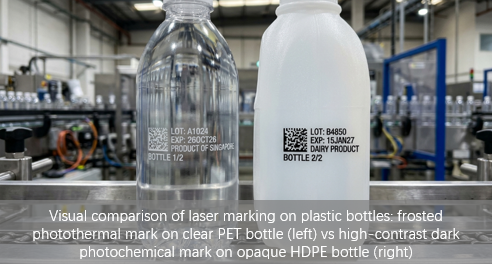
PET Bottling: Relies on structural wall clarity and thin-walled geometry. Using a standard CO₂ laser at high power risks pinhole micro-fractures. It requires precise CO₂ absorption tuning or a UV laser marking system for zero-thermal-stress coding.
HDPE Bottling: Demands clear contrast on opaque, semi-rigid surfaces. While a continuous inkjet printer or thermal inkjet printer applying specialized inks works, high-speed lines use a CO₂ laser coder or a UV system for permanent, chemical-resistant date codes without consumables.
1. The Physics of Polymer Absorption: Why One Laser Does Not Fit All
For packaging engineers managing an automated line, achieving a sharp date code or GS1 DataMatrix requires understanding light-material interactions. Polymers absorb photonic energy based on their molecular bond frequencies:
Polyethylene Terephthalate (PET)
PET is a semi-crystalline, highly transparent thermoplastic with strong resonance near the waveband. Because blow-molded PET beverage bottles feature thin wall profiles, applying an unoptimized beam creates excessive heat. This results in structural wall piercing, stress cracking, or distorted 2D codes.
High-Density Polyethylene (HDPE)
HDPE is a semi-rigid, non-polar polyolefin containing crystalline and amorphous domains, often loaded with titanium dioxide or color pigments. HDPE exhibits poor absorption across near-infrared spectrums (making standard fiber lasers ineffective without heavy additive masterbatches). Instead, it requires the high thermal energy of a CO₂ laser system to induce surface foaming, or the cold-ablation mechanism of a UV laser marking machine to achieve high-contrast color shifts.
2. CO₂ Laser Marking: Substrate Tuning & Waveband Strategy
A CO₂ laser marker remains an industrial workhorse across liquid packaging plants. However, selecting the correct laser tube wavelength is critical to avoid container damage.
Optimizing CO₂ Lasers for PET ( vs. )
Standard CO₂ lasers emit at , where PET absorption is relatively low. To compensate, operators often increase laser power, which melts through the container wall.
By deploying a flying CO₂ laser marker tuned specifically to , the energy matches the ester bond absorption peak of PET. This allows the laser to create a crisp, white frosted mark on the outer surface layer at high line speeds without compromising container pressure integrity.
Optimizing CO₂ Lasers for HDPE
Because HDPE absorbs far less energy, a standard CO₂ laser system is preferred. The high-energy beam melts the surface polymer, causing controlled micro-foaming. This creates a raised, tactile batch code that remains legible even when exposed to harsh chemical environments.
3. UV Laser Marking: Cold Ablation for High-Value Applications
Where thermal stress must be eliminated, a UV laser provides an ideal alternative to thermal lasers and inkjet-based systems.
The Photochemical Advantage
Unlike infrared lasers, third-harmonic generation (THG) UV lasers emit high-energy UV photons that break chemical bonds directly in the polymer matrix. This photochemical reaction ("cold marking") produces a high-contrast mark with:
Zero Heat-Affected Zone (HAZ): No structural weakening of thin PET container walls.
Smooth Surface Finish: No micro-cavities where bacteria or liquid residues can collect.
High Contrast on HDPE: Interacts with additives like to create crisp dark grey or black marks on colored HDPE jugs and caps without charring.
4. Substrate vs. Technology Selection Matrix
Substrate & Container Profile | Primary Coding Option | Alternative Option | Primary Risk / Failure Mode |
Thin-Wall PET Bottles | 9.3 m Flying CO₂ Laser | 355 nm UV Laser | Wall perforation, pinholes, or distorted codes. |
Opaque HDPE Jugs / Caps | 355 nm UV Laser | 10.6 m CO₂ Laser | Low contrast, micro-charring, or poor optical scannability. |
Pouch & Flexible Film | TIJ / TTO Printer | CO₂ Laser Coder | Film burn-through or ink smudge before curing. |
Coated Metal Closures | Fiber Laser Marker | UV Laser Coder | Thermal distortion of inner plastic liner seals. |
5. Alternative Coding Technologies: When Inkjet Makes Sense
While a flying laser marking machine or online laser marking machine eliminates ongoing consumable costs, plant managers often evaluate other product marking systems:
Continuous Inkjet Printing: A continuous inkjet printer or industrial continuous inkjet printers excel at high-speed non-contact printing across curved container bases. When printing on dark HDPE containers, white inkjet ink ensures clear visual contrast.
Thermal Inkjet (TIJ): A TIJ inkjet printer utilizes quick-change cartridges that deliver up to 600 DPI resolution. This makes it ideal for printing high-density DataMatrix codes on flat bottle labels and cartons.
Thermal Transfer Overprinting (TTO): A thermal transfer printer or TTO printer remains the standard for inline flexible pouch and film printing prior to bottle filling.
6. Frequently Asked Questions (FAQ)
Q1: Can a single CO₂ laser marking system switch between PET and HDPE bottles on the same packaging line?
A: Yes, provided the system features adjustable pulse frequency and duty cycle control. However, if the machine uses a standard tube, PET marking must be carefully throttled to prevent pinholes. For mixed lines, a CO₂ laser or a UV laser marking system offers the broadest operational window.
Q2: Why does a fiber laser fail to mark clear PET or HDPE bottles effectively?
A: Standard fiber lasers operate in the near-infrared spectrum. Unmodified PET and HDPE are optically transparent at this wavelength, allowing the beam to pass through without producing a readable mark, unless expensive laser-absorbing additives are mixed into the resin.
Q3: What is the main operational advantage of a flying laser over an inkjet bottle printer?
A: A flying laser marking system marks products in motion without inks, solvents, or printhead maintenance. This lowers total cost of ownership (TCO) and avoids ink-smudging issues on high-speed lines.
Q4: How do line speeds affect the choice between CO₂ and UV laser systems?
A: CO₂ lasers deliver higher total thermal power, making them capable of ultra-high-speed character vectoring on fast beverage bottling lines. UV lasers, while offering superior contrast, typically run at lower average wattage and require high-speed galvo scanners to maintain pace on rapid production runs.
???? Related Technical Resources & Substrate Guides
???? EPDM & Black Rubber Cables: White Ink CIJ vs. UV Laser Coding for Extruded Rubber Hoses
???? Dark PVC/PE Wire Extrusion: High-Contrast Wire Marking Solutions & Cable Tagging Technologies
???? HDPE Bottle Ink Adhesion: Surface Energy, Dyne Testing & Inkjet Printing on HDPE Containers
???? PCB Micro-Marking: High-Density QR Code Marking on Electronics Substrates