


News & Blogs
By Meenjet Application Engineering Team | October 26, 2026
Executive Summary
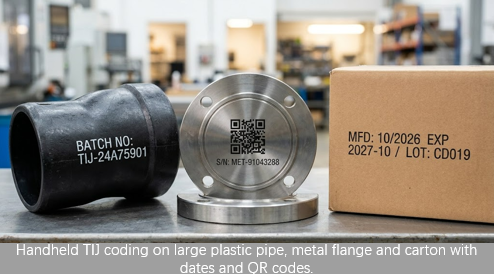
Not every part fits on a production line. Large castings, irregular housings, low-volume batches, and parts already installed on site cannot go to an inline printer. For these jobs, a handheld thermal inkjet (TIJ) printer is the practical choice.
This guide explains when handheld TIJ is the right tool, when it is not, how to choose the right ink, and how the two Meenjet M-series models differ in real production use.
???? For Production & Maintenance Managers
Question | Answer |
What is a handheld TIJ printer used for? | Date codes, batch numbers, QR codes, and serial numbers on large, irregular, or low-volume parts that cannot go on a line. |
Can it replace an inline printer on a high-volume line? | No. Handheld is for flexibility, not line speed. For continuous high-volume production, use inline TIJ, CIJ, or laser. |
Which materials does it handle? | Plastics, metals, glass, cartons, cables, pipes, and painted surfaces. Porous, rough materials like concrete and stone are not suitable. |
Which model for standard date and batch coding? | M6. High-resolution date and batch printing, plug-and-play. |
Which model for barcode scanning and WiFi/MES integration? | M9. Built-in scanner, WiFi, and built-in encoder. |
Does it require daily maintenance? | No. TIJ has no wearing parts and no solvent handling. Maintenance is limited to replacing ink cartridges and capping the print head during long idle periods. |
Glossary:
TIJ: Thermal Inkjet — ink is heated and ejected through a nozzle.
Variable data: Content that changes with each print, such as serial numbers, dates, or batch codes.
MES: Manufacturing Execution System, used to track production and traceability data.
Throw distance: The distance between the print head and the surface. For handheld TIJ, this is typically 2–5 mm.
1. Why Handheld TIJ Fits Large & Irregular Parts
An inline printer requires a fixed position, a conveyor, and a repeatable product path. Many parts do not meet these conditions.
Parts Too Large to Move
Large castings, welded frames, and heavy components cannot be lifted onto a conveyor. A handheld printer marks them in place.
Irregular Shapes and Uneven Surfaces
Curved housings, protruding brackets, and uneven surfaces make inline positioning difficult. A handheld printer follows the surface manually, with a 2–5 mm throw distance.
Low-Volume and High-Mix Production
For small batches and multiple part variants, setting up a dedicated inline station is not economical. A handheld printer avoids fixture costs and setup time.
Field Service and Installed Parts
When a part is already installed at a customer site or needs to be marked after delivery, a portable printer is the only practical option.
Key insight: Handheld TIJ is not a slower version of inline TIJ. It is a different tool for a different job: marking parts that cannot go on a line.
2. Handheld TIJ vs Handheld Laser vs Labels
Three portable marking methods compete for these scenarios. They are not interchangeable.
Factor | Handheld TIJ | Handheld Laser | Labels |
Consumables | Ink cartridges | None | Label stock |
Mark durability | 3–5 years (substrate-dependent) | Permanent | 1–3 years |
Metal marking | Requires primer or coated surface | ✅ Direct on bare metal | ✅ Works with adhesive |
Plastic marking | ✅ Best choice | Depends on plastic | ✅ Works on smooth plastic |
Curved and irregular surfaces | ✅ Good | ???? Requires focal distance control | ???? May peel at edges |
Data change per print | ✅ Instant | ✅ Instant | ❌ Requires pre-printing |
Upfront cost | Moderate | High | Low |
Key insight: Handheld TIJ is the best choice for plastic, cartons, painted metal, and glass in low-volume or field applications. For permanent marks on bare metal, a handheld fiber laser is more durable. For short-term or project-based tagging, labels are sufficient.
3. Ink & Substrate Selection
Handheld TIJ works by depositing ink directly onto the surface. Ink choice determines adhesion and durability.
Plastics (PP, PE, PET, PVC, ABS)
Solvent-based ink is required for non-porous plastics. Water-based ink will bead up or rub off. For dark plastics, white or yellow pigment ink provides contrast.
Metals and Painted Surfaces
On bare metal, ink adhesion is poor without surface treatment. Use a primer or choose a coated surface. On painted metal, solvent ink bonds well to the paint layer.
Glass
Solvent ink adheres to glass, but the mark is not permanent. For glass parts exposed to washing or handling, test adhesion before production.
Cartons and Paper
Water-based ink is sufficient for porous surfaces. Solvent ink works but is not necessary.
Materials Not Suitable for TIJ
Concrete, stone, raw wood, and other highly porous or rough surfaces are not suitable for handheld TIJ. Ink penetrates the surface and spreads, producing an unreadable code. Use stencil spray, pneumatic marking, or laser for these materials.
Key insight: Ink selection is not a detail. It is the difference between a mark that survives the production environment and one that rubs off in the first handling cycle.
4. Meet the M-Series: M6 vs M9
The Meenjet M-series shares a common platform: HP TIJ2.5 technology, embedded Linux, 1–12.7 mm print height, 2–5 mm throw distance, 2,600 mAh battery, and a 4.3-inch color touchscreen. Both models print up to 300 DPI. The key differences are in data handling and system integration.
M6: Standard Date and Batch Coding
The M6 is designed for straightforward date, batch, and QR code printing. It requires no training, no database connection, and no inline setup. It is the right choice when the job is to print the same or manually entered data on parts in the field.
Best for: Daily date and batch coding on cartons, bottles, plastics, and painted metal.
M9: Scanner, WiFi, and MES Integration
The M9 adds a built-in barcode and QR code scanner, WiFi connectivity, and a built-in encoder. It can scan a part, read the code, and print the corresponding data in one operation. WiFi supports connection to MES or other production software. A nozzle protection cover allows short breaks without removing the cartridge.
Best for: Scan-and-print workflows, traceability data from MES, and automated variable content without manual entry.
For full specifications, see the M6 product page and the M9 product page.
5. Cost & Maintenance Reality
Handheld TIJ has a low maintenance burden, but the cost structure is different from inline printers.
Consumable Cost
The M6 and M9 use the same HP TIJ2.5 ink platform. Cartridge yield depends on print height and resolution:
At 12.7 mm height: approximately 250,000 characters
At 10 mm height: approximately 300,000 characters
At 5 mm height: approximately 600,000 characters
At 2 mm height: approximately 1,600,000 characters
Original HP cartridges last about 1.5 times longer than refilled cartridges. Refilled cartridges may cost less per unit but often produce lower adhesion and shorter service life.
Downtime Risk
The main risk in handheld TIJ is print head clogging during idle periods. If the printer is stored without the cartridge capped, ink can dry in the nozzle. The M9 includes a nozzle protection cover for short breaks. For both models, removing the cartridge and capping it during long idle periods is recommended.
Total Cost of Ownership
Factor | Handheld TIJ | Handheld Laser | Labels |
Upfront cost | Moderate | High | Low |
Consumables | Ink cartridges | None | Label stock |
Maintenance | Low | Low | None |
Cost per mark | Low | Very low | Moderate |
Best for | Plastic, cartons, painted metal, low volume | Bare metal, permanent marks | Short-term tagging |
Rule of thumb: If the part is plastic, carton, painted metal, or glass, and the mark does not need to be permanent, handheld TIJ is the most economical and flexible choice. If the part is bare metal and the mark must survive the life of the product, a handheld fiber laser is better.
Frequently Asked Questions (FAQ)
Q1: Can a handheld TIJ printer mark bare metal?
A: Not reliably. Bare metal has low surface energy and poor ink adhesion. Use a primer, or choose a painted or coated surface. For permanent marks on bare metal, use a handheld fiber laser.
Q2: Can a handheld TIJ printer be mounted on a conveyor?
A: Yes, with a bracket and sensor. However, for continuous high-speed production, a dedicated inline printer (MXPlus or MXPro) is more efficient.
Q3: What is the difference between M6 and M9?
A: The M6 is for standard date and batch coding with manual entry. The M9 adds a built-in scanner, WiFi, and MES integration for automated scan-and-print workflows. Both share the same HP TIJ2.5 print engine, 300 DPI resolution, and 1–12.7 mm print height.
Q4: Which ink should I use for plastic bottles?
A: Solvent-based ink. Water-based ink will not adhere to non-porous plastic. For dark bottles, use white or yellow pigment ink.
Q5: What is the minimum order for a free sample test?
A: No minimum. Send us your parts, and our engineers will test the M-series and recommend the right model and ink.
???? Request a Free Sample Test
Send us your parts. Our engineers will:
Test the M-series on your specific materials
Recommend the right model (M6 or M9) and ink
Provide a cost and configuration proposal
No obligation. Report delivered within 5 business days.
???? Request a Free Sample Test
Related Technical Resources
About the Author
Meenjet Application Engineering Team — Over 15 years of combined field experience supporting handheld TIJ, inline TIJ, CIJ, and laser installations across manufacturing, logistics, and field service. Our team has resolved hundreds of substrate compatibility and field marking challenges.
Reviewed by: Senior Application Engineer, Meenjet
Last Updated: October 26, 2026