



News & Blogs
By Meenjet Application Engineering Team | September 28, 2026
Executive Summary
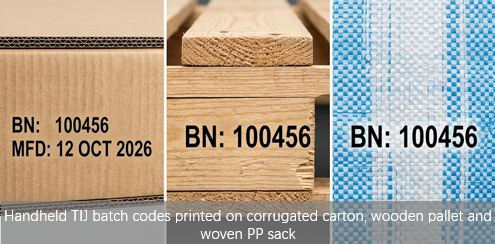
Warehouse and logistics operations need fast, legible batch codes on three very different surfaces: corrugated cartons, wooden or plastic pallets, and woven polypropylene sacks.
Each surface presents a different coding challenge. Cartons absorb ink unevenly through their fluted structure. Pallets have rough, sometimes wet or dirty surfaces. Sacks are porous, flexible, and rarely flat.
Handheld Thermal Inkjet (TIJ) printers solve these problems—but only when the ink, throw distance, and print height are matched to each substrate. This guide covers the three substrate challenges, the parameter tuning for each, and how the Meenjet M6, M7, and M9 handheld printers handle logistics environments.
???? For Warehouse & Logistics Managers
Question | Answer |
What are these printers used for? | Batch codes, dates, tracking numbers, and barcodes on cartons, pallets, and sacks. |
Why handheld instead of inline? | No fixed line needed. Operators mark goods at the receiving dock, staging area, or loading bay. |
Which model? | M6 for basic marking; M7 for multi-language and variable data; M9 for WiFi connectivity and barcode scanning. |
What resolution? | 300 DPI—sufficient for text, batch codes, and standard 1D/2D barcodes. |
How fast? | A single operator can mark a carton in 2–4 seconds, depending on code size and content. |
The Three Substrate Challenges in Logistics
Substrate | Surface Property | Coding Challenge |
Corrugated carton | Porous, fluted structure | Ink bleeds along the flutes; edges lose sharpness |
Wooden pallet | Rough, often wet or dirty | Ink adhesion fails; codes rub off during handling |
Woven PP sack | Porous, flexible, uneven | Ink penetrates too deeply; low contrast |
Key insight: A single set of parameters will not work across all three. Each substrate needs its own ink, throw distance, and print speed.
1. Corrugated Cartons
Corrugated cartons are the most common logistics substrate—and the most forgiving, if handled correctly.
The challenge: The fluted structure creates capillary channels. Low-viscosity ink is pulled into these channels, causing bleed and reducing edge sharpness.
Directional tuning:
Use fast-drying solvent ink: Prevents capillary absorption before curing
Maintain 2–4 mm throw distance: Keeps droplets focused before contact
Use 300 DPI resolution: Sufficient for batch codes and 1D barcodes on carton surfaces
Print at moderate speed: Allows ink to cure before the carton is stacked
Common mistake: Using water-based ink on coated cartons. The coating repels water-based formulations, causing the ink to form droplets on the surface.
2. Wooden and Plastic Pallets
Pallets are marked for ownership, batch tracking, and return logistics. Unlike cartons, pallets are reused—so codes must survive handling, weather, and washing.
The challenge: Wooden pallets have rough, uneven surfaces. Plastic pallets may have mold release agents or surface contamination. Both reduce ink adhesion.
Directional tuning:
Pre-clean the surface: Remove dust, oil, or moisture before marking
Use high-contrast pigmented ink: White or yellow for dark pallets
Increase ink volume per dot: Compensates for surface roughness
Verify adhesion: For critical markings, use a Dyne pen to check surface energy. A reading of ≥38 dyn/cm indicates the surface will accept ink (per ASTM D2578).
Note on print height: Pallets are often marked with large, easily visible codes. The M-series supports print heights up to 12.7 mm—larger codes can be created by combining multiple lines.
3. Woven Polypropylene Sacks
Sacks are the most difficult logistics substrate. They are porous, flexible, and rarely flat. Ink that works on cartons will often fail on sacks.
The challenge: Woven PP has large surface pores. Thin ink penetrates too deeply, producing a faint, low-contrast mark. The flexibility of the sack also means the surface moves during printing.
Directional tuning:
Use high-viscosity ink: Reduces penetration into the weave
Reduce throw distance: Keep the printhead 2–3 mm from the surface
Print at lower speed: Allows more time for droplet transfer on uneven surfaces
Use a guide rail or fixture: Stabilizes the sack during printing
Important limitation: Very rough or heavily textured sacks may not achieve Grade A barcode quality (per ISO/IEC 15415). For traceability-critical applications, consider printing on a label applied to the sack instead.
Parameter Tuning Matrix by Substrate
Substrate | Ink Type | Throw Distance | Print Speed | Key Adjustment |
Corrugated carton (coated) | Solvent fast-dry | 2–3 mm | Medium | Verify coating compatibility |
Corrugated carton (uncoated) | Solvent fast-dry | 2–4 mm | Medium | Standard |
Wooden pallet | Pigmented high-contrast | 2–3 mm | Medium | Pre-clean surface |
Plastic pallet | Solvent fast-dry | 2–3 mm | Fast | Check mold release |
Woven PP sack | High-viscosity | 2–3 mm | Slow | Use guide rail |
Stretch-wrapped pallet | Solvent fast-dry | 2–3 mm | Medium | Test on film first |
Field Case: Third-Party Logistics Provider Cuts Carton Marking Time by 60%
A third-party logistics (3PL) provider in Southeast Asia was marking 4,500 corrugated cartons per shift with a legacy stencil-and-spray system. The process required:
Manual stencil preparation for each batch
Drying time of 40–60 seconds before cartons could be stacked
Frequent rework when stencils smeared
After switching to a Meenjet M7 handheld TIJ printer with solvent fast-dry ink:
Metric | Before (Stencil) | After (M7 Handheld TIJ) |
Time per carton | 8–10 seconds | 2–4 seconds |
Drying time | 40–60 seconds | <3 seconds |
Rework rate | ~7% | <0.5% |
Operator training | 2 days | 30 minutes |
Key takeaway: The M7's cartridge-based design eliminated stencil preparation entirely. Batch data was imported from Excel, allowing the operator to switch between SKUs without manual setup.
Why Handheld TIJ Fits Logistics Operations
Requirement | Handheld TIJ Advantage |
No fixed line | Mark goods anywhere: receiving dock, staging, loading bay |
Variable surfaces | Adjustable throw distance handles cartons, pallets, sacks |
Fast setup | Operator training in under 30 minutes |
Portable | Battery-powered; no cables or compressed air |
Low maintenance | Cartridge-based; no solvent handling or nozzle cleaning |
When Handheld TIJ Is the Right Choice—and When It Isn't
Handheld TIJ is a flexibility-first solution. It is the right choice when marking needs to happen wherever the goods are—not where a fixed line happens to be.
But it is not the right choice for every logistics operation. The table below shows the recommended solution for each scenario.
Scenario | Recommended Solution |
Receiving dock, staging area, or loading bay | Handheld TIJ |
Large or irregular items (pallets, oversized cartons) | Handheld TIJ |
Low-to-medium volume (up to ~2,000 marks/day) | Handheld TIJ |
Multiple marking locations within one facility | Handheld TIJ |
Frequent SKU or batch changes | Handheld TIJ |
High-volume fixed production line (>5,000 marks/day) | Inline TIJ or CIJ |
Fine 2D codes requiring Grade A on woven sacks | Label application |
Codes requiring automatic WMS trigger without operator | Inline system with PLC integration |
How to read this table: Each row shows the recommended solution for that scenario—not whether handheld TIJ is "good" or "bad." Handheld TIJ is the right choice when flexibility matters more than throughput. For fixed, high-volume lines, an inline system delivers better consistency and speed.
Meenjet M-Series Handheld TIJ Printers
Model | Best For | Key Feature |
M6 | Basic carton and pallet marking | Compact, USB (Excel/TXT) database import |
M7 | Multi-language, complex variable data | 14 languages, DM codes, counting |
M9 | Connected warehouses, barcode workflows | WiFi + HTTP, barcode scanning (UPC/EAN/QR/DM) |
All three models share the same core platform:
300 DPI resolution
1–12.7 mm print height
2–5 mm print distance
2600 mAh battery
IP54 protection
Selection rule: M6 for simple carton marking; M7 for operations with multiple languages or complex data; M9 for warehouses with existing WMS integration or barcode scanning workflows.
For complete specifications, visit the M6/M7/M9 product page.
Frequently Asked Questions (FAQ)
Q1: Can handheld TIJ print on corrugated cartons without bleed?
A: Yes, with fast-drying solvent ink and proper throw distance (2–4 mm). Water-based inks will bleed on uncoated cartons and form droplets on coated cartons.
Q2: Can I print barcodes on woven PP sacks?
A: Standard 1D barcodes are possible on smoother sacks. Very rough or heavily textured sacks may not achieve reliable scan rates—consider applying a label instead.
Q3: How large can the printed code be?
A: The M-series supports print heights up to 12.7 mm per line. Larger codes can be created by combining multiple lines or using larger font matrices.
Q4: How long does the battery last?
A: The 2600 mAh battery supports approximately 4–6 hours of continuous operation, depending on print density and ambient temperature.
Q5: Can the printer connect to a warehouse management system?
A: The M9 supports WiFi (HTTP protocol) and barcode scanning, allowing integration with WMS workflows. The M6 and M7 support USB database import (Excel/TXT).
Q6: What is the minimum order for a free sample test?
A: No minimum. Send us your carton, pallet sample, or sack, and our engineers will test the optimal parameters and return a report within 5 business days.
Q7: Do handheld TIJ printers support GS1 standard barcodes for logistics?
A: Yes. The M-series supports Code39, EAN8/13, Code128, EAN128, UPC-A, Data Matrix, and QR Code. EAN128 and Data Matrix are commonly used for GS1 logistics labeling (SSCC, batch, and date information).
Q8: When should I choose an inline system instead of handheld?
A: Choose inline when your daily volume is high, when you need automatic WMS-triggered printing, or when you require Grade A 2D codes on rough substrates. See the "When Handheld TIJ Is the Right Choice" section above for the full comparison table.
???? Send Us Your Substrate for a Free Sample Test
Send us your carton, pallet, or sack. Our engineers will:
Test the optimal ink and parameter settings for your substrate
Mark a sample code and verify legibility
Recommend the right M-series model for your operation
No obligation. Report delivered within 5 business days.
???? Request a Free Sample Test
Related Technical Resources
About the Author
Meenjet Application Engineering Team — Over 15 years of combined field experience supporting handheld TIJ installations across logistics, warehousing, manufacturing, and construction sites. Our team has resolved hundreds of adhesion and print quality issues on porous and rough substrates.
Reviewed by: Senior TIJ Application Engineer, Meenjet
Last Updated: September 28, 2026