




News & Blogs
By Meenjet Application Engineering Team | October 23, 2026
Executive Summary
Continuous inkjet (CIJ) printers remain the standard for high-speed coding on curved, irregular, and difficult substrates. While thermal inkjet (TIJ) and laser have taken over many flat-surface applications, CIJ still wins where the line runs fast, the surface is round, or the code must be printed in white on a dark background.
This guide explains how to choose the right CIJ printer for your line, including when to use standard high-speed models and when to use precision micro-coding models with opaque pigment inks.
???? For Production & Packaging Managers
Question | Answer |
When should I choose a standard CIJ printer? | For high-speed lines (up to 480 m/min), standard dates, batch codes, and up to 4 lines of text. |
When should I choose a precision CIJ printer? | For micro-coding on electronics, small components, or when white/yellow opaque ink is needed on dark surfaces. |
Can CIJ print on bottles and curved surfaces? | Yes. CIJ is non-contact and handles curved bottles, cables, and irregular surfaces easily. |
Can CIJ print on cables and extrusion? | Yes. Standard models handle high-speed text; precision models handle high-contrast white marks on dark cable. |
Do CIJ printers require daily maintenance? | CIJ requires regular cleaning, but modern models offer 30-day standby with one-click restart or auto-sealing to reduce downtime. |
Which CIJ models support micro-coding? | Precision models with 40 μm ruby nozzles can print text as small as 0.6 mm. |
Glossary:
CIJ: Continuous Inkjet — ink droplets are continuously charged and deflected to form characters.
TIJ: Thermal Inkjet — ink is heated and ejected through a nozzle.
Micro-coding: Printing very small text or 2D codes, typically below 1 mm in height.
Opaque ink: Pigment-based ink that prints white or yellow on dark surfaces.
1. Why CIJ Still Dominates High-Speed Lines
CIJ is not the newest technology, but it remains the most reliable choice for three specific scenarios. First, on high-speed lines (300+ m/min), CIJ maintains print quality at extreme speeds, while TIJ may struggle with ink drying and nozzle clogging. Second, on curved or irregular surfaces, CIJ prints at a distance without contact, whereas laser requires a precise focal distance and TIJ requires close contact. Third, on dark surfaces requiring white ink, CIJ supports opaque pigment inks, which TIJ and laser cannot match.
Key insight: CIJ is not a general-purpose printer. It is a specialized tool for high-speed, non-contact, curved-surface coding. For flat cartons and labels, TIJ or laser is often more economical. For metal and glass, laser is more durable.
2. Substrate Selection Guide
Bottles and Curved Containers
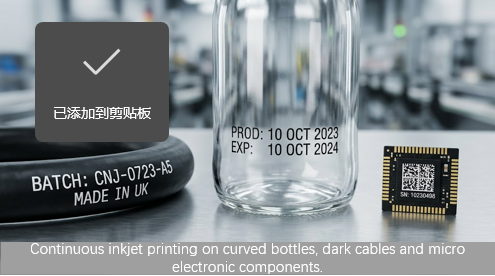
Standard CIJ is ideal for beverage and food bottles at standard speeds, handling dates and batch codes across 4 lines. When you need high-contrast white codes on dark bottles, cosmetic packaging, or micro-codes on small caps, a precision CIJ model with a 40 μm nozzle and opaque pigment ink support is required.
Cables and Extrusion
For standard cable marking at high speeds, standard CIJ handles the job efficiently. However, if you are marking dark PVC or rubber cables and need high-contrast white marks, precision CIJ with opaque white or yellow ink is the right choice. Precision models also handle micro-codes on small-diameter cables with accurate placement.
Electronics and Small Components
Electronics require precision. A precision CIJ model with a 40 μm nozzle can print micro-text as small as 0.6 mm on PCBs and connectors, and supports high-density 2D codes like Data Matrix and QR codes down to 10×10 modules. Standard CIJ is sufficient for larger electronic housings and standard batch codes.
Pharmaceutical and Food Packaging
For high-speed date coding on cartons and labels, standard CIJ provides the speed and reliability you need. If your packaging is dark and requires white codes, or if you need micro-codes on vials and small containers, precision CIJ with opaque inks is the better fit.
3. Meet the Meenjet CIJ Series
The Meenjet CIJ lineup is designed around two distinct production needs: standard high-speed coding and precision micro-coding.
The standard CIJ model (MX1890) is the workhorse for high-speed lines. It is built for speed, reliability, and ease of maintenance, featuring a 30-day standby with one-click restart that reduces downtime during seasonal shutdowns. It is the right choice for standard dates, batch codes, and up to 4 lines of text on standard substrates.
The precision CIJ model (MX2890) is the specialized tool for challenging applications. It features a 40 μm ruby nozzle capable of printing micro-text down to 0.6 mm, and supports opaque white and yellow pigment inks for high-contrast marking on dark surfaces. It is the ideal solution for electronics, dark cables, and complex packaging.
For full technical specifications, please visit the MX1890 product page and the MX2890 product page.
4. Cost & Maintenance Reality
CIJ is not a low-maintenance technology. It requires regular cleaning, solvent handling, and consumable replacement. Buyers should understand three realities.
First, ink and solvent consumption are ongoing costs. A standard CIJ model with a 750 ml ink cartridge prints approximately 8 million characters, or about 1 million production dates, with solvent consumption typically at 10 ml per hour. Precision models use 400 ml ink and 500 ml make-up, with consumption depending on print density and line speed.
Second, maintenance requirements are real. CIJ print heads must be cleaned regularly to prevent nozzle clogging, and solvent is consumed during startup, shutdown, and cleaning cycles. However, modern models mitigate this: the standard MX1890 offers 30-day standby with one-click restart to reduce solvent waste during idle periods, while the precision MX2890 features auto-sealing and self-cleaning to minimize manual intervention.
Third, total cost of ownership must be weighed against alternatives. Use the table below to compare CIJ with TIJ and laser for your specific scenario.
Factor | CIJ | TIJ | Laser |
Upfront cost | High | Moderate | High |
Consumables | Ink, solvent, make-up | Ink cartridges | None |
Maintenance | High | Low | Low |
Downtime risk | Medium to high | Low | Low |
Best for | High-speed, curved surfaces | Flat surfaces, low to medium volume | Permanent marks on metal and glass |
Rule of thumb: CIJ is the right choice when the line runs above 300 m/min, the surface is curved, or the code must be printed in white on a dark background. For flat surfaces and lower speeds, TIJ is more economical. For permanent marks on metal and glass, laser is better.
Frequently Asked Questions (FAQ)
Q1: What is the difference between standard and precision CIJ printers?
A: Standard CIJ printers focus on high speed (up to 480 m/min), standard inks, and up to 4 lines. Precision CIJ printers focus on micro-coding (40 μm nozzle, 0.6 mm text), opaque white/yellow inks, and up to 5 lines.
Q2: Can CIJ print white ink on dark cables?
A: Yes. Precision CIJ models support opaque pigment inks in white and yellow, making them suitable for high-contrast marking on dark PVC and rubber cables.
Q3: Do CIJ printers require daily maintenance?
A: CIJ printers require regular cleaning and solvent handling. Standard models offer 30-day standby with one-click restart, reducing maintenance during idle periods. Precision models feature auto-sealing and self-cleaning to minimize manual intervention.
Q4: Can CIJ print on curved surfaces?
A: Yes. CIJ is a non-contact printing method with a throw distance of 5–15 mm (standard) or 2–20 mm (precision), making it suitable for curved bottles, cables, and irregular surfaces.
Q5: What is the minimum order for a free line audit?
A: No minimum. Send us your line details and product samples, and our engineers will recommend the right CIJ setup.
???? Request a Free Line Audit
Send us your line details. Our engineers will:
Review your line speed, substrate, and coding requirements
Recommend standard CIJ, precision CIJ, TIJ, or laser
Provide a cost and configuration proposal
No obligation. Report delivered within 5 business days.
???? Request a Free Line Audit
Related Technical Resources
Online TIJ vs CIJ vs Laser: Which for Cartons, Bottles, and Film?
CIJ vs TIJ: Which Inkjet Printer Is Right for Your Business?
About the Author
Meenjet Application Engineering Team — Over 15 years of combined field experience supporting CIJ, TIJ, and laser installations across food and beverage, pharmaceuticals, cable and pipe, electronics, and logistics. Our team has resolved hundreds of substrate compatibility and line integration challenges.
Reviewed by: Senior Application Engineer, Meenjet
Last Updated: October 23, 2026