




News & Blogs
Solve Scannability Failures: An Engineering Guide to Surface Energy, MEK Solvents, and Consumable-Free UV Laser Marking
⚡ Executive Summary
Facing QR code rub-off or smudging on HDPE containers? The fix depends on your line speed and budget:
Slow / Intermittent lines : Switch to high-adhesion MEK-based solvent inks (Cheapest upfront investment).
High-speed lines : Add Flame/Corona pre-treatment before your CIJ printer (Balanced performance).
Zero-defect chemical & pharma lines: Upgrade to a 355nm UV Cold Laser (Highest long-term ROI with zero consumables).
???? Table of Contents
1. The Root Cause: The "Dyne Level" Trap
2. The 3 Industrial Solutions to Fix HDPE Adhesion
3. Decision Matrix: Which Solution Fits Your Line & Budget?
4. Engineering Checklist for Grade A HDPE Code Scannability
5. Frequently Asked Questions (FAQ)
6. Free Sample Testing Evaluation (CTA)
1. The Root Cause: The "Dyne Level" Trap
Why do lot numbers and DataMatrix codes rub off HDPE bottles, agrochemical drums, and extruded pipes so easily? It comes down to three physical and chemical challenges on your packaging line:
Obstacle 1: The Surface Energy Deficiency
Think of HDPE like a freshly waxed car hood—water beads up and rolls right off. Printed marks do the exact same thing because untreated HDPE has a surface energy well below .
The Engineering Rule: For liquid inks or surface coatings to stick properly, you need at least . Below that threshold, ink cannot "wet" the surface; it sits on top, dries into a brittle film, and flakes off at the first touch of a conveyor guide rail.
Obstacle 2: Mold Release Agents & Plasticizers
Blow-molded HDPE containers retain microscopic layers of mold release wax or internal slip agents. This creates a chemical barrier that repels standard water-based or low-solvent inks.
Obstacle 3: Thermal Expansion vs. Rigid Markings
HDPE expands when hot-filled or stored outdoors. Inflexible ink layers fail to flex with the container walls, leading to micro-cracking and eventual code loss under transport friction.
2. The 3 Industrial Solutions to Fix HDPE Adhesion
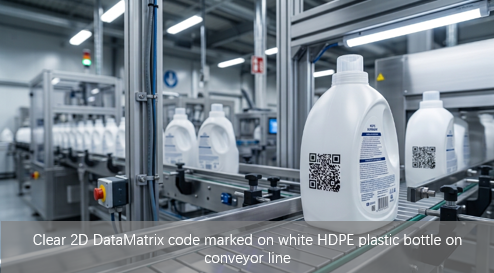
Figure 1: High-contrast 2D DataMatrix code on an HDPE bottle traveling on a conveyor line, achieving ISO/IEC 15415 Grade A scannability after fixing surface adhesion issues.
Option A: High-Adhesion Solvent Inks (TIJ / CIJ)
How It Works: Uses aggressive fast-drying MEK (Methyl Ethyl Ketone) or modified ethanol-based solvent inks that slightly etch the micro-surface of the HDPE, anchoring pigments into the plastic matrix.
Best Used For: Intermittent production lines, offline packaging stations, and seasonal short runs.
Limitations: Requires a minimum drying time of 1–2 seconds before hitting conveyor rails.
Option B: Corona / Flame Pre-treatment + Inkjet Coding
How It Works: Passing the HDPE bottle through a localized flame or electrical corona discharge oxidizes surface molecules, temporarily boosting surface tension from to .
Best Used For: High-speed 24/7 bottling lines using Continuous Inkjet (CIJ) printers.
Limitations: Adds physical equipment footprint, energy costs, and maintenance complexity to the line.
Option C: 355nm UV Cold Laser (The Zero-Consumable Solution)
How It Works: While CO₂ lasers melt HDPE into unreadable, burnt bubbles (a common mistake we see in the field), a 355nm UV Cold Laser triggers a photochemical reaction. Rather than relying on surface energy, it creates a crisp, high-contrast dark or white color change inside the polymer matrix itself.
Best Used For: Agrochemical drums exposed to sunlight, pharma vials requiring sterile compliance, and high-speed pipe extrusion.
Why Engineers Prefer It: The mark becomes part of the plastic container. It is 100% permanent, weather-proof, and chemical-resistant, completely eliminating recurring ink costs and code rub-off risks.
3. Decision Matrix: Which Solution Fits Your Line & Budget?
???? How to use this matrix: Not sure which technology applies to your line? Start with your annual production volume, line speed, and shift schedule—then match across to compare capital costs vs. long-term operating expenses.
Scenario / Goal | Recommended Tech | Why? | Capital Cost | Operating Cost |
Seasonal / Low-Volume Lines | High-Adhesion Solvent Ink (TIJ) | No line retrofitting; fast cartridge swap. | Very Low | Moderate (Ink cartridges) |
High-Speed Beverage Bottling | Corona Pre-treatment + CIJ | Corona raises Dyne levels so standard CIJ ink sticks fast. | Moderate | Moderate (Ink & Make-up) |
Outdoor HDPE Pipes / Chemical Drums | 355nm UV Cold Laser | Solvents degrade under UV light; laser marks are weatherproof. | Higher | Zero (No consumables) |
Pharma Vials / Zero-Defect Quality | 355nm UV Cold Laser | Guarantees zero micro-cracks, zero smudging, ISO Grade A codes. | Higher | Zero (Full ROI in 12–18 mo) |
4. Engineering Checklist for Grade A HDPE Code Scannability
Follow these field steps to ensure your 2D DataMatrix and QR codes pass ISO/IEC 15415 optical verification:
Run a Dyne Pen Test: Use a Dyne test pen on your untreated HDPE bottles to verify if mold release agents are blocking surface adhesion.
Eliminate Rail Friction: Ensure containers travel undisturbed for at least 3 seconds post-printing before contacting turn tables or side-guide rails.
Calibrate Laser Focal Depth: When using a UV laser on curved HDPE containers, adjust the dynamic 3D galvano scanner to maintain focus within .
5. Frequently Asked Questions (FAQ)
Q1: Can I use a Fiber Laser (1064nm) to mark HDPE plastic bottles?
A: Natural or un-pigmented HDPE is translucent to 1064nm fiber wavelengths; the laser beam will pass straight through without creating a mark. While fiber lasers can mark dark-pigmented HDPE with special additives, they tend to cause rough thermal swelling. A 355nm UV cold laser is universally recommended for clean, damage-free marks on all HDPE colors.
Q2: CIJ vs TIJ vs Laser: Which is easiest to maintain on an HDPE line?
A: TIJ solvent printers require the least maintenance (just wipe the printhead or swap cartridges). UV Lasers require near-zero daily maintenance since they use no fluids or nozzles. CIJ printers require the most maintenance due to fluid viscosity monitoring and line flushing.
Q3: Why is solvent ink still smudging on my blow-molded jugs?
A: Smudging usually indicates that the mold release wax on the jug is too thick, or your conveyor speed doesn't allow the solvent to evaporate fully before hitting guide rails. Installing a brief flame pre-treatment jet or switching to a faster MEK solvent formula will fix this immediately.
6. Free Sample Testing Evaluation
???? Get Your Free HDPE Sample Test
Not sure if your current marking method will pass the scratch or drop test?
Send us 5 empty HDPE containers from your line. Our application engineers will run a complimentary Dyne test and 355nm UV laser marking evaluation, returning a 24-hour video report with complete adhesion results—no obligation.
???? Request Your Free HDPE Sample Test Now (Contact Engineering Team)
???? Explore Our Material Traceability Matrix
Encountering QR code scannability issues on other industrial substrates? Read our technical engineering guides:
???? Glass Containers & Vials: UV Laser Coding for Glass Vials: Solving Readability & No-Read Errors
???? Metal Substrates & DPM: Fiber Laser vs Micro-Percussion: Fixing High-Reflectivity Metal DPM Failures
???? PCB Circuit Boards: High-Scannability Micro QR Code Marking on PCB Boards
???? Flexible Films & Plastic Packaging: Improving QR Code Scannability on Flexible Films and Soft Plastics