



News & Blogs
Solve Scannability Failures: An Engineering Guide to Pigmented Inks, Surface De-oiling, and UV Laser Marking on Extruded Elastomers
⚡ Executive Summary
Facing low-contrast or smudging DataMatrix codes on black rubber, EPDM hoses, or extruded automotive seals? The solution depends on your production environment and budget:
High-speed extrusion lines: Use Continuous Inkjet (CIJ) with High-Contrast Pigmented Inks (White/Yellow) (Proven industry standard).
Offline packaging & small batch hoses: Use Thermal Inkjet (TIJ) with Fast-Drying White Solvent Inks (Low upfront cost, zero solvent maintenance).
Zero-consumable & high-temperature lines: Upgrade to a 355nm UV Cold Laser (Creates a permanent contrast change inside the elastomer matrix).
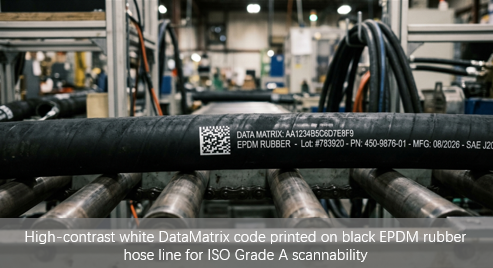
1. The Triple Challenge: Why Marking Black Rubber Is Hard
Marking lot numbers, GS1 DataMatrix codes, and part tracking numbers on EPDM (Ethylene Propylene Diene Monomer) hoses, brake lines, and rubber extrusion profiles presents three distinct physical obstacles that differ significantly from standard plastic wire jacketing:
The Zero-Contrast Trap (Carbon Black Absorption): Industrial rubber relies heavily on carbon black pigment for structural integrity and UV resistance. Standard black dye-based inks absorb completely into the dark substrate, yielding 0% optical contrast under machine vision scanners.
Plasticizer Migration & Oily Exudation: As EPDM exits the vulcanization or hot-water cooling trough, plasticizers, waxes, and processing oils continuously migrate to the surface. This forms a hydrophobic, slippery microscopic film that prevents standard inks from bonding, causing codes to smear immediately upon contact with drive belts or coiling reels.
Dynamic Bending & Flexural Stress: Unlike rigid PVC pipes or thin wire jackets, rubber hoses experience substantial dimensional expansion under pressure and high flexural strain during coiling. Rigid ink films lacking specialized cross-linking resins will micro-crack and flake off during transport.
2. The 3 Technical Solutions for High-Scannability Codes
Option A: Continuous Inkjet (CIJ) with Pigmented Inks (White / Yellow)
How It Works: Pigmented CIJ systems use opaque titanium dioxide or chrome yellow pigment particles suspended in fast-evaporating solvent carriers. Equipped with continuous hydraulic agitation loops, these systems prevent heavy pigment particles from settling at the bottom of the reservoir.
Best Used For: High-speed, continuous extrusion lines running 24/7.
Key Advantage: Instant drying times allow the mark to set before hitting coiling tables or guiding rollers.
Option B: Thermal Inkjet (TIJ) with White Solvent Inks
How It Works: High-resolution cartridge-based TIJ systems throw fast-drying white MEK or ethanol solvent inks directly onto the substrate via high-density micro-nozzles.
Best Used For: Intermittent hose marking, offline manual stations, off-line rework, and short batch runs.
Key Advantage: Zero hydraulic pumps or solvent makeup fluids. Maintenance is as simple as swapping out a spent white solvent cartridge.
Option C: 355nm UV Cold Laser Marking (The Consumable-Free Solution)
How It Works: Unlike CO₂ or Fiber lasers that thermally melt rubber into unreadable, sticky carbonized char, a 355nm UV Cold Laser breaks molecular bonds photochemically. It induces a controlled photochemical reaction with titanium dioxide or vulcanization additives inside the rubber matrix, generating a bright, high-contrast light grey/white mark.
Best Used For: High-temperature automotive cooling lines, hydraulic hoses, and medical-grade elastomer tubing requiring 100% permanent, chemical-proof traceability.
Why Engineers Prefer It: Zero ink costs, zero nozzle clogging from dust, and absolute resistance to hydraulic oils, brake fluids, engine heat, and high-pressure washing.
3. Decision Matrix: Pigmented Inks vs. UV Laser Marking
Feature / Metric | CIJ Pigmented Inkjet | TIJ White Solvent | 355nm UV Cold Laser |
Max Line Speed | Ultra-Fast | Moderate | Fast |
Contrast on Black EPDM | High (Vibrant White/Yellow) | High (Vibrant White) | Sharp Light Grey-White |
Bending & Flex Scratch Resistance | Good (Requires resin-rich ink) | Moderate | Maximum (Part of substrate) |
Chemical & Oil Resistance | Moderate | Moderate | 100% Permanent |
Initial Equipment Investment | Moderate | Low | Higher |
Consumables & Maintenance | High (Inks, makeup, agitation filter) | Low (Cartridges only) | Zero Consumables |
4. Engineering Checklist for ISO Grade A Readability on EPDM
To achieve ISO/IEC 15415 Grade A scannability on curved, oil-exudating rubber profiles, apply these three line adjustments:
Step 1: Install High-Pressure Air Knives Prior to Printing
Mount a dual-slot air knife right after the cooling water bath to blow off standing water and strip away superficial wax exudation before the substrate enters the marking zone.
Step 2: Utilize F-Theta Long Focal Depth Lenses (Laser Setup)
When marking 2D DataMatrix codes on small-diameter curved hoses, utilize an F-theta lens with an expanded focal depth to prevent optical defocus and edge distortion at the outer margins of the code.
Step 3: Verify Adhesion via Dyne Testing
Ensure the surface energy of the treated rubber surface reaches at least 38–40 dynes/cm to guarantee solvent ink wetting and cross-linking adhesion.
5. Frequently Asked Questions (FAQ)
Q1: Can I use a standard Fiber Laser (1064nm) to mark black EPDM rubber?
A: Standard Fiber lasers generate intense localized thermal heat that melts black rubber, producing sticky, carbonized black marks with virtually zero contrast. A 355nm UV Cold Laser or specialized pigmented inkjet is required for light-on-dark contrast.
Q2: How do I prevent white CIJ ink from settling when the line pauses?
A: Ensure your CIJ system features an automated ink recirculation and agitation program that runs even in standby mode. If your production line experiences frequent long shutdowns, a TIJ solvent printer or 355nm UV laser eliminates nozzle settlement completely.
Q3: Will hydraulic fluid or engine heat degrade white inkjet codes on rubber hoses?
A: Standard dye or general-purpose solvent inks will dissolve when exposed to glycol, engine oil, or high heat. You must specify a specialized resin-fortified cross-linking white ink or utilize a UV cold laser, which creates an indelible mark immune to fluid degradation.
???? Get Your Free Rubber & Hose Sample Test
Struggling with low contrast or code smudging on your elastomer extrusion line?
Send us a sample of your black rubber or EPDM hose material. Our application engineers will evaluate surface energy, test white pigmented inks and 355nm UV lasers, and return a comprehensive 24-Hour Sample Verification Report with ISO Grade A scannability scores.
???? Request Your Free Hose Marking Sample Test (Contact Engineering Team)
???? Explore Our Material Traceability Matrix
Looking for high-contrast coding solutions across other dark or challenging industrial substrates? Explore our technical guides:
???? Dark Wires & Cables: How to Achieve High-Contrast Coding on Dark-Colored Wires and Cables
???? HDPE Plastics & Containers: How to Fix HDPE Code Rub-Off in 3 Steps: Adhesion, Dyne Testing & UV Lasers
???? Metal & DPM Marking: How to Mark High-Scannability DPM QR Codes on Metal
???? PCB Circuit Boards: How to Print Micro QR Codes on PCB Boards That Always Scan Successfully