




News & Blogs
An Engineering Guide to Laser Substrate Interaction, Wavelength Selection (1064nm MOPA vs. 355nm UV), and Achieving ISO/IEC 15415 Grade A DPM Scannability
???? Executive Summary (Quick Reader's Guide)
Direct Part Marking (DPM) of barcodes on anodized aluminum requires balancing optical contrast and oxide layer integrity:
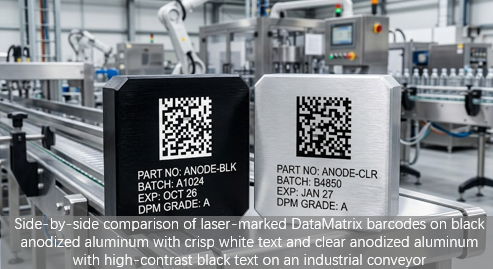
Black & Dark Anodized: Best processed using MOPA Fiber Lasers (1064 nm) with short pulse widths to selectively ablate or bleach organic pigments, producing brilliant white marks ( cell contrast).
Clear & Natural Anodized: Requires sub-surface thermal transformation using MOPA Fiber (high frequency, narrow pulse) or photochemical processing via UV Lasers (355 nm) to generate dense black marks without penetrating the anodic oxide barrier.
1. The Engineering Challenge: Optical Contrast vs. Corrosion Resistance
Anodized aluminum components are ubiquitous in aerospace, automotive, electronics, and medical device manufacturing. However, printing scannable 2D DataMatrix or GS1 barcodes directly on anodized surfaces poses a classical engineering trade-off:
Substrate Reflectivity Differential: Standard optical 2D barcode readers calculate contrast based on specular reflection. Natural silver anodizing scatters light uniformly, causing low reflectance difference () if the mark is not deeply oxidized.
Micro-Pores & Corrosion Layer Breach: Traditional long-pulse Q-switched lasers deliver heavy thermal shock, fracturing the sealed layer ( thick). This exposes raw aluminum to air, leading to salt spray test failure (ASTM B117) and chemical oxidation over time.
2. Selection Matrix: Black Anodized vs. Clear Natural Anodized
Different surface colors require completely inverse marking mechanisms to achieve Grade A/B scannability.
Strategy A: Black & Dark Anodized Aluminum (White-on-Dark Markings)
On dark backgrounds, high contrast is achieved by generating a crisp white or bright silver code cell.
Mechanism: Selective thermal bleaching or ultra-shallow surface ablation of sealed organic/inorganic pigments within the anodic pores.
Optimal Laser: MOPA Fiber Laser (1064 nm) with pulse width tuned to .
Key Advantage: Short nanosecond pulses restrict the Heat-Affected Zone (HAZ), preventing localized melting or yellowing around the code cell edges.
Strategy B: Clear & Natural Anodized Aluminum (Black-on-Light Markings)
On silver or clear anodized backgrounds, barcode scanners demand a high-density, non-reflective black mark.
Mechanism: Sub-surface thermal carbonization/oxidation directly beneath or inside the oxide layer without altering surface roughness.
Optimal Laser: Short-Pulse MOPA Fiber Laser or UV Cold Laser (355 nm).
Key Advantage: UV photons directly break chemical bonds via photochemical reaction rather than photothermal melting, keeping the outer oxide layer 100% intact.
3. Technology Comparison: MOPA Fiber Laser vs. UV Laser vs. CIJ
Technical Parameter | MOPA Fiber Laser (1064 nm) | UV Laser (355 nm) | Continuous Inkjet (CIJ) |
Marking Mechanism | Photothermal / Pulse Bleaching | Photochemical / Cold Processing | Solvent Ink Adhesion |
Mark Contrast (Black Anodized) | Superior (Chalk White) | Good (Light Grey) | Moderate (White Ink) |
Mark Contrast (Clear Anodized) | Excellent (Dark Black) | Superior (Deep Matte Black) | Poor (Low contrast on silver) |
Oxide Layer Breach Risk | Low (When pulse ) | Zero (100% Intact Surface) | None (Surface Addition) |
Barcode Grade (ISO 15415) | Grade A / B | Grade A | Grade C / D |
Consumables & Maintenance | Zero Consumables | Zero Consumables | High Ink/Solvent Costs |
???? For Procurement & Process Engineering:
While both MOPA fiber lasers and UV lasers achieve ISO Grade A barcodes on anodized aluminum, MOPA systems typically offer 20–30% lower CapEx and higher marking speeds for black-anodized components. Conversely, UV lasers are preferred for clear-anodized medical implants where zero thermal stress is strictly mandated. Request a free laser sample test to calculate your cost-per-part on actual production samples.
4. Laser Parameter Optimization for ISO/IEC 15415 Grade A Barcodes
To consistently achieve Grade A 2D DataMatrix and QR code verification scores, laser beam parameters must be tuned to eliminate cell edge bleed and grid non-uniformity.
Recommended Baseline Parameters (Black Anodized Aluminum)
Laser Source: 20W – 30W MOPA Fiber Laser
Wavelength: 1064 nm
Pulse Width: 8 ns - 15 ns (Prevents thermal substrate burn)
Frequency (Repetition Rate): 50 kHz - 200kHz (Balanced peak power for vibrant bleaching)
Marking Speed: 1200 mm/s - 2200 mm/s
Hatch Line Distance: 0.02 mm - 0.03 mm
Recommended Baseline Parameters (Clear Anodized Aluminum)
Laser Source: 20W MOPA Fiber Laser OR 5W–10W UV Laser (Higher UV wattage needed for >100mm/s flying lines)
Wavelength: 1064 nm (MOPA) / 355 nm (UV)
Pulse Width: 2 ns - 6 ns (MOPA) / < 10ns (UV)
Frequency: 200 kHz -400 kHz
Marking Speed: 500 mm/s - 900mm/s
Hatch Line Distance: 0.015mm - 0.02mm
5. Frequently Asked Questions (FAQ)
Q1: Does laser barcode marking degrade the salt spray corrosion resistance of anodized aluminum?
A: Standard Q-switched fiber lasers with long fixed pulses () generate high thermal heat that fractures the anodic layer, causing rapid oxidation in salt spray tests. However, using a MOPA fiber laser with narrow pulse widths or a 355 nm UV laser alters surface optics within the coating layer without breaching the substrate barrier, successfully passing 96-hour ASTM B117 salt spray testing.
Q2: Why are standard Q-switched fiber lasers ineffective for clear anodized aluminum?
A: Standard Q-switched lasers lack pulse width adjustment. Their long pulse durations deliver excessive energy per pulse, ablating the clear anodic coating and turning the raw aluminum into a rough, low-contrast grey mark rather than a smooth, non-reflective black barcode.
Q3: How do I eliminate cell edge bleed on ultra-small 2D DataMatrix codes?
A: Reduce the hatch spacing to, increase pulse frequency, and lower pulse duration to under . Ensure the laser optical setup uses a high-precision F-theta lens with a small focal spot diameter.