




News & Blogs
By Meenjet Application Engineering Team | November 25, 2026
Executive Summary
Large injection molds, die-casting tools, and progressive stamping dies are high-value capital assets that often weigh several tons. While initial part numbers are typically engraved during tool fabrication, a significant share of marking happens on the shop floor: adding revision numbers (Rev IDs) after cavity polishing, updating shot-count intervals, or applying high-contrast DataMatrix codes for automated asset tracking. Moving a 5-ton steel mold onto a stationary benchtop laser workstation is impractical, and adhesive labels or ink codes fail immediately under molding temperatures, hydraulic oil, and release agents.
This guide covers portable 1064 nm fiber laser marking for heavy tooling. It examines three engineering variables: marking hardened tool steels (H13, P20, S136) without inducing mechanical stress, surviving extreme thermal and chemical operating environments, and why a semiconductor laser is insufficient for deep engraving on hardened dies.
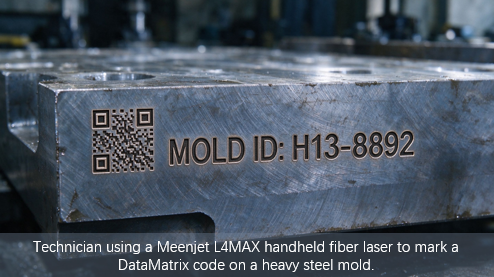
???? Quick Reference for Tooling Engineers & Maintenance Managers
Question | Technical Answer |
Can a portable fiber laser mark hardened tool steels? | Yes. A 1064 nm fiber laser (such as the Meenjet L4MAX) marks hardened steels including H13, P20, S136, and cemented carbide without physical contact. |
Why not use dot peen or manual steel stamps on molds? | Mechanical impact creates localized stress concentrations and micro-cracks in hardened steel (48–58 HRC), risking premature fatigue failure in precision tooling. |
Will laser marks survive release agents and high molding temperatures? | Yes. Laser engraving or annealing alters the metal surface directly, withstanding temperatures above 200 °C, mold cleaners, and continuous friction. |
Why not use a semiconductor laser for hardened steel? | A 450 nm semiconductor laser only produces a shallow surface anneal. It cannot penetrate hardened tool steel, and the mark will be removed by the first polishing cycle. |
Can it operate away from power outlets on the press floor? | Yes. While standard power is 220V/50Hz, the L4MAX supports an optional 11,600 mAh detachable battery for cordless operation. |
1. Why Mold and Die Traceability Fails Without On-Site Marking
In automotive (IATF 16949) and medical device (ISO 13485) manufacturing, every tool requires full lifecycle traceability. When a toolmaker polishes a worn cavity, replaces a core insert, or modifies a gate, the mold's revision status changes. Relying on paper travelers, hanging metal tags, or solvent ink leads to lost history and costly production errors—such as running an outdated mold revision on a press.
A portable laser marker allows engineers to update permanent identification directly on the mold base in seconds.
Factor | Traditional Methods (Tags, Ink, Dot Peen) | Portable 1064 nm Fiber Laser |
Workflow | Transport mold to bench or attach loose tags | Bring the handheld laser head directly to the mold |
Mechanical Stress | High impact (dot peen/stamping) risks micro-cracks | Non-contact, zero mechanical stress on hardened steel |
Thermal & Chemical | Ink dissolves in mold release; tags tear off | Permanent metallurgical mark; immune to heat and solvents |
Setup Time | Crane rigging or mechanical fixture clamping | Red-light alignment; mark completed in under 10 seconds |
Key insight: A heavy mold cannot easily travel to a fixed marking station. Bringing a 1064 nm fiber laser head directly to the mold eliminates crane rigging delays while preserving strict revision control.
2. Challenge 1: Marking Hardened Tool Steels Without Stress
Tooling components are typically machined from pre-hardened or heat-treated alloys such as H13, P20, D2, S136, and cemented carbide. Once heat-treated to 48–58 HRC, these metals resist conventional mechanical scribing and stamping.
Controlled Engraving vs. Annealing
Depending on the required durability and the specific tool steel, a 1064 nm fiber laser supports two distinct marking modes:
Deep Engraving (0.05–0.1 mm depth): For mold bases and die shoes subjected to heavy abrasive wear, ensuring the code survives multiple resurfacing cycles.
Surface Annealing: For stainless mold steels (such as S136) where surface smoothness must remain undisturbed, producing a high-contrast dark mark without material removal.
Because the laser beam vaporizes or oxidizes a microscopic surface layer without physical contact, it introduces zero mechanical shock—protecting tight dimensional tolerances near parting lines and cooling channels. (Note: Never mark on critical forming surfaces or active cavities without an engineering assessment.)
Key insight: On precision dies, how you mark is just as critical as what you mark. Non-contact fiber laser processing protects structural integrity on high-HRC tool steels where mechanical stamping creates failure points.
3. Challenge 2: Surviving Heat, Oil, and Maintenance Cycles
Molds operate in harsh thermal and chemical cycles. During injection or die-casting runs, surface temperatures regularly exceed 80–200 °C, accompanied by pressurized hydraulic fluids, silicone mold releases, and cleaning protocols.
Inkjet codes wash away during routine degreasing. Laser-etched marks remain legible even after repeated cleaning. Furthermore, automated tool cribs rely on handheld barcode scanners to log molds in and out of presses. By adjusting pulse frequency and marking speed (up to 12,000 mm/s), a fiber laser produces crisp, high-contrast 2D DataMatrix codes that scan reliably even under a thin film of shop oil.
Key insight: Durability is decided by the marking method. A code that survives the press but fails the degreaser is not a traceable code.
4. Challenge 3: Ergonomics and Positioning on Oversized Tooling
Marking a 10-ton progressive stamping die presents a physical access problem. The surface may be a vertical side wall, inside a recessed clamping slot, or a cylindrical ejector plate.
Engineering Design for Shop-Floor Access
Tethered Lightweight Laser Head: The Meenjet L4MAX separates the 7-inch touchscreen controller from the ergonomic handheld laser head via a 1.75 m armored cable. Operators can maneuver the head around hoists, manifolds, and press tie-bars.
Red-Light Alignment & ±3 μm Repeatability: Built-in red-light positioning projects the exact boundary onto the mold face before firing, ensuring straight alignment on narrow mold plates without trial runs.
Cordless Flexibility: An optional 11,600 mAh detachable battery enables engineers to walk down rows of presses and audit installed molds without running extension cords.
Key insight: Effective shop-floor marking requires separating the heavy power source from the handheld optics. A tethered, armor-protected laser head gives toolmakers the reach needed to mark installed dies safely.
5. When Fiber Laser Is the Only Option
Throughout the three challenges above, one engineering conclusion becomes clear: on hardened tool steel, the laser source determines whether the mark survives the tool's lifecycle. A 450 nm semiconductor laser—regardless of its power rating—produces only a surface anneal on H13 or P20, and that mark is removed by the first polishing cycle.
For heavy molds and stamping dies, a 1064 nm fiber laser is the required configuration.
The Meenjet L4MAX is built for this scenario. It pairs a lightweight handheld laser head with a separate controller via a 1.75 m armored cable, allowing the operator to reach into press openings, recessed clamping slots, and deep mold cavities. The built-in red-light alignment projects the exact marking boundary before firing, and the ±3 μm repeat positioning accuracy keeps the code aligned on narrow mold plates.
For power selection on tool steel:
10W / 20W: Standard surface marking and annealing on carbon steel and P20 mold bases.
30W / 50W: Deeper engraving on hardened H13, D2, and cemented carbide dies, ensuring the mark remains visible after heavy wear or light resurfacing.
For factory assets that do not involve hardened steel—such as anodized aluminum tags, wooden inspection jigs, or packaging crates—a 450 nm semiconductor laser is a practical alternative. But for the mold base itself, the fiber laser is not an upgrade; it is the baseline requirement.
Frequently Asked Questions (FAQ)
Q1: Which laser power (20W, 30W, or 50W) should I choose for hardened mold steel?
A: For high-contrast surface marking on P20 or carbon steel mold bases, 20W is sufficient. If your process requires deeper engraving on hardened H13 or cemented carbide dies so marks remain visible after light resurfacing, choose 30W or 50W.
Q2: Will laser marking damage the mold surface?
A: At controlled depth (under 0.1 mm), fiber laser marking does not introduce stress concentrations or micro-cracks. The process should be validated on a sample of the actual mold steel before production. Never mark on critical forming surfaces without an engineering assessment.
Q3: Can the L4MAX mark cylindrical mold components?
A: Yes. Within its focal depth tolerance, the L4MAX marks curved surfaces such as large steel rollers and round die housings. Using the red-light indicator helps verify proper working distance before triggering the laser.
Q4: Does the L4MAX require consumables or water cooling?
A: No. The L4MAX uses an air-cooled solid-state fiber laser source rated for ≥100,000 working hours. It requires zero ink, solvents, or external water chillers, minimizing maintenance in dusty tool rooms.
???? Request a Free Sample Test on Your Tool Steel
Send us a coupon or scrap block of your actual tooling material—H13, P20, S136, carbon steel, or cemented carbide—along with the DataMatrix or text specifications you need to mark. Our application engineers will:
Test 20W, 30W, and 50W fiber laser parameters on your exact alloy.
Measure engraving depth, contrast, and 2D barcode scan grades.
Recommend the optimal L4MAX configuration and lens setup.
No obligation. Comprehensive test report delivered within 5 business days.
???? Request a Free Sample Test
Related Technical Resources
Handheld Laser vs. Handheld TIJ: Which Portable Tool for Which Surface?
Black Annealing on Stainless Steel with Fiber Lasers: Achieving Permanent High-Contrast Marks
About the Author
Meenjet Application Engineering Team — Over 15 years of combined field experience supporting industrial laser, CIJ, and TIJ installations across automotive tooling, metal fabrication, and heavy manufacturing.
Reviewed by: Senior Laser Application Engineer, Meenjet
Last Updated: November 25, 2026