



News & Blogs
By Meenjet Application Engineering Team | October 10, 2026
Executive Summary
Both handheld laser markers and handheld Thermal Inkjet (TIJ) printers are portable, battery-powered, and designed for on-site marking. But they work on completely different physical principles—and choosing the wrong one can mean wasted investment or unreadable codes.
The short answer: Handheld laser is for permanent marks on hard surfaces—including metal, coated metal, and certain non-metals. Handheld TIJ is for ink-based codes on porous or heat-sensitive surfaces. If you need both capabilities, you need both tools.
This guide compares the two technologies across material compatibility, mark durability, cost structure, and use case—so you can specify the right tool before purchase.
???? For Procurement & Field Operations Managers
Question | Answer |
Which works on metal? | Handheld laser (fiber type). Handheld TIJ cannot mark bare metal without a coating. |
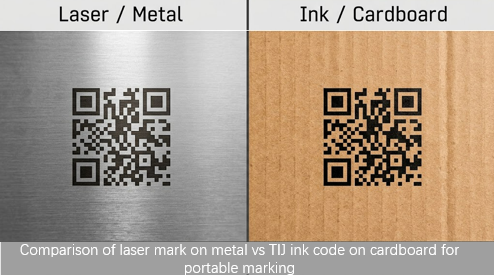
Which works on cardboard? | Both work, but handheld TIJ is faster and lower cost for paper-based materials. |
Which is permanent? | Laser marks are permanent (no ink to rub off). TIJ marks are durable but can be removed with solvents. |
Which has ongoing costs? | TIJ requires ink cartridges. Laser requires no consumables. |
Which is faster? | TIJ is faster for large text on porous surfaces. Laser is faster for small, high-precision marks on metal. |
Which costs less upfront? | Handheld TIJ. Laser costs more but eliminates consumable costs over time. |
1. The Fundamental Difference: Ink vs Light
Principle | Handheld TIJ | Handheld Laser |
Marking medium | Ink droplets | Focused light beam |
Contact | Non-contact | Non-contact |
How the mark forms | Ink bonds to surface | Laser modifies surface (oxidation, annealing, or ablation) |
Consumables | Ink cartridges | None |
Surface heat | None | Minimal to moderate (depends on laser type) |
Key insight: Handheld TIJ adds material to the surface. Handheld laser changes the surface. This single difference explains almost every other contrast in this guide.
2. Material Compatibility: Where Each Tool Works
Material | Handheld TIJ | Handheld Laser |
Cardboard / carton | ✅ Excellent | ✅ Good (CO₂ type; semiconductor laser also works) |
Paper / labels | ✅ Excellent | ???? May char or burn |
Wood (raw) | ✅ Good | ✅ Excellent |
Wood (coated) | ???? Ink may not adhere | ✅ Good |
Plastic (HDPE, ABS, PVC) | ✅ Good with solvent ink | ✅ Good (fiber laser on dark plastics) |
Bare metal (steel, aluminum) | ❌ Not without coating | ✅ Excellent (fiber laser) |
Coated metal | ✅ Good | ✅ Excellent |
Anodized aluminum | ???? Limited contrast | ✅ Excellent |
Glass | ???? Ink adhesion issues | ???? Depends on laser type; semiconductor laser works on dark glass |
Rubber / silicone | ???? Ink adhesion issues | ✅ Good |
Rule of thumb: If the surface is porous (paper, cardboard, raw wood), TIJ is usually the faster and cheaper choice. If the surface is metal or hard plastic, laser is usually the only reliable option.
Laser types explained: Semiconductor lasers (450 nm) work best on non-metals, coated metals, and certain stainless steels. Fiber lasers (1064 nm) are required for bare metals such as carbon steel, aluminum, copper, and cemented carbide.
Product mapping:
L4 PRO / L4 Ultra (semiconductor laser, 450 nm): wood, coated metal, stainless steel, marble, leather, dark acrylic, felt, fabric, rubber, cardstock, ceramic, painted metal, anodized metal
L4 MAX (fiber laser, 1064 nm): stainless steel, carbon steel, anodized aluminum, aluminum alloys, copper-iron alloys, copper, iron, cemented carbide, HDPE, ABS, PVC, PES, stone
3. Mark Durability: What Survives Handling and Exposure
Durability Factor | Handheld TIJ | Handheld Laser |
Friction / rubbing | Durable with solvent ink | Permanent |
Water / moisture | Depends on ink type | Permanent |
Solvents / chemicals | Removable with solvent | Permanent |
UV / sunlight | May fade over time | Permanent |
High temperature | Ink may degrade | Permanent |
Key insight: Laser marks become part of the material. They cannot be wiped off, dissolved, or worn away. TIJ marks are durable but not indestructible—they can be removed with the right solvent.
When this matters: For traceability applications where marks must survive years of exposure or repeated handling, laser is the safer choice. For short-life packaging or internal logistics codes, TIJ is sufficient.
4. Speed and Throughput
Factor | Handheld TIJ | Handheld Laser |
Best for | Large text, batch codes, 1D/2D barcodes | Small, high-precision marks |
Typical mark time | 2–4 seconds per carton | 3–8 seconds per metal part (depends on content) |
High-volume suitability | ✅ For porous surfaces | ✅ For metal parts |
Multi-line text | ✅ Fast | ???? Slower (galvo scanning) |
Key insight: TIJ excels when marking large amounts of text on porous surfaces at speed. Laser excels when marking small, high-contrast codes on metal—especially where permanence matters more than speed.
Note on galvo scanning: Handheld laser markers use a galvo mirror system to steer the laser beam across the marking area. The beam moves in a precise pattern, which is slower than inkjet for large text but far more accurate for fine 2D codes.
5. Cost Structure: Upfront vs Ongoing
Cost Factor | Handheld TIJ | Handheld Laser |
Equipment cost | Lower | Higher |
Consumables | Ink cartridges | None |
Maintenance | Cartridge replacement | Minimal (no moving parts in the beam path) |
Cost per mark | Depends on ink usage | Near zero after purchase |
Break-even point | — | Typically 12–24 months at moderate volume |
Key insight: If your annual marking volume is low (under 10,000 marks), TIJ usually has lower total cost. If your volume is high and ongoing, laser's zero-consumable model delivers lower total cost of ownership.
6. When to Choose Each Tool
Scenario | Recommended Tool |
Metal parts, pipes, steel beams | Handheld laser (fiber) |
Cardboard cartons, pallets, sacks | Handheld TIJ |
Wood, leather, fabric, ceramics | Handheld laser (semiconductor) |
Batch codes on paper labels | Handheld TIJ |
Permanent marks for traceability | Handheld laser |
Multi-color marks (white, yellow, black) | Handheld TIJ |
Small, high-precision 2D codes on metal | Handheld laser (fiber) |
Fast large-text marking on cartons | Handheld TIJ |
No consumables, high-volume operation | Handheld laser |
7. Meenjet's Handheld Portfolio
Product Line | Models | Best For |
Handheld TIJ | M6, M7, M9 | Cartons, pallets, sacks, paper, porous surfaces |
Handheld Semiconductor Laser | L4 PRO, L4 Ultra | Wood, coated metal, stainless steel, leather, fabric, dark acrylic |
Handheld Fiber Laser | L4 MAX | Steel, stainless steel, aluminum, copper, cemented carbide, HDPE, ABS, PVC |
L4 MAX key specifications:
Fiber laser, 1064 nm
Power: ≥10W / 20W / 30W / 50W (selectable)
Marking area: 110 × 110 mm (customizable)
Marking speed: ≤12,000 mm/s
7-inch touchscreen
Optional built-in 11,600 mAh battery
Applicable materials: stainless steel, carbon steel, anodized aluminum, aluminum alloys, copper-iron alloys, copper, iron, cemented carbide, HDPE, ABS, PVC, PES, stone
L4 PRO / L4 Ultra key specifications:
Semiconductor laser, 450 nm
Power: ≥5W (PRO) / ≥10W (Ultra)
Marking area: 50 × 50 mm
Removable battery (9000 mAh PRO / 9900 mAh Ultra)
5-inch touchscreen
Applicable materials: wood, coated metal, stainless steel, marble, leather, dark acrylic, felt, fabric, rubber, cardstock, ceramic, painted metal, anodized metal
M-series handheld TIJ key specifications:
300 DPI resolution
Print height: 1–12.7 mm
Print distance: 2–5 mm
2600 mAh battery
IP54 protection
Technical boundary: Final tool selection depends on your specific substrate, marking content, and production volume. We recommend a free sample test before purchase.
For complete specifications:
Frequently Asked Questions (FAQ)
Q1: Can handheld TIJ mark bare metal?
A: Not reliably. TIJ ink requires surface absorption or chemical bonding. Bare metal has neither, so ink beads up or rubs off. Use a handheld laser for bare metal.
Q2: Can handheld laser mark cardboard?
A: Yes, but it may char or burn the surface. For clean, high-contrast codes on cardboard, handheld TIJ is usually the better choice.
Q3: Which is more portable?
A: Both are battery-powered and handheld. Handheld TIJ units are typically lighter (under 1 kg). Handheld laser units are heavier (2–4 kg) due to the laser source and cooling system.
Q4: Do I need both tools?
A: If your operation marks both metal and porous materials, yes. Many field service teams carry both a handheld laser for metal parts and a handheld TIJ for packaging and labels.
Q5: Which is safer?
A: Handheld TIJ uses ink cartridges—no laser safety concerns. Handheld laser requires laser safety glasses and operator training. Both are safe when used correctly.
Q6: What is the minimum order for a free sample test?
A: No minimum. Send us your substrate samples, and our engineers will test both technologies and recommend the optimal tool for your application.
???? Send Us Your Substrate for a Free Comparison Test
Send us your material samples. Our engineers will:
Test both handheld laser and handheld TIJ on your substrate
Compare mark quality, durability, and speed
Recommend the right tool for your application
No obligation. Report delivered within 5 business days.
???? Request a Free Comparison Test
Related Technical Resources
Handheld TIJ for Logistics & Warehousing: Solving Batch Codes on Cartons, Pallets & Sacks
How to Achieve High-Contrast Coding on Dark-Colored Wires and Cables
Fiber Laser Black Annealing on Stainless Steel: Achieving Permanent High-Contrast Marks
About the Author
Meenjet Application Engineering Team — Over 15 years of combined field experience supporting handheld laser and handheld TIJ installations across manufacturing, construction, logistics, and field service operations. Our team has resolved hundreds of material compatibility and tool selection challenges.
Reviewed by: Senior Application Engineer, Meenjet
Last Updated: October 10, 2026