




News & Blogs
By Meenjet Application Engineering Team | November 22, 2026
1. Executive Summary
As electric vehicle production expands, EV battery cell laser marking has become a critical step for traceability. Each cell requires a unique QR code or Data Matrix code to link its physical identity with manufacturing records and inspection data. Furthermore, with the EU Battery Regulation 2023/1542 requiring a scannable QR code on EV batteries over 2 kWh by February 2027, manufacturers are under pressure to implement reliable, permanent identification.
For prismatic lithium-ion cells, direct fiber laser marking on approved exterior areas of the aluminum casing is the standard approach. It creates permanent, high-contrast marks without labels or ink. However, successful Data Matrix marking on battery cells requires more than sufficient laser power. Casing alloys, surface reflection, synchronization with line speed, and energy control must be validated.
This guide covers the three critical variables for evaluating an online fiber laser marking solution for EV battery QR code traceability.
Application scope: This article focuses on direct laser marking on approved exterior areas of prismatic aluminum battery cell casings. It does not cover electrode foil marking or internal cell structures.
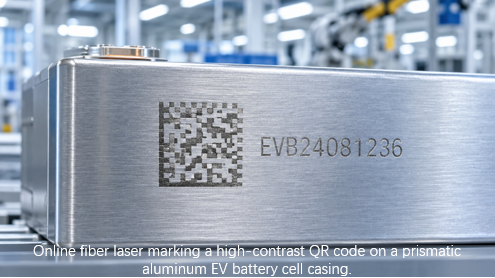
2. What EV Battery Production Managers Need to Know
Production question | Key consideration |
Can a fiber laser mark aluminum battery casings? | Yes, fiber lasers are widely used for aluminum. However, marking quality is highly dependent on the alloy (e.g., 3003 vs. 6061), surface finish, and laser parameters. Sample testing is required. |
Can QR codes be marked on moving battery cells? | Yes, in-motion marking is achievable. A photocell triggers the laser and an encoder tracks conveyor speed. The complete line integration must be tested under actual production speeds. |
Will the code remain readable? | Code quality depends on mark contrast, symbol design, and the scanner. Direct Part Marking (DPM) on aluminum can produce reflections; using a proper verification system is mandatory. |
Can laser marking affect cell integrity? | Excessive laser energy can alter the casing surface. The marking location (typically the side wall, away from welds) and process window must be approved by the battery manufacturer. |
Which laser power should be evaluated? | MFF-20, MFF-30, and MFF-50 offer different power options. Selection should be based on actual casing samples, required cycle time, and code contrast requirements. |
3. Challenge 1: Synchronizing Laser Marking with Battery Production Lines
In automated battery manufacturing, cells travel at a controlled production rate. The marking system must apply the correct code to the correct cell while maintaining the production rhythm. A laser's maximum scanning speed (e.g., 12,000 mm/s) is an internal specification—it does not directly dictate how many cells can be marked per minute.
Key integration considerations
Product detection and triggering: A reliable sensor must detect the cell and trigger the laser at the exact millisecond the approved marking area enters the marking field.
Conveyor synchronization: Because the product moves, the laser must compensate for the conveyor speed. An encoder is required to sync the marking process with the line speed, preventing distorted or stretched codes.
Code-to-cell data matching: Each cell requires a unique identifier. The system must integrate with the line PLC or MES to ensure the database assigns the correct data to the correct physical cell.
Available marking time: The production line provides a strict time window. Testing must measure the complete cycle using the intended DataMatrix or QR code content, not just a simple text string.
4. Challenge 2: Achieving Readable QR Codes on Aluminum Battery Casings
A permanent code is only useful if it can be reliably read throughout the traceability chain. Aluminum presents a challenge because its surface reflection and finish can influence the appearance of a laser mark.
Select the code based on the reading application
Before finalizing the laser parameters, define the code requirements with your traceability team:
Code format and size: QR codes and Data Matrix codes are both used. The format depends on the available marking area and the scanner type.
Contrast and edge definition: Depending on the alloy, a laser can produce a dark mark on a light background or an etched, textured mark. High-contrast marks are preferred for optical scanners, while textured marks work well for DPM verifiers.
Verification standard: For applications requiring formal direct-part-mark verification, code quality should be assessed using ISO/IEC 29158:2025 under representative production lighting. This standard specifies the DPM quality test method, but final grading depends on the actual scanner and customer requirements.
A code that looks clear to the human eye may fail automated reading. Always test the mark with the exact industrial scanner intended for the production floor.
5. Challenge 3: Controlling Laser Energy and Protecting Cell Integrity
Permanent marking must be balanced against the need to preserve the battery casing.
Confirm the marking location
On prismatic cells, the approved marking area is typically the side wall. Marking near welds or sealing regions must be avoided. This is not only because laser heat could affect the seal, but because the downstream welding process itself can cause spatter that obscures the code. The exact marking location must be approved by the battery manufacturer.
Establish a controlled process window
Fiber lasers concentrate energy on a small surface area. A visible mark should never be assumed safe for production. The process window must be developed on representative casing samples, controlling variables like laser output power, scanning speed, pulse frequency, and number of passes. The goal is to achieve a readable code without compromising the structural integrity or protective coating of the casing.
Validate the marked casing
After marking, inspect the sample against the manufacturer's requirements. Depending on the application, validation may include surface appearance, marking depth, and downstream environmental tests. A successful code-reading test alone does not demonstrate that the marking process is suitable for production.
6. Flying Fiber Laser Marking Solution: The MFF Series
For automated EV battery manufacturing, a flying fiber laser marking machine provides a practical solution for permanent identification on aluminum casing surfaces.
Operating at a wavelength of 1,064 nm, Meenjet's MFF series offers 20W, 30W, and 50W output-power options. The series features a standard 110 × 110 mm marking area (with optional 150 × 150 mm and 300 × 300 mm areas) and supports dynamic database content for unique QR and Data Matrix generation.
Power Selection Overview:
MFF-20: Best for standard line speeds and smaller Data Matrix codes on standard aluminum alloys.
MFF-30: The most versatile option for higher line speeds or darker, high-contrast marks on reflective alloys.
MFF-50: Designed for maximum throughput, larger code sizes, or deeper engraving where required.
Actual marking quality and production throughput depend on the casing material and line conditions. Triggering and conveyor synchronization requirements should be confirmed through application testing before deployment.
7. Application Testing Before Production Integration
Before selecting a laser configuration, a structured sample evaluation is essential. A successful laboratory test is an important first step, but it does not replace production-line validation.
For meaningful results, provide representative battery casing samples rather than generic aluminum plates. The test request should include:
The actual casing alloy and surface finish.
The required code format, dimensions, and data content.
The actual scanner and lighting conditions used on the line.
The target production-line cycle time.
Contact Meenjet to discuss your EV battery cell laser marking application and arrange a sample evaluation.
8. Frequently Asked Questions
Can a fiber laser mark QR codes directly on aluminum EV battery casings?
Yes, fiber laser marking is widely used for direct QR code and Data Matrix marking on aluminum casings. The result depends on the aluminum alloy, surface finish, and laser parameters. Representative samples should always be tested before production approval.
How do I choose between a 20W, 30W, and 50W fiber laser?
The appropriate power depends on the casing surface, code dimensions, and production cycle time. Higher output power does not automatically guarantee better readability. Compare the three options using the same representative samples and acceptance criteria.
Can an online fiber laser mark battery cells while they are moving?
Yes, in-motion marking is achievable on conveyor-based production lines. The system must be coordinated with product detection, triggering, and an encoder for line speed synchronization. The specific integration must be confirmed for the exact installation.
9. Request an EV Battery Cell Marking Assessment
Planning to add permanent QR code or Data Matrix identification to aluminum battery casings?
Meenjet can help evaluate a suitable fiber laser marking configuration based on your material, code requirements, and production-line conditions.
To begin an application assessment, provide:
Battery casing material and surface treatment.
Photos or drawings of the proposed marking area.
Required code format and approximate dimensions.
Target production speed or available marking time.
Preferred reading equipment or code verification requirements.
???? Request a Free Sample Test
10. Related Technical Resources
Flying Fiber Laser Marking Machine: How to Choose 20W, 30W, or 50W
Anodized Aluminum Marking: Wear-Resistant Coding and High-Contrast DataMatrix Readability
11. About the Author
Meenjet Application Engineering Team — Over 15 years of combined field experience supporting CIJ, TIJ, and laser installations across automotive, battery manufacturing, packaging, and chemical industries.
Reviewed by: Senior Application Engineer, Meenjet
Last Updated: November 22, 2026