




News & Blogs
Stop AOI No-Reads: A Side-by-Side Comparison of UV, CO2, and Inkjet for High-Speed Glass DPM Marking
Are your vision inspection scanners continuously flagging "No-Read" errors on glass bottles or glossy pharmaceutical vials?
Direct Part Marking (DPM) on glass is notoriously unforgiving. High-speed Automated Optical Inspection (AOI) systems routinely fail to decode 2D barcodes due to internal light refraction, curved surface optical distortion, and micro-cracking caused by improper laser thermal shock. Below is a 3-step engineering playbook to eliminate these errors and achieve Grade A/B DPM scannability under ISO/IEC 15415 and ISO/IEC 29158 standards (skimmable in under 5 minutes).
Quick Diagnostic Decision Tree: Which Marking Tech Fits Your Substrate?
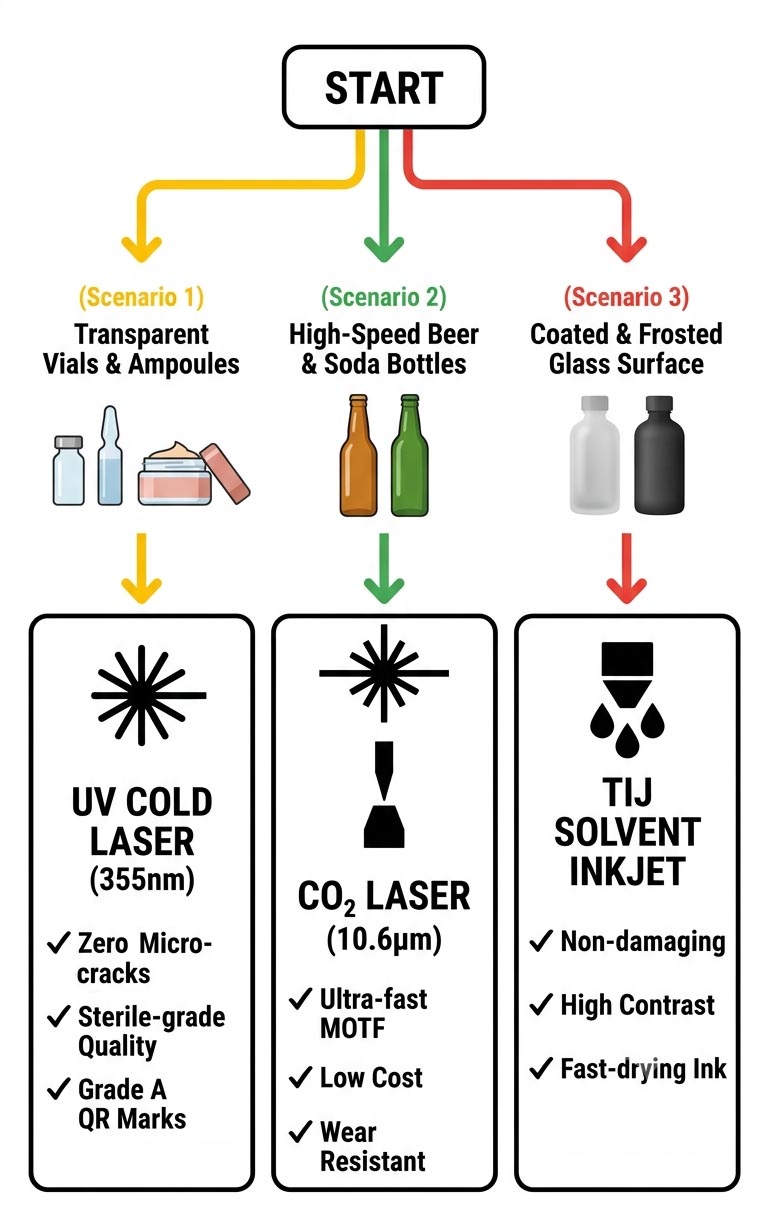
(Click image to expand technical selection flowchart)
Scenario 1: Transparent Glass Vials, Ampoules, or Premium Cosmetics Select Option A (UV Cold Laser). Prevents micro-cracks, zero flaking, highest optical contrast.
Scenario 2: High-Speed Returnable Beverage Bottles (Amber/Green Glass) Select Option B (CO2 Laser). Ultra-fast surface etching for high-volume bottling lines.
Scenario 3: Coated Glass, Warehousing Tags, or Opaque Glossy Packaging Select Option C (High-Adhesion TIJ Solvent Ink). Non-damaging, dark-to-light high contrast without heat exposure.
1. Solved: The Top 3 Glass & Glossy Surface DPM Marking Headaches
Problem 1: Internal Refraction Glare Blinding Optical Scanners (Low-Contrast DPM Codes)
Transparent glass and glossy PET act as natural lenses. Inspection LED lighting passes through the front wall, bounces off internal fluid or geometry, and creates specular glare that blinds decoding cameras.
Engineering Solution: Deploy a 355nm UV laser to exploit photochemical absorption rather than photothermal melting. The UV beam breaks molecular bonds to create opaque, frosted white code modules with high diffuse reflectance. This completely blocks light transmission and eliminates internal refraction glare.
Problem 2: Micro-Cracking and Glass Flaking (Thermal Stress Distortion)
Standard CO2 lasers etch glass via intense local heating, causing micro-fractures. Over time, temperature shifts cause glass flakes to shed, destroying matrix grid geometry and contaminating sterile manufacturing environments (a severe compliance risk similar to scannability defects on sterile flexible films).
Engineering Solution: Transition to short-pulse UV or Femtosecond lasers. Operating via "cold processing," these lasers generate negligible Heat-Affected Zones (HAZ), guaranteeing smooth module edges with zero particle shedding.
Problem 3: Code Geometry Distortion on Curved Bottle Neck & Shoulder Surfaces
Marking DPM 2D codes across tapered or cylindrical glass surfaces distorts module grid geometry, causing focal plane drift and axial non-uniformity failures during vision verification.
Engineering Solution: Integrate a 3D dynamic focusing galvo scanner paired with telecentric field lenses. This dynamically shifts the laser focal point across 3D contours in real-time, maintaining a uniform spot size and an expanded focal tolerance of up to to absorb bottle vibration.
2. Choosing the Right Marking Technology for Glass Substrates
Option A: UV Laser Marking Machine (355nm Cold Laser)
Marking Permanence: 100% Permanent (Indelible, chemical, & autoclave resistant)
Maintenance & Consumables: Minimal consumables (No ink/solvent; low protective lens wear)
Primary Factory Advantage: Photochemical cold marking eliminates micro-cracks; delivers ultra-fine spot sizes ideal for high-density micro DPM QR codes on injectable vials.
Option B: CO2 Laser Marking Machine (10.6μm Wavelength)
Marking Permanence: 100% Permanent (Surface thermal fracture mark)
Maintenance & Consumables: Low maintenance (Extended gas tube lifespan)
Primary Factory Advantage: Extremely high-speed outer surface etching for returnable beverage bottles and heavy glass containers.
Option C: High-Resolution TIJ Inkjet Printer (Solvent-Based Ink)
Marking Permanence: Semi-Permanent (Vulnerable to heavy mechanical abrasion)
Maintenance & Consumables: Low maintenance (Mess-free cartridge replacement)
Primary Factory Advantage: Uses fast-drying, high-adhesion white or black solvent ink to print high-contrast codes on dark or glossy substrates without modifying the glass structure.
Critical Consideration for Regulated Industries (Pharma / F&B):
For sterile packaging, injectable vials, and medical glass, UV laser marking is the global industry standard. It guarantees zero structural damage, zero glass particulate shedding, and 100% permanent Direct Part Marking (DPM) traceability that withstands cryogenic storage and harsh chemical washes.
Pro Tip for High-Speed Conveyor Integration (MOTF):
When line speeds exceed 300 feet per minute (FPM), calibrate your rotary encoder's pulse-to-distance ratio and set the galvo scanner's signal delay compensation. This prevents "pixel stretching" and rectangular module elongation along the conveyor direction.
3. Quick Checklist for 100% Scannable Glass Codes
Position Off-Axis or Polarized Lighting: Mount AOI camera lighting at a 30° to 45° dark-field angle or install cross-polarized filters to neutralize direct specular bounce reflections from transparent walls.
Calibrate Laser Pulse Frequency (kHz): Fine-tune pulse repetition rates and power density to avoid over-engraving, which creates unwanted light scattering and fuzzy module borders.
Control Conveyor Wobble: Install precision side-guide rails to keep bottle lateral movement strictly within the extended telecentric depth of field.
Validate Code Quality Post-Cooling: On hot-end glass container manufacturing lines, verify DPM codes after the annealing lehr stage, as thermal stress relief can subtly alter final optical contrast.
4. Frequently Asked Questions (FAQ)
Q1: Can I use a Fiber Laser to mark on glass bottles?
A: No. Fiber lasers (1064nm wavelength) are designed for high-reflectivity metal substrates and opaque plastics. Glass is optically transparent to 1064nm light, meaning the laser beam will pass straight through the bottle without marking, or cause violent cracking if energy builds up internally. Use a 355nm UV or CO2 laser instead.
Q2: What is the main difference between CO2 and UV laser marks on glass?
A: CO2 lasers use heat to micro-fracture the glass surface, resulting in a rougher, semi-opaque mark that carries a risk of micro-cracking. UV lasers use "cold" photochemical processing to break chemical bonds, producing a smooth, ultra-fine, opaque white mark with zero micro-fractures.
Q3: How do I achieve an ISO Grade A rating for DPM QR codes on transparent glass?
A: To achieve Grade A under ISO/IEC 15415 or AIM DPM (ISO/IEC 29158) standards, you must maximize Cell Contrast (CC). Use a UV laser to create a dense, frosted base layer, and configure dark-field off-axis lighting on your verifier to eliminate background specular reflection.
Conclusion
Overcoming DPM QR code reading failures on glass requires matching laser wavelength to material absorption mechanics. By leveraging UV cold-laser technology or high-adhesion specialized inks, packaging engineers can eliminate refraction glare, eradicate micro-cracking, and guarantee Grade A DPM scannability across the entire supply chain.
Need a site-specific recommendation? Our application engineers can suggest the optimal wavelength (355nm/532nm/10.6μm) and galvo configuration based on your actual bottle samples and line speed—no obligation, just a 15-minute technical review.
Explore Our Complete Material Traceability Matrix
Encountering QR code scannability issues on other industrial substrates? Read our specialized engineering guides:
???? Metal Substrates & DPM: Fix High-Reflectivity Metal DPM QR Code Marking Headaches
???? PCB Circuit Boards: How to Print High-Scannability Micro QR Codes on PCB Boards
???? Flexible Films & Plastic Packaging: How to Improve QR Code Scannability on Flexible Films and Plastic Packaging