



News & Blogs
By Meenjet Application Engineering Team | November 3, 2026
Executive Summary
Food and beverage packaging presents three coding challenges that general industrial marking does not: condensation on cold-filled bottles, washdown and chemical cleaning, and food-contact compliance. Ink-based CIJ systems can handle all three, but only if the printer, the ink, and the enclosure are matched to the environment.
This guide explains how to solve condensation, washdown, and compliance in CIJ coding, and how the Meenjet MX series is built for these conditions.
???? For Food & Beverage Production Managers
Question | Answer |
Why does condensation break CIJ codes? | Water on the bottle surface prevents ink from adhering. Moisture-penetrating MEK inks, an air knife de-watering system, and proper print head positioning solve this. |
What IP rating is needed for washdown? | IP55 for low-pressure rinse and humidity. IP65 for standard water jets. For high-pressure, high-temperature washdown (CIP/SIP), IP66 or IP69K is required. |
Can CIJ print on chilled or frosted bottles? | Yes, with MEK-based moisture-penetrating inks and a pre-print air knife. Standard inks may smudge or fail to adhere. |
What does "food-contact compliant" mean for CIJ ink? | The ink must be formulated for indirect food contact and, for thin or porous packaging, must also meet low-migration standards such as the Swiss Ordinance or Nestlé Guidance. |
Which Meenjet model fits food and beverage lines? | MX series. IP55 protection, up to 480 m/min, 4-line capability, and solvent consumption as low as 10 ml/hour (at 20°C, standard MEK ink, continuous operation). |
Does CIJ require frequent maintenance in wet environments? | CIJ requires regular cleaning, but MX series models offer 30-day standby with one-click restart and self-cleaning. |
Can CIJ handle returnable glass bottles? | Yes, with dual-performance inks that resist ice-water immersion but wash off cleanly in hot caustic bottle washers. |
Glossary:
Condensation: Water droplets that form on cold surfaces when warm, humid air contacts them.
Washdown: Routine cleaning with water and chemicals, common in food and dairy plants.
Low migration: Ink formulated so that substances do not transfer through packaging into the food at levels above regulatory limits.
IP55 / IP65 / IP66 / IP69K: Ingress protection ratings. IP55 resists low-pressure jets. IP65 resists standard water jets. IP66 resists powerful water jets. IP69K resists high-pressure, high-temperature washdown.
1. Why Food and Beverage Coding Is Different
General industrial coding happens in dry, controlled environments. Food and beverage coding happens in wet, cold, and chemically aggressive conditions.
Factor | General Industrial | Food & Beverage |
Surface condition | Dry, clean | Condensation, frost, oil, residues |
Environment | Factory floor | Washdown, humidity, temperature swings |
Cleaning | Occasional | Daily or shift-based, with chemicals |
Regulatory | Asset tracking | Food safety, traceability, retailer requirements |
Substrate | Metal, plastic, labels | Glass, PET, aluminum, film, cartons |
Consequence of failure | Internal tracking error | Recall, fine, retailer rejection |
Key insight: A code that fails on a beverage line is not just a marking error. It is a compliance failure that can stop a shipment or trigger a recall.
2. Challenge 1: Condensation on Cold-Filled Bottles
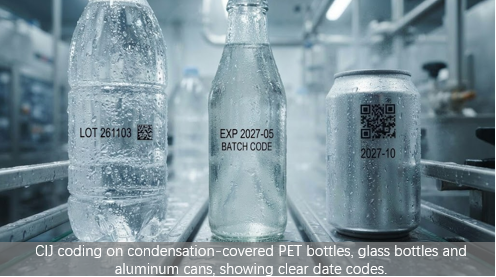
Cold-filled bottles and cans form condensation when they leave the filler and meet warmer air. Frost can also form if the product is frozen. This water film isolates the ink from the substrate, causing poor adhesion, ink spreading, and codes that rub off easily.
How to Solve Condensation in CIJ Coding
You cannot simply print blindly through water. Solving condensation requires a combination of ink selection, surface preparation, and print head positioning.
1. Use Moisture-Penetrating Inks
Standard CIJ inks will fail on wet surfaces. You must specify moisture-penetrating inks designed for water film displacement.
Chemistry: These are typically MEK (ketone) or alcohol-based fast-dry inks containing strong penetrating agents. MEK/ethanol blends are formulated for food plant EHS safety, with SDS documentation available for factory safety reviews.
Mechanism: The ink breaks through the water film, displaces the moisture, and bonds directly to the PET, glass, or HDPE surface.
Drying Speed: Drying time is usually 0.2–0.5 seconds, preventing the ink droplet from being diluted by residual condensation.
2. Install Pre-Treatment: Air Knife De-Watering Systems
Before the print head, install a high-pressure air knife de-watering system.
De-watering: This blows away free water droplets and frost from the coding area.
Dry Window: It creates a "dry window" of a few hundred milliseconds, allowing the print head to print and the ink to dry instantly before new condensation forms.
3. Adjust Print Head Distance and Position
Distance: Keep the print head at an optimal 5–10 mm from the bottle surface.
Position: Code on a relatively flat area (e.g., neck or middle body) that the air knife can dry easily. Avoid recessed areas like the bottle base where water pools.
Substrate-Specific Recommendations
Substrate | Main Challenge | Recommended Setup |
PET Bottles | Low surface energy; water forms large droplets | Moisture-resistant MEK ink + high-pressure air knife |
Glass Bottles | Very smooth surface; thick water film | Glass-specific high-adhesion ink + surface blow-drying |
HDPE / PP | Hydrophobic material; water beads up | Penetrating polyolefin-specific ink |
Key insight: Condensation is not just a printer problem. It is a process problem. The right combination of MEK ink, an air knife de-watering system, and a 5–10 mm print distance is what makes the code stick.
3. Challenge 2: Washdown and Chemical Cleaning
Food and beverage plants clean equipment daily, often with water jets and chemical sanitizers. The printer enclosure and the ink must survive this.
IP Ratings Explained (Corrected)
IP ratings are frequently misunderstood. The correct application is critical:
IP55: Protected against dust and low-pressure water jets. Suitable for high-humidity, non-wash zones and light rinsing.
IP65: Dust-tight and protected against standard water jets (12.5 L/min at 30 kPa). Suitable for low-pressure washdown and foaming.
IP66: Dust-tight and protected against powerful water jets (100 L/min at 100 kPa). Required for medium-to-high pressure washdown.
IP69K: Dust-tight and protected against high-pressure, high-temperature washdown (80°C, 80–100 bar). Required for CIP/SIP cycles in dairy, meat, and brewery plants.
Important: IP65 is not suitable for high-pressure washdown. If your plant uses high-pressure jets or steam cleaning, specify IP66 or IP69K. If the MX series is only IP55/IP65 rated, it must be installed with a protective shield or positioned away from direct high-pressure spray.
Stainless Steel Enclosures
Stainless steel housings resist corrosion and are easier to clean than painted steel or plastic. Sloped surfaces allow water to run off, reducing pooling and contamination risk.
Ink Resistance to Cleaning Chemicals
Some CIJ inks are formulated to resist cleaning chemicals and to remain legible after washdown. For returnable bottles, the opposite is required: an ink that washes off cleanly in caustic solution without leaving residue.
Key insight: Match the IP rating to the actual washdown zone. IP55 for humidity and light rinse. IP65 for standard jets. IP66 or IP69K for high-pressure, high-temperature cleaning.
4. Challenge 3: Food-Contact Compliance and Migration
CIJ ink is applied to the exterior of packaging. It is not intended to contact the food itself, but it must be formulated so that incidental contact does not pose a safety risk.
Indirect Food Contact and Low Migration
"Indirect food contact" means the ink is applied to the outside of the package, separated from the food by a barrier. However, for thin or porous packaging (e.g., plastic film, thin PET), low-molecular-weight substances in the ink can migrate through the packaging into the food.
This is why "indirect contact" alone is not enough. For these applications, specify inks that meet low-migration standards:
Swiss Ordinance SR 817.023.21: Lists permitted substances and requires a Declaration of Compliance (DoC) for printing inks.
Nestlé Guidance Notes on Packaging Inks: An exclusion list managed by Nestlé for inks used on food packaging.
EuPIA Guidelines: General framework and exclusion list for printing inks.
How to Specify Compliant Ink
Ask the ink supplier for:
A Declaration of Compliance (DoC) for the target market (FDA, EU, or local regulation)
Confirmation that the ink meets low-migration requirements if the packaging is thin or porous
The ink's intended use (indirect contact, returnable bottles, or specific substrates)
A safety data sheet and food-contact declaration
What CIJ Cannot Do
CIJ is not a direct food-contact printing method. It should not be used to print directly on edible surfaces or on the food-contact side of packaging.
Key insight: Compliance is an ink property, not a printer property. For thin packaging, "indirect contact" is not enough—the ink must also be low-migration.
5. Meet the MX Series
For food and beverage lines, the CIJ printer must handle high speeds, wet environments, and long production runs. The Meenjet MX series is built for these conditions.
The MX1890 is the standard choice for high-speed lines: IP55 protection, up to 480 m/min, 4 lines of content, and a 10.1-inch touchscreen. Solvent consumption is typically 10 ml per hour at 20°C ambient, based on standard MEK ink under continuous operation (consumption increases at higher temperatures). The 750 ml ink cartridge prints approximately 8 million characters. The 30-day standby with one-click restart reduces downtime during seasonal shutdowns or product changeovers.
The MX2890 extends the range to micro-coding and opaque white or yellow inks, which are useful for dark bottles, small caps, and dense 2D codes on pharmaceutical or dairy packaging.
For full specifications, see the MX1890 product page and the MX2890 product page.
6. Cost & Maintenance Reality
CIJ has consumables and maintenance requirements. Buyers should understand the cost structure before specifying a system.
Consumable Cost
Ink and solvent consumption depend on print coverage, line speed, and ink type.
Moisture-penetrating and food-grade inks may cost more than standard inks.
Returnable bottle inks may require specific solvent blends.
Maintenance
Print heads must be cleaned regularly to prevent clogging.
Solvent is consumed during startup, shutdown, and cleaning.
MX series models offer 30-day standby with one-click restart, reducing solvent waste during idle periods.
Total Cost of Ownership (Corrected)
Factor | CIJ | Laser | TIJ |
Upfront cost | Moderate to High | High | Moderate |
Consumables | Ink, solvent, make-up | None | Ink cartridges |
Maintenance | High | Low (but optics need protection in wet zones) | Low |
Condensation handling | ✅ Best with MEK ink and air knife | ???? Permanent mark, but optics risk condensation | ❌ Poor adhesion on wet surfaces |
Washdown | ✅ IP55/IP65/IP66/IP69K available | ✅ IP65 heads available, but optics need positive pressure | ✅ IP65 enclosures available, but not for wet/condensation zones |
Food-contact compliance | ✅ Compliant low-migration inks available | ✅ No ink | ✅ Compliant inks available |
Best for | High-speed wet, condensation-prone lines | Dry lines, permanent marks on glass/PET | Flat packaging, outer cartons, dry environments |
Rule of thumb: If the line runs at high speed, the surface is wet or condensation-prone, and the environment requires washdown, CIJ is the most reliable choice. For permanent marks on dry surfaces, laser may be more economical. TIJ is best suited for flat packaging and dry environments, not for wet or condensation-heavy lines.
Frequently Asked Questions (FAQ)
Q1: Can CIJ print through condensation?
A: Yes. When combined with a pre-print air knife and MEK-based moisture-penetrating inks, CIJ can produce clear, durable codes on wet or frosted bottles. Standard inks may smudge or fail to adhere.
Q2: What IP rating do I need for washdown?
A: IP55 for humidity and light rinse. IP65 for standard water jets. IP66 for powerful jets. IP69K for high-pressure, high-temperature CIP/SIP cycles. Match the rating to your actual washdown zone, not a generic "washdown" label.
Q3: Is CIJ ink food-safe?
A: CIJ inks for food and beverage packaging are formulated for indirect food contact. For thin or porous packaging, they must also meet low-migration standards such as the Swiss Ordinance or Nestlé Guidance. Ask the supplier for a Declaration of Compliance for your market.
Q4: Can CIJ print on returnable glass bottles?
A: Yes, with dual-performance inks that resist ice-water immersion but wash off cleanly in hot caustic bottle washers (typically 70–80°C, 1.5–3% NaOH). This ensures the code survives cold storage but does not contaminate the bottle washing process.
Q5: What is the minimum order for a free sample test?
A: No minimum. Send us your substrates and line conditions, and our engineers will test the MX series and recommend the right ink.
???? Request a Free Sample Test
Send us your bottles, cans, or packaging samples. Our engineers will:
Test the MX series on your specific substrates and conditions
Recommend the right ink for condensation, washdown, low-migration, or returnable bottles
Provide a cost and configuration proposal
No obligation. Report delivered within 5 business days.
???? Request a Free Sample Test
Related Technical Resources
CIJ Coding for Food Packaging: FDA and EU Food-Contact Compliance
Solving Ink Smudging on Cold Drink Lines: Anti-Condensation Coding Solutions
About the Author
Meenjet Application Engineering Team — Over 15 years of combined field experience supporting CIJ, TIJ, and laser installations across food and beverage, dairy, and packaging manufacturing.
Reviewed by: Senior Application Engineer, Meenjet
Last Updated: November 3, 2026