



News & Blogs
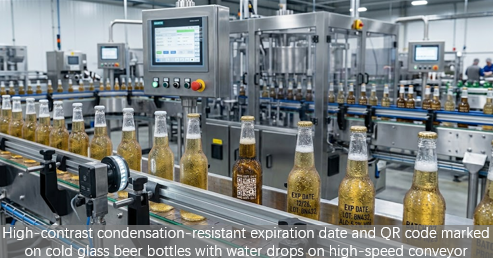
Executive Summary: Printing durable batch codes, expiration dates, and 2D barcodes on condensation-covered beverage containers is a constant operational challenge. Micro-water films disrupt ink surface wetting, leading to code smudging and high rejection rates on packaging lines. This guide outlines a three-tier engineering protocol—combining targeted mechanical drying, specialized hydrophobic inks, and non-contact laser systems—to guarantee 100% scannability on high-speed bottling and canning lines.
???? Why "Waterproof Ink" Alone Isn't the Answer
A common misconception among line operators is searching for a magic "waterproof ink" to solve cold-fill coding issues. Standard off-the-shelf water-resistant inks are engineered to resist moisture after the ink film has fully cured. When printing on cold containers, the micro-water film physically blocks ink-substrate contact before chemical bonding can occur.
Because the ink floats on water rather than anchoring to the substrate, even waterproof ink will rub off easily. This is why a combined approach—mechanical drying (Tier 1) alongside chemical or laser adaptation (Tiers 2 & 3)—is strictly required on cold, wet lines.
1. The Root Cause: Why Moisture Defeats Standard Industrial Inks
In cold-fill operations (2℃-6℃), humid ambient air rapidly cools below its dew point upon touching cold glass, PET, or metal surfaces. This creates a micro-condensation barrier that causes three distinct failure modes during printing:
Wetting Failure: A continuous microscopic layer of water prevents standard solvent or water-based inks from making contact with the underlying polymer or glass matrix.
Solvent Dilution & Delayed Curing: Humidity slows solvent evaporation. Slow-drying ink stays tacky for several seconds, leaving it vulnerable to friction on accumulation tables.
Vapor-Pressure Delamination: Trapped micro-water droplets vaporize as the container warms to ambient temperature. The resulting vapor pressure lifts the dried ink film from underneath, causing delamination and flaking later in the supply chain.
2. The Three-Tier Defense Strategy Against Code Smudging
Tier 1: Mechanical Drying Optimization (Eliminating Macro-Water)
No ink or laser can bypass heavy, standing water drops. Your pre-print drying setup must be calibrated precisely:
Air Knife Velocity & Angle: Position high-velocity air knives 150mm upstream of the print station. Angle the nozzles at 30°-45° against the line direction to shear water away rather than flattening it against the bottle neck.
Targeted Focus: Focus airflow specifically on the exact printing zone (e.g., bottle shoulder, concave can bottom) to save compressed air while ensuring a moisture-free print window.
Tier 2: Chemical Ink Adaptation (Penetrating Residual Condensation)
Because cold containers re-condense moisture within milliseconds after passing the air knife, the printing system must handle lingering micro-moisture:
Hydrophobic MEK/Ethanol Formulations: Transition to specialized fast-drying Methyl Ethyl Ketone (MEK) inks engineered with hydrophobic binders. These solvents push through micro-water droplets and bite directly into the substrate within <0.8 seconds.
High-Resin Glass Inks: For returnable or non-returnable glass bottles, use high-resin inks that prevent water vapor migration underneath the dried print matrix during warming.
Tier 3: Non-Contact Laser Coding (The Consumables-Free Alternative)
Where ink drying times limit line speed, laser marking offers an inkless solution that solves adhesion issues entirely:
UV Lasers (355 nm): Photochemically mark PET bottles and sensitive labels without generating thermal stress. The UV beam flash-vaporizes micro-moisture instantly while forming a clean, permanent contrast code.
Fiber Lasers (1064 nm): Designed for high-speed aluminum beverage lines (>600 cans/min). The localized laser pulse vaporizes surface condensation while ablating the outer lacquer to reveal the bright metal substrate.
3. Technology Comparison for Wet Line Coding
Parameter | UV / Fiber Laser System | ||
Solvent Flash-Off / Curing Time | 0.2-0.8 seconds(Surface dry)
(2–5s full chemical cure) | 1.0-2.0 seconds(Surface dry)
(3–8s full chemical cure) | Instantaneous
(No drying phase; moisture flash-vaporized) |
Moisture Tolerance | High (Handles micro-film) | Moderate (Requires dry surface) | Extremely High (Vaporizes moisture) |
Ideal Substrate | Aluminum Cans, Glass, PET | Smooth PET, Coated Cartons | PET, Glass, Anodized/Raw Aluminum |
Smudge Resistance | High (Fast solvent flash-off) | Moderate to High | 100% Permanent (Indelible) |
Maintenance Profile | Regular washdown & fluid refilling | Cartridge replacement | Zero Consumables / Low Maintenance |
???? Engineering Note: Table values for CIJ/TIJ represent surface dry time (tack-free). Full chemical cross-linking may require 2 to 5 seconds depending on ambient humidity, ink formulation, and substrate surface temperature.
4. Line Adjustment Checklist for Production Engineers
To immediately eliminate code smudging on your existing line, verify these four mechanical settings:
Minimize Printhead Throw Distance: Set the CIJ printhead distance to 2 mm-4 mm from the container. Shorter throw distances prevent flying ink droplets from being deflected by local air turbulence around wet bottles.
Eliminate Downstream Contact Points: Ensure no guide rails, starwheels, or side-belt transfer mechanisms contact the printed area for at least 2.0 seconds post-printing.
Verify Dew Point Conditions: Monitor ambient humidity around the print zone. Installing localized dry-air shrouds around the print station reduces re-condensation rates.
5. Frequently Asked Questions (FAQ)
Q1: Why does inkjet coding on wet glass bottles smudge even with an air knife installed?
A: Glass has high thermal mass. Once chilled, glass bottles re-condense micro-moisture almost instantaneously after leaving the air knife. Standard inks float on this micro-film rather than bonding to the glass. Switching to a fast-drying hydrophobic MEK ink solves this issue.
Q2: Is Thermal Inkjet (TIJ) suitable for cold, condensation-heavy beverage lines?
A: TIJ can be used if paired with an aggressive air knife setup and specialized quick-drying solvent cartridges. However, for ultra-high-speed lines with heavy continuous moisture, CIJ with MEK ink or UV Laser marking is generally recommended.
Q3: Will UV laser marking puncture or weaken thin PET beverage bottles?
A: No. 355 nm UV lasers utilize "cold processing," breaking molecular bonds in the surface layer of the PET without generating excess heat. This creates a high-contrast mark without melting or compromising bottle wall strength.
Q4: Which solution offers the lowest Total Cost of Ownership (TCO) for wet beverage lines?
A: For lines with lower speeds or intermittent production, MEK-based CIJ offers the lowest upfront CapEx (5,000-$12,000) but incurs continuous ink and solvent costs. For high-speed 24/7 operations ($>500 bottles/min), a UV or Fiber Laser system has a higher initial CapEx ($15,000–$30,000) but near-zero consumable costs, completely eliminating downtime for fluid refills and printhead cleaning. Most high-volume beverage plants achieve a full ROI on laser systems within 18–24 months.