




News & Blogs
By Meenjet Application Engineering Team | November 9, 2026
Executive Summary
Timber and panel production presents coding challenges that general packaging does not: rough and porous surfaces that absorb ink unevenly, outdoor storage that demands weather resistance, and a constant presence of sawdust that threatens print head reliability. Inline thermal inkjet (TIJ) printers can handle these conditions, but only with the right ink, the right print height, and the right dust management strategy.
This guide explains how to solve ink absorption, weather resistance, and grade mark traceability on timber and panels, and how the Meenjet MX series—rated IP54 for dust protection—is built for these conditions.
???? For Timber & Panel Production Managers
Question | Answer |
Can TIJ print on rough, porous timber? | Yes, with solvent-based or penetrating inks. Water-based inks may wick excessively on raw wood. |
Does the MX series have dust protection? | Yes. The MXPro and MXPlus are rated IP54, protecting against limited dust ingress and water splashes. Sufficient for standard timber workshops, not for extreme dust or direct washdown. |
What print height is needed for grade marks? | Grade marks and batch numbers typically range from 5 mm to 50 mm. The MXPro offers 1–50.8 mm. |
Will the codes survive outdoor storage? | With weather-resistant solvent inks, yes. Standard water-based inks may fade or wash off. |
Can it print on MDF and plywood? | Yes. Solvent inks are required for adhesion on smoother panel surfaces. |
Does it integrate with the production line? | Yes. Photocell and encoder inputs synchronize printing with conveyor speed. |
Which Meenjet model for wide panels? | MXPro. Up to 4 print heads for wide coverage and multi-line marking. |
Glossary:
TIJ: Thermal Inkjet — ink is heated and ejected through a nozzle.
IP54: Ingress Protection rating: dust-protected (limited ingress) and splash-resistant.
MDF: Medium-density fibreboard.
OSB: Oriented strand board.
Grade mark: A visual indicator of timber quality, strength, or origin, often required by certification schemes.
1. Why Timber Coding Is Different from Packaging Coding
General packaging coding happens on smooth, consistent surfaces in controlled environments. Timber coding happens on rough, variable surfaces in dusty workshops and outdoor storage.
Factor | General Packaging | Timber & Panel |
Surface | Smooth cartons, film, labels | Rough sawn timber, plywood, MDF, OSB |
Ink absorption | Uniform | Uneven; raw wood wicks ink along grain |
Environment | Dry warehouse | Sawdust, humidity, outdoor storage |
Code content | Date, batch, QR | Grade mark, batch, length, certification |
Durability required | Weeks to months | Months to 2+ years |
Reader | Retailer, consumer | Builder, inspector, certifier |
Key insight: A faded or unreadable mark on timber is not just a marking error. It can fail a grade inspection, delay a shipment, or invalidate a certification claim.
2. Challenge 1: Rough, Porous Surfaces and Ink Absorption
Timber and wood-based panels vary widely in surface texture and porosity. Raw sawn timber has open grain that can wick ink along the fibers. Plywood and MDF are smoother but still absorbent.
Ink Selection for Timber
Raw timber and sawn wood: Solvent-based inks penetrate the grain and resist wicking. Water-based inks may spread and become illegible.
Plywood and MDF: Solvent-based inks bond to the surface and resist smudging.
OSB (oriented strand board): Very rough surface; test print height and ink viscosity. For highly textured OSB with deep surface gaps, ensure the print distance remains strictly within 2–5 mm, or use higher ink drop volume to compensate.
Print Height and Coverage
Grade marks and batch numbers typically range from 5 mm to 50 mm. The MXPro supports 1–50.8 mm print height, covering the standard range for timber coding. Multiple print heads can be stacked for wider marks or multi-line text.
Key insight: Ink absorption is not a printer limitation. It is a surface and ink interaction. Test the specific wood species and panel type before production.
3. Challenge 2: Sawdust and Dust Protection
Woodworking shops generate continuous sawdust. Dust that settles on the print head can clog nozzles, cause missing dots, and degrade code readability.
IP54 Dust Protection
The MXPro and MXPlus are rated IP54:
Dust protection (5): Limited dust ingress does not interfere with normal operation.
Water protection (4): Resists splashes from any direction.
IP54 is sufficient for standard timber workshops. It is not suitable for extremely high dust concentration (e.g., near a sawdust extraction outlet) or direct washdown.
Additional Field Measures
Even with IP54, the following practices extend equipment life in dusty environments:
Install the print head away from the sawdust source and out of the direct airflow from cutting or sanding.
Cover the print head during idle periods to prevent dust settling on the nozzle plate.
Increase the cleaning cycle frequency: inspect nozzles every 2–4 hours in high-dust conditions instead of once per shift.
Use the printer's self-cleaning function if available.
Keep the photocell sensor lens clean. Sawdust buildup on the sensor can cause false triggers (double printing) or missed triggers (no print). Include the sensor in the routine cleaning checklist.
Key insight: IP54 is the baseline. Field practices determine whether the equipment survives the shift.
4. Challenge 3: Weather Resistance for Outdoor Storage
Timber and panels are often stored outdoors or in unheated, humid warehouses. Rain, condensation, and UV exposure can degrade standard inks.
Ink Selection for Weather Resistance
Solvent-based inks: Penetrate the surface and resist moisture and UV better than water-based inks.
UV-resistant inks: Reduce fading over months of sun exposure.
Certification marks: Ensure the ink is compatible with the certification scheme's durability requirements (e.g., FSC or PEFC chain-of-custody marks).
Print Position and Surface Preparation
Print on a dry, flat area of the panel. Avoid knots, splits, and wet spots.
For rough sawn timber, print on a planed or smoother section if available.
If the surface is dusty, wipe it before printing.
Key insight: Weather resistance is an ink property. The right ink determines whether the grade mark survives the first rainy season.
5. Challenge 4: Grade Marks and Batch Traceability
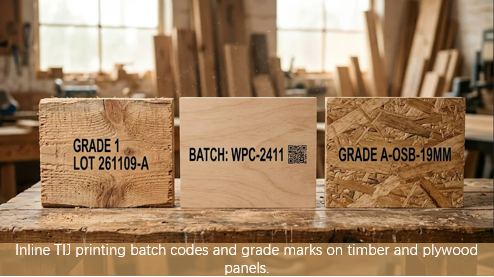
Timber and panel products often require grade marks (strength, appearance, or origin), batch numbers, and certification codes. These must remain legible for inspectors, builders, and certifiers.
Grade Marks
Grade marks vary by market: JAS in Japan, EN 338 in Europe, and various national grading schemes. The printer must produce clear, permanent marks that withstand handling and weather.
Batch Traceability
Batch codes link the panel to production records, mill origin, and certification. Inline TIJ prints these codes directly on the panel without labels or pre-printing.
Certification Codes
FSC and PEFC chain-of-custody codes may be required on panels. The printer must produce high-contrast, durable codes that remain readable for the certification period.
Key insight: Grade marks and batch codes are not decorative. They are compliance documents that must survive the life of the product.
6. Meet the MX Series
For timber and panel lines, the printer must handle wide formats, rough surfaces, and dusty environments. The Meenjet MX series is rated IP54 for dust and splash protection.
MXPlus: 1–2 print heads, up to 25.4 mm height, up to 120 m/min. Best for narrow panels or lower line speeds.
MXPro: 1–4 print heads, up to 50.8 mm height, up to 240 m/min. Best for wide panels, multi-line grade marks, and higher line speeds.
Both models support solvent-based and weather-resistant inks, photocell and encoder synchronization, and Ethernet-based MES integration.
For full specifications, see the MXPlus product page and the MXPro product page.
If IP54 is not sufficient: In applications with extremely high dust concentration or direct washdown, the MX series may require additional external protection, or a different configuration may be needed. Contact our engineers to evaluate the specific conditions.
7. Cost & Maintenance Reality
Inline TIJ has a low maintenance burden, but dust and ink type affect the cost structure.
Consumable Cost
Solvent-based and weather-resistant inks may cost more than standard water-based inks.
Cartridge yield depends on print height and coverage. A 50 mm grade mark uses more ink than a 5 mm batch code.
Original HP cartridges last longer and produce more consistent adhesion than refilled cartridges.
Maintenance in Dusty Environments
IP54 provides baseline protection, but regular cleaning is still required.
In high-dust conditions, clean the print head and photocell sensor every 2–4 hours.
Cover the print head during idle periods.
Total Cost of Ownership
Factor | Inline TIJ | Pre-printed Labels | Stencil Spray |
Upfront cost | Moderate | Low (but high labor) | Low |
Consumables | Ink cartridges | Label stock | Paint |
Flexibility | High (on-demand) | Low (fixed print) | Medium |
Weather resistance | ✅ With solvent ink | ???? May peel | ✅ Durable |
Dust sensitivity | ???? IP54, needs cleaning | ✅ Sealed | ✅ Not affected |
Best for | Variable grade marks, batch codes | High-volume fixed marks | Simple, large marks |
Rule of thumb: If the marking content changes frequently and requires variable data (grade marks, batch codes, dates), inline TIJ is more flexible than stencil spray or pre-printed labels. If the environment has extremely high dust and no cleaning routine is possible, stencil spray or a sealed IP65 system may be more reliable.
Frequently Asked Questions (FAQ)
Q1: Can TIJ print on rough sawn timber?
A: Yes, with solvent-based ink. Test print height and viscosity on your specific wood species first.
Q2: Does the MX series have dust protection?
A: Yes, IP54. It handles standard workshops, but not extreme dust or direct washdown without extra protection.
Q3: Will the grade mark survive outdoor storage?
A: With solvent-based or weather-resistant ink, yes. Water-based inks may fade.
Q4: What is the maximum print height for grade marks?
A: The MXPro supports up to 50.8 mm, covering typical grade marks (5–50 mm). Multiple heads can be stacked for larger marks.
Q5: What is the minimum order for a free sample test?
A: No minimum. Send us your timber and panel samples, and our engineers will test the MX series and recommend the right ink.
???? Request a Free Sample Test
Send us your timber and panel samples. Our engineers will:
Test the MX series on your specific wood species and panel types
Recommend the right ink for absorption and weather resistance
Provide a cost and configuration proposal
No obligation. Report delivered within 5 business days.
???? Request a Free Sample Test
Related Technical Resources
Online TIJ vs CIJ vs Laser: Which for Cartons, Bottles, and Film?
Inline TIJ for Secondary Packaging: Labels, LCM, and Hybrid Lines
About the Author
Meenjet Application Engineering Team — Over 15 years of combined field experience supporting inline TIJ, handheld TIJ, CIJ, and laser installations across woodworking, packaging, and logistics.
Reviewed by: Senior Application Engineer, Meenjet
Last Updated: November 9, 2026