



News & Blogs
By Meenjet Application Engineering Team | November 5, 2026
Executive Summary
Seed and agricultural packaging has coding requirements that general packaging does not: weather-resistant marks that survive outdoor storage, small character coding for germination rates and purity, and batch traceability that holds up across distribution. Handheld thermal inkjet (TIJ) printers can handle all three, but only if the ink, the print height, and the workflow are matched to the conditions.
This guide explains how to solve weather resistance, germination rate coding, and batch traceability in seed packaging, and how the Meenjet M-series is built for these conditions.
???? For Seed & Agricultural Production Managers
Question | Answer |
Why do standard inks fail on seed sacks? | Seed sacks are exposed to humidity, rain, and outdoor storage. Standard water-based inks may smudge or fade. Solvent-based or weather-resistant inks are required. |
Can TIJ print small characters like germination rates? | Yes. With 300 DPI and 1–12.7 mm print height, both M6 and M9 can print germination percentages, purity, net weight, and lot numbers clearly. |
What is the best way to code batch numbers on seed sacks? | Handheld TIJ. It prints directly on paper, woven PP, or plastic sacks without pre-printing or labels. |
Can the printer handle variable data like lot-specific germination rates? | Yes. The M9 supports USB and WiFi variable data input, and can scan existing codes to print matching data. |
Does TIJ require consumables? | Yes, ink cartridges. But there are no ribbons, no solvents, and no wearing parts. |
Which Meenjet model for standard seed sack coding? | M6. Economical, no database required. |
Which Meenjet model for scan-and-print traceability? | M9. Built-in scanner, WiFi, and MES integration. |
Glossary:
TIJ: Thermal Inkjet — ink is heated and ejected through a nozzle.
Germination rate: The percentage of seeds in a lot that are expected to sprout.
Lot code: A batch identifier used to trace seed production and distribution.
Weather-resistant ink: Ink formulated to resist moisture, UV, and temperature changes during outdoor storage.
1. Why Seed Packaging Coding Is Different
Standard industrial packaging coding happens in dry warehouses and retail environments. Seed packaging coding happens in fields, outdoor storage, and distribution chains exposed to weather.
Factor | Standard Industrial Packaging | Seed & Agricultural Packaging |
Surface | Cartons, film, labels | Paper sacks, heavy-duty PP woven sacks, plastic sacks |
Environment | Indoor warehouse | Outdoor storage, humidity, rain, UV |
Code content | Date, batch, QR | Date, lot, germination rate, purity, net weight |
Durability required | Weeks to months | Months to 2+ years |
Reader | Retailer, consumer | Farmer, agronomist, distributor, regulator |
Consequence of failure | Customer complaint | Crop failure, regulatory fine, recall |
Key insight: A faded code on a seed sack is not just a marking error. It can mean a farmer cannot verify germination rate or lot origin, which affects planting decisions and regulatory compliance.
Many seed distributors report that codes applied at the warehouse without weather-resistant ink fail within one outdoor storage season. Switching to a solvent-based ink and a handheld TIJ printer resolved the problem without changing the sack material.
2. Challenge 1: Weather and Moisture Resistance
Seed sacks are stored outdoors, in unheated warehouses, or in humid climates. Rain, condensation, and UV exposure can degrade standard inks.
Ink Selection for Weather Resistance
Standard water-based TIJ inks may smudge or fade when exposed to moisture. For seed sacks, specify solvent-based or weather-resistant inks formulated for porous surfaces.
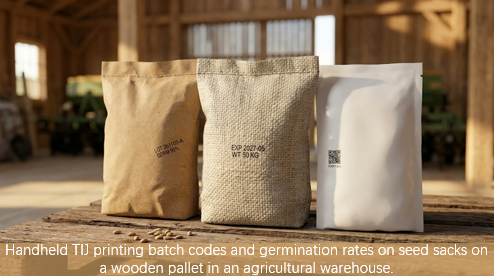
Paper and heavy-duty PP woven sacks: Solvent-based ink penetrates the fibers and resists moisture. For a portable inkjet printer for woven sacks, solvent ink is the only reliable choice.
Plastic sacks: Solvent-based ink bonds to the film surface.
Outdoor storage: UV-resistant inks reduce fading over months of sun exposure.
Print Position and Surface Preparation
Print on a dry, flat area of the sack. Avoid folds, seams, and wet spots.
For woven PP sacks, print on the smoother side if available.
If the sack surface is dusty, wipe it before printing.
Key insight: Weather resistance is an ink property, not a printer property. The right ink determines whether the code survives the first rain.
3. Challenge 2: Germination Rate and Small Character Coding
Seed sacks require small, legible characters: germination percentage, purity, net weight, lot number, and sometimes a QR code. These must remain readable by farmers, agronomists, and inspectors.
Print Height and Resolution
The M-series offers 1–12.7 mm print height and 300 DPI resolution. This is sufficient for:
Germination rate (e.g., GERM 95%)
Purity (e.g., PURITY 99%)
Net weight (e.g., NET 25 kg)
Lot number (e.g., LOT 261105-A)
Small QR codes for traceability
Multi-Line Printing
Seed sacks often require 3–5 lines of text. The M-series supports up to 5 lines, allowing germination rate, purity, net weight, and lot number to be printed in a single pass.
Legibility on Different Sack Materials
Paper sacks: High contrast with solvent ink.
Heavy-duty PP woven sacks: Ink may wick along fibers; test print height and ink viscosity. When using a portable inkjet printer for woven sacks, expect slightly wider character edges due to fiber texture.
Plastic sacks: High contrast with solvent ink; avoid water-based inks.
Key insight: Small characters are not a limitation of TIJ. They are a limitation of ink and surface. Test the sack material before production.
4. Challenge 3: Batch Traceability on Sacks
Seed traceability requires lot codes that link the sack to production records, germination test results, and distribution. Handheld TIJ allows on-demand coding without pre-printing, and it is the most practical solution for batch coding for seed sacks.
Standard Lot Coding (M6)
For most seed companies, the M6 is sufficient. It prints fixed or manually entered lot codes, dates, and germination rates directly on the sack. No database connection is required.
Scan-and-Print Traceability (M9)
For companies that need to scan an existing barcode on the sack and print matching data, the M9 offers a built-in scanner and WiFi. The operator scans the sack, the printer retrieves the corresponding lot data, and prints it in one step.
QR Codes for Field Verification
Some seed companies print QR codes that link to germination test results or planting instructions. The M-series supports QR and Data Matrix codes at 300 DPI, readable by smartphones and handheld scanners.
Key insight: Traceability is not just a code. It is a workflow. The M6 handles standard lot coding. The M9 handles scan-and-print workflows that link the sack to a database.
5. Meet the M-Series: M6 and M9
Both models are suitable for seed and agricultural packaging. The key difference lies in the operational workflow:
M6: Standard seed sack coding. Best for date codes, batch numbers, germination rates, and small character coding. No database connection required. The most economical choice for most seed companies.
M9: Scan-and-print and MES integration. Best when the operator needs to scan an existing barcode on the sack and print the corresponding data in one step. WiFi supports connection to traceability software.
Both models share the same HP TIJ2.5 print engine, 1–12.7 mm print height, 4.3-inch touchscreen, and up to 5 lines of text. For full specifications, see the Meenjet M6 handheld inkjet printer and the Meenjet M9 handheld inkjet printer.
6. Cost & Maintenance Reality
Handheld TIJ has a low maintenance burden, but consumable cost depends on ink type and print coverage.
Consumable Cost
Solvent-based and weather-resistant inks may cost more than standard water-based inks.
Cartridge yield depends on print height and resolution. A 12.7 mm code uses more ink than a 5 mm code.
Original HP cartridges last longer and produce more consistent adhesion than refilled cartridges.
Maintenance
No wearing parts and no solvent handling.
Cartridge replacement takes only seconds.
Keep the print head clean; dust from sacks can affect print quality.
Total Cost of Ownership
Factor | Handheld TIJ | Pre-printed Sacks | Labels |
Upfront cost | Moderate | Low (but high inventory) | Low |
Consumables | Ink cartridges | Pre-printed sack stock | Label stock |
Flexibility | High (on-demand) | Low (fixed print) | Moderate |
Weather resistance | ✅ With solvent ink | ✅ Depending on sack print | ???? May peel |
Best for | Variable lot codes, small batches | High-volume fixed print | Short-term tagging |
Rule of thumb: If the lot code, germination rate, or date changes frequently, handheld TIJ is more economical than pre-printed sacks. If the print is fixed and volumes are high, pre-printed sacks may be cheaper.
Frequently Asked Questions (FAQ)
Q1: Can handheld TIJ print on heavy-duty PP woven seed sacks?
A: Yes, with solvent-based ink. Woven PP sacks have a textured surface that may cause ink to wick along fibers. Test print height and ink viscosity before production.
Q2: Will the code survive rain and outdoor storage?
A: With solvent-based or weather-resistant ink, yes. Standard water-based inks may smudge or fade. Test the ink on your specific sack material.
Q3: Can the printer print germination rates and lot numbers on the same sack?
A: Yes. The M-series supports up to 5 lines of text at 1–12.7 mm height, enough for germination rate, purity, net weight, and lot number.
Q4: What is the difference between M6 and M9?
A: The M6 is for standard lot coding with manual entry. The M9 adds a built-in scanner, WiFi, and MES integration for scan-and-print traceability workflows.
Q5: What is the minimum order for a free sample test?
A: No minimum. Send us your seed sacks and ink requirements, and our engineers will test the M-series and recommend the right configuration.
???? Request a Free Sample Test
Send us your seed sacks and packaging samples. Our engineers will:
Test the M-series on your specific sack materials
Recommend the right ink for weather resistance and small character coding
Provide a cost and configuration proposal
No obligation. Report delivered within 5 business days.
???? Request a Free Sample Test
Related Technical Resources
About the Author
Meenjet Application Engineering Team — Over 15 years of combined field experience supporting handheld TIJ, inline TIJ, CIJ, and laser installations across agriculture, packaging, and logistics.
Reviewed by: Senior Application Engineer, Meenjet
Last Updated: November 5, 2026