



News & Blogs
By Meenjet Application Engineering Team | October 15, 2026
Executive Summary
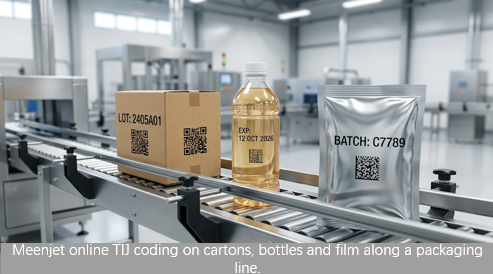
Packaging lines need reliable coding: dates, batch numbers, QR codes, and variable data. Three technologies compete for this job: online thermal inkjet (TIJ), continuous inkjet (CIJ), and laser. Each works at different speeds, on different substrates, and at different total cost of ownership.
This guide compares TIJ against CIJ and laser for packaging lines, and explains how to choose between the two Meenjet online TIJ models: MXPlus for small and medium lines, and MXPro for high-speed lines.
???? For Production & Packaging Managers
Question | Answer |
Which technology is best for cartons? | Online TIJ. Fast, low maintenance, prints on porous surfaces. |
Which technology is best for bottles? | TIJ or CIJ. TIJ for medium speed; CIJ for very high speed. |
Which technology is best for film? | TIJ or laser. TIJ for flexible film; laser for permanent marks. |
Which has the lowest maintenance? | TIJ. No wearing parts, no solvent handling, no routine nozzle cleaning. |
Which technology runs fastest? | CIJ and MXPro. MXPro reaches 240 m/min; CIJ can exceed that. |
Which has the lowest total cost of ownership? | TIJ for most small and medium lines. |
Which Meenjet model for small and medium lines? | MXPlus (1–2 print heads, up to 120 m/min). |
Which Meenjet model for high-speed lines? | MXPro (1–4 print heads, up to 240 m/min). |
Glossary:
TIJ: Thermal Inkjet — ink is heated and ejected through a nozzle.
CIJ: Continuous Inkjet — ink droplets are continuously charged and deflected.
TCO: Total Cost of Ownership — equipment, consumables, maintenance, and downtime.
Photocell: A sensor that triggers printing when a product passes.
1. Why Online TIJ Is Different from Handheld TIJ
Handheld TIJ is designed for low-volume, on-demand marking. Online TIJ is designed for continuous production lines.
Factor | Handheld TIJ | Online TIJ |
Installation | Portable, battery-powered | Fixed on conveyor, powered by line |
Print speed | Manual pace | Up to 240 m/min (MXPro) |
Print height | 1–12.7 mm (typical) | 1–25.4 mm (MXPlus); 1–50.8 mm (MXPro) |
Trigger | Manual button | Photocell or encoder |
Use case | Asset marking, field service | Packaging lines, continuous coding |
Consumables | Ink cartridges | Ink cartridges |
Key insight: Handheld TIJ is a tool. Online TIJ is a production system. They share ink technology but serve different workflows.
2. CIJ vs Online TIJ vs Laser: Technology Comparison
Factor | Online TIJ | CIJ | Laser |
How it works | Ink is heated and ejected | Ink droplets are charged and deflected | Laser modifies the surface |
Print quality | High (up to 1,200 DPI) | Medium | High, permanent |
Speed | Up to 240 m/min (MXPro) | Very high (300+ m/min) | High, depends on material |
Maintenance | Low, no wearing parts | High, nozzle cleaning, solvent handling | Low, no consumables |
Consumables | Ink cartridges | Ink, solvent, make-up | None |
Substrate range | Porous and non-porous | Porous and non-porous | Depends on material |
Permanent mark | No | No | Yes |
Best for | Cartons, bottles, film, pipes, cables | High-speed beverage, cable, pipe | Metal, glass, hard plastics |
Upfront cost | Moderate | High | High |
Cost per mark | Low | Medium | Very low at high volume |
Key insight: CIJ wins on raw speed and continuous uptime. TIJ wins on print quality, maintenance, and total cost for most small and medium lines. Laser wins when a permanent mark is required.
3. Substrate Selection Guide
The right technology also depends on the substrate. The following guide covers the five most common packaging substrates.
Substrate 1: Cartons and Corrugated Board
Technology | Works? | Notes |
Online TIJ | ✅ Best choice | Fast, low maintenance, prints on porous surfaces |
CIJ | ✅ Works | Higher speed, higher maintenance |
Laser | ???? Limited | Can cut or burn corrugated board |
Recommendation: Online TIJ (MXPlus or MXPro). Use MXPro for high-speed carton lines.
Substrate 2: Bottles (PET, HDPE, Glass)
Technology | Works? | Notes |
Online TIJ | ✅ Good | Solvent or UV ink for non-porous surfaces |
CIJ | ✅ Best for very high speed | Standard in beverage lines |
Laser | ???? Depends | CO₂ laser for glass; UV laser for PET |
Recommendation: TIJ for medium speed; CIJ for very high speed beverage lines.
Substrate 3: Flexible Film and Pouches
Technology | Works? | Notes |
Online TIJ | ✅ Good | Solvent ink bonds well to film |
CIJ | ✅ Works | Fast, but solvent handling required |
Laser | ???? Limited | Can burn thin film |
Recommendation: TIJ for most film applications. Test ink adhesion before production.
Substrate 4: Pipes, Cables, and Extruded Profiles
Technology | Works? | Notes |
Online TIJ | ✅ Good | Prints on curved surfaces at line speed |
CIJ | ✅ Best for high speed | Common in cable and pipe extrusion |
Laser | ???? Depends | Works on some plastics, not all |
Recommendation: TIJ for medium speed; CIJ for high-speed extrusion lines.
Substrate 5: Metal and Glass
Technology | Works? | Notes |
Online TIJ | ???? Limited | Ink adhesion on bare metal is poor |
CIJ | ✅ Works | Common in canning and glass lines |
Laser | ✅ Best choice | Permanent mark on metal and glass |
Recommendation: Laser for permanent marks. TIJ only with proper surface treatment.
4. MXPlus vs MXPro: Which Online TIJ for Your Line?
Factor | MXPlus | MXPro |
Print heads | 1–2 | 1–4 |
Print height | 1–25.4 mm | 1–50.8 mm |
Maximum speed | 120 m/min | 240 m/min |
Resolution | X: 50–1,200 DPI; Y: 300–600 DPI | X: 50–1,200 DPI; Y: 300–600 DPI |
Communication | RS232 | TCP/IP, RS232, Modbus-TCP |
Interface | USB, DB9, I/O, Encoder, Photocell | Ethernet, USB, DB9, I/O, Encoder, Photocell |
Storage | 8 GB RAM | 8 GB, up to 10,000 messages |
Best for | Small and medium lines | High-speed industrial lines |
Typical industries | Cartons, bottles, boards, pipes, cables | Cartons, glass, plastics, metals, concrete, pipes |
Rule of thumb:
Line speed under 120 m/min → MXPlus
Line speed above 120 m/min → MXPro
Print height over 25.4 mm → MXPro
Multiple print heads needed → MXPro
5. Durability & Cost Comparison
Durability and cost are the two factors that most often decide the final choice.
Factor | Online TIJ | CIJ | Laser |
Expected lifespan | 5–8 years | 7–10 years | 10+ years |
Maintenance | Low | High | Low |
Consumables | Ink cartridges | Ink, solvent, make-up | None |
Cost per mark | Low | Medium | Very low at high volume |
Downtime risk | Low | Medium to high | Low |
Print quality | High | Medium | High |
Permanent mark | No | No | Yes |
Suitable volume | Low to high | Very high | Medium to high |
Rule of thumb: If the line runs under 240 m/min and the mark does not need to be permanent, TIJ usually has the lowest TCO. If the line runs above 240 m/min or needs a permanent mark, consider CIJ or laser.
Break-even analysis: For lines running 8 hours per day, online TIJ typically pays back the equipment cost within 12–18 months compared with CIJ, due to lower maintenance and consumable costs.
6. Meet the MXPlus and MXPro
MXPlus Online Thermal Inkjet Printer
An intelligent online TIJ coding machine for small and medium businesses.
1–2 print heads, print height up to 25.4 mm
Up to 120 m/min print speed
Up to 1,200 DPI resolution
7-inch touch screen with intuitive interface
Photocell sensor for automatic printing
Prints dates, batch codes, QR codes, and variable data
MXPro High-Speed Inline TIJ Printer
A high-speed industrial inline thermal inkjet printer for demanding packaging lines.
1–4 print heads, print height up to 50.8 mm
Up to 240 m/min print speed
X-axis 50–1,200 DPI; Y-axis 300–600 DPI
Separate controller and print head design
Supports TCP/IP, RS232, and Modbus-TCP
Prints on cartons, glass, plastics, metals, concrete, and pipes
Frequently Asked Questions (FAQ)
Q1: Can online TIJ replace CIJ on a high-speed line?
A: For lines up to 240 m/min, yes. MXPro handles most carton, bottle, and film applications. For lines above 240 m/min or continuous 24/7 operation, CIJ may still be required.
Q2: Do TIJ printers require daily maintenance?
A: No. TIJ printers have no wearing parts and no solvent handling. Routine maintenance is limited to replacing ink cartridges and cleaning the print head when needed.
Q3: Which Meenjet model should I choose for cartons?
A: MXPlus for lines under 120 m/min. MXPro for lines above 120 m/min or when print height exceeds 25.4 mm.
Q4: Can online TIJ print on curved surfaces like bottles and cables?
A: Yes. Online TIJ prints on curved surfaces at line speed. Ink adhesion depends on the substrate; test before production.
Q5: What is the minimum order for a free line audit?
A: No minimum. Send us your line details and product samples, and our engineers will recommend the right configuration.
???? Request a Free Line Audit
Send us your line details. Our engineers will:
Review your line speed, substrate, and print height requirements
Recommend MXPlus, MXPro, CIJ, or laser
Provide a cost and configuration proposal
No obligation. Report delivered within 5 business days.
???? Request a Free Line Audit
Related Technical Resources
About the Author
Meenjet Application Engineering Team — Over 15 years of combined field experience supporting online TIJ, handheld TIJ, and laser installations across manufacturing, packaging, and logistics. Our team has resolved hundreds of substrate compatibility and line integration challenges.
Reviewed by: Senior Application Engineer, Meenjet
Last Updated: October 15, 2026