




News & Blogs
By Meenjet Application Engineering Team | October 11, 2026
Executive Summary
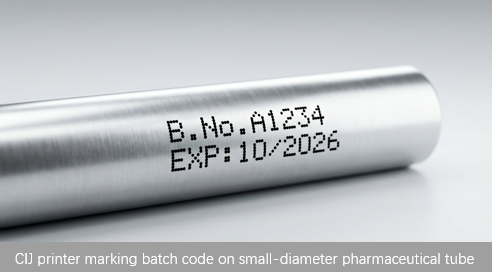
Pharmaceutical and ointment tubes present a specific coding challenge: printing batch codes, expiry dates, and lot numbers on a small-diameter, curved surface—at production speed, without smudging or distortion.
Tubes are typically 10–50 mm in diameter and made of aluminum, PE, PP, or laminate. The curved surface means the printhead must maintain a consistent throw distance across the curved surface. The small print window leaves little margin for positioning errors.
Continuous Inkjet (CIJ) handles this application—but only when the throw distance, ink viscosity, and encoder synchronization are correctly tuned. This guide covers the three coding challenges specific to tube packaging and how the Meenjet MX2890 handles them.
???? For Pharmaceutical Packaging Managers
Question | Answer |
What is this used for? | Batch codes, expiry dates, lot numbers, and serialization on pharmaceutical and ointment tubes. |
Why CIJ instead of TIJ? | CIJ handles higher line speeds and provides better adhesion on curved, non-porous tube surfaces. |
What is the main challenge? | Maintaining consistent throw distance across the curved surface—typically 2–8 mm depending on nozzle size. |
What about small tubes (<20 mm)? | Use a 40μm nozzle for a smaller spot size and finer character definition. |
Does it work on laminate tubes? | Yes. Solvent-based fast-dry ink adheres well to laminate, PE, and aluminum surfaces. |
1. Why Tube Coding Is Different from Bottle Coding
Property | Bottles | Tubes |
Diameter | 40–100 mm | 10–50 mm |
Surface curvature | Gentle | Tight |
Print window | Large | Narrow (often <15 mm) |
Rotational stability | Stable | May rotate during transport |
Typical line speed | 100–400 m/min | 60–200 m/min |
Key insight: A tube's small diameter means the surface curves away from the printhead faster than a bottle's. A throw distance that works at the center of the print area may be too far at the edges, causing character distortion.
2. Three Coding Challenges on Tube Lines
Challenge 1: Curved Surface and Throw Distance
What happens: Characters at the edges of the code appear stretched, compressed, or faded.
Why it happens: On a curved surface, the distance between the printhead and the tube surface varies across the print area. If the throw distance at the center is 5 mm, it may be 7 mm at the edge—enough to cause droplet divergence.
Directional tuning:
Reduce throw distance: Use the minimum reliable distance (2–4 mm for 40μm nozzle, 2–6 mm for 50μm nozzle)
Use a smaller nozzle: A 40μm nozzle produces a smaller spot, reducing edge distortion
Center the code in the print window: Position the code at the apex of the curve, not near the edge
Align the printhead perpendicular to the tube axis: Ensures the throw distance is consistent across the code height
Challenge 2: Ink Adhesion on Non-Porous Surfaces
What happens: The code smears or rubs off during handling, packaging, or sterilization.
Why it happens: Tube materials—PE, PP, laminate, and aluminum—are non-porous with low surface energy. Standard inks bead up rather than bond.
Directional tuning:
Use solvent-based fast-dry ink: Formulated for low-energy surfaces
Verify surface energy: Use a Dyne pen (target ≥38 dyn/cm). If below, corona treatment may be required
Reduce throw distance: Shorter distance improves droplet placement accuracy
Check drying time: Ensure ink dries before the tube contacts downstream guide rails
Challenge 3: Tube Rotation During Printing
What happens: The code appears skewed, rotated, or misaligned around the tube circumference.
Why it happens: Tubes may rotate slightly as they move along the conveyor. If the encoder is synchronized only to line speed (not tube rotation), the code will be misplaced.
Directional tuning:
Verify encoder synchronization: Pulse-per-mm must be calibrated at production speed
Use a tube guide rail: Stabilizes the tube and prevents rotation
Position the photocell correctly: Ensure the trigger point is consistent across all tubes
Check for tube slippage: If tubes slip on the conveyor, the encoder pulse count will be inaccurate
3. Parameter Tuning Matrix for Tube Coding
Tube Type | Nozzle Size | Throw Distance | Print Height | Key Adjustment |
Aluminum tube (10–20 mm) | 40μm | 2–4 mm | 0.6–5 mm | Center code on apex |
Aluminum tube (20–35 mm) | 50μm | 2–6 mm | 1–8 mm | Standard setup |
PE tube (10–20 mm) | 40μm | 2–4 mm | 0.6–5 mm | Verify surface energy |
PE tube (20–35 mm) | 50μm | 2–6 mm | 1–8 mm | Use fast-dry ink |
Laminate tube (any size) | 50μm | 2–6 mm | 1–8 mm | Check layer adhesion |
Large tube (>35 mm) | 65μm | 2–10 mm | 2–10 mm | Standard setup |
Note: These are starting points. Final parameters depend on tube material, diameter, ink type, and production speed. Always run a test grid before production.
4. Achieving Legible Codes on Small Tubes
For tubes with a diameter below 20 mm, the print window is often less than 10 mm. This leaves very little margin for positioning errors.
Recommendations:
Use a 40μm nozzle: Produces the smallest spot size for fine characters
Keep the code to 1–2 lines: Multiple lines increase the risk of edge distortion
Use a short code format: Minimize the number of characters to reduce print time
Verify with a barcode verifier: Check that 2D codes meet ISO/IEC 15415 Grade B or higher
Code format example for small tubes:
LOT: A1234
EXP: 2027-06
This two-line format fits in a 6–8 mm print window on a 15 mm tube.
5. Meenjet MX2890 for Tube Coding
Feature | Specification |
Printing lines | 1–5 lines |
Nozzle options | 40μm / 50μm / 65μm |
Print height | 0.6–5 mm (40μm), 1–8 mm (50μm), 2–10 mm (65μm) |
Throw distance | 2–8 mm (40μm), 2–10 mm (50μm), 2–20 mm (65μm) |
Printing speed | Up to 433 m/min (65μm nozzle, single-line 5×5 font) |
Barcodes | Code39, EAN8/13, Code128, EAN128, Data Matrix, QR Code, UPC-A |
QR codes | Data Matrix (10–32), QR Code (QR21/25/29) |
Interface | Photocell, shaft encoder, USB |
Screen | 10.1" HD touchscreen |
Consumables | 400 ml ink / 500 ml makeup |
Protection | IP54 operation interface |
Technical boundary: The MX2890 is capable of CIJ coding on pharmaceutical and ointment tubes, verified through internal application testing. However, tube materials and diameters vary widely. Final validation must be performed on your specific tubes. We recommend a free sample test before production commitment.
For complete specifications, visit the MX2890 product page.
Frequently Asked Questions (FAQ)
Q1: Can CIJ print on small tubes under 20 mm diameter?
A: Yes, with a 40μm nozzle and throw distance of 2–4 mm. Keep the code to 1–2 lines and center it on the apex of the curve.
Q2: Why does my code smear on PE tubes?
A: PE has low surface energy. Use solvent-based fast-dry ink and verify surface energy with a Dyne pen (target ≥38 dyn/cm). If below, corona treatment may be required.
Q3: How do I prevent tube rotation during printing?
A: Use a tube guide rail to stabilize the tube. Verify encoder synchronization and ensure the photocell trigger point is consistent.
Q4: What is the smallest character height achievable?
A: With a 40μm nozzle, minimum print height is 0.6 mm. For legibility, 1.0–1.5 mm is recommended for most pharmaceutical tube applications.
Q5: Does CIJ work on laminate tubes?
A: Yes. Solvent-based fast-dry ink adheres well to laminate surfaces. Verify adhesion with a rub test before production.
Q6: What is the minimum order for a free sample test?
A: No minimum. Send us your tube samples, and our engineers will test the optimal parameters and return a report within 5 business days.
???? Send Us Your Tubes for a Free Sample Test
Send us your pharmaceutical or ointment tubes. Our engineers will:
Test the optimal nozzle size, ink, and throw distance for your tube
Print a sample batch code and verify legibility
Recommend the right MX2890 configuration for your line
No obligation. Report delivered within 5 business days.
???? Request a Free Sample Test
Related Technical Resources
CIJ Ink Separation: How Temperature & Humidity Ruin Your Codes
CIJ Coding for Food Packaging: Meeting FDA & EU Food Contact Compliance
About the Author
Meenjet Application Engineering Team — Over 15 years of combined field experience supporting CIJ installations across pharmaceutical, cosmetic, food, and industrial packaging lines. Our team has resolved hundreds of adhesion, throw distance, and grade-verification issues on small-diameter and curved substrates.
Reviewed by: Senior CIJ Application Engineer, Meenjet
Last Updated: October 11, 2026