




News & Blogs
By Meenjet Application Engineering Team | November 16, 2026
Executive Summary
Lubricant and chemical containers are not coded in the same conditions as food packaging. The surfaces are often oily, dusty, or covered with a chemical film that prevents standard inks from bonding. Many containers are dark HDPE drums or coated metal pails, where a low-contrast code disappears against the surface. And the code itself—batch number, production date, QR or DataMatrix for traceability—is small, frequently changed, and must survive outdoor storage and handling.
This guide covers small-character CIJ coding for batch date coding and traceability on lubricant and chemical containers: ink adhesion on oily surfaces, high-contrast printing on dark containers, and code durability through transport. Large-character UN numbers and GHS hazard marks are typically pre-printed labels and are outside the scope of CIJ coding discussed here.
???? For Chemical & Lubricant Production Managers
Question | Answer |
Why does ink fail on lubricant containers? | Oil or chemical residue prevents the ink from bonding. Solvent-based or oil-resistant inks are required, and heavy residue should be wiped before printing. |
Can CIJ print on dark HDPE drums and metal pails? | Yes. Opaque white pigment ink for CIJ, or yellow pigment ink, provides contrast on dark surfaces. Adhesion should be tested on the actual container before production. |
What code content is CIJ used for on chemical containers? | Batch numbers, production and expiry dates, QR or DataMatrix codes for traceability, and supplementary production codes. |
Can CIJ print UN numbers and GHS hazard marks? | CIJ can print small supplementary codes. UN numbers and GHS hazard marks are usually pre-printed labels and are not the primary CIJ application on these containers. |
What print height is needed for batch and date codes? | Small-character codes typically range from 0.6 mm to 10 mm depending on the nozzle. The MX2890 covers 0.6–10 mm across its nozzle options. |
Does CIJ require consumables? | Yes, ink and make-up solvent. The MX1890 consumes roughly 10 ml of solvent per hour, and a 750 ml ink cartridge prints approximately 8 million characters. |
Which Meenjet CIJ model for micro-codes on small parts? | MX2890, with 40μm/50μm/65μm ruby nozzles and print height from 0.6 mm to 10 mm. |
Which Meenjet CIJ model for high-speed batch codes? | MX1890, with up to 4 lines and a maximum speed of 480 m/min in 5-dot high-speed mode. |
Glossary:
CIJ: Continuous Inkjet—ink droplets are continuously charged and deflected to form characters.
HDPE: High-density polyethylene, a common material for chemical drums and lubricant containers.
Opaque pigment ink: Ink formulated with pigment particles to produce a visible mark on dark or low-contrast surfaces.
Make-up solvent: Solvent added to CIJ ink to maintain viscosity as the ink is consumed.
Oil-resistant ink: Ink formulated to adhere to surfaces with light oil or chemical residue.
1. Why Chemical and Lubricant Container Coding Is Different
Food and beverage packaging is coded in wet or condensing environments. Chemical and lubricant containers are coded in oily, dusty, or chemically contaminated environments, and the containers themselves are often dark or coated.
Factor | Food & Beverage | Chemical & Lubricant |
Surface condition | Condensation, washdown | Oil residue, chemical film, dust |
Container color | Usually light | Often dark HDPE or coated metal |
Code content | Date, batch, QR | Batch, date, QR/DataMatrix, supplementary codes |
Character size | Small (1–12 mm) | Small (0.6–10 mm) for batch and date codes |
Environment | Wet, cold | Oily, dusty, outdoor storage |
Consequence of failure | Recall, retailer rejection | Traceability failure, transport delay, regulatory fine |
Key insight: On a chemical container, the code is small and the surface is hostile. The two variables that decide success are the ink and the contrast, not the printer's headline speed.
2. Challenge 1: Oil and Chemical Residue on Container Surfaces
Lubricant containers are often filled and capped with oil residue on the outside. Chemical drums may carry residual solvent, dust, or release agents. Water-based and some standard solvent inks cannot penetrate an oil film—the ink sits on top, does not bond, and rubs off during handling.
Lubricant filling lines often carry airborne oil mist that settles on container surfaces downstream of the filler. The residue is lighter than a liquid film but still sufficient to inhibit adhesion on untreated HDPE. The failure mode is not always the ink itself: a thin film left by an over-lubricated capping head, or by a filler nozzle that drips between cycles, can be enough to prevent bonding even when the ink chemistry is correct.
Ink Selection for Oil-Resistant Adhesion
Solvent-based inks: Formulated to penetrate light oil films and bond to HDPE or coated metal.
Oil-resistant inks: Designed for lubricant containers and oily surfaces. Confirm with the ink supplier that the formulation is compatible with the specific oil or chemical residue.
Surface preparation: Heavy oil or chemical residue should be wiped before printing. Light oil films may be printable with parameter tuning.
Print Position
Print on a dry, clean area of the container. Avoid the fill cap, the handle, and areas where oil pools. On drums, the side wall or the top rim is typically cleaner than the bottom.
Key insight: Ink adhesion is an ink property, not a printer property. The right ink determines whether the code survives the oil film.
3. Challenge 2: High-Contrast Small-Character Coding on Dark Containers
Many chemical drums and lubricant pails are dark HDPE or coated metal. A standard black code on a dark surface is technically printed and practically unreadable. On a dark chemical container, two variables determine readability: the contrast of the ink against the surface, and the size of the character relative to the container surface area.
Opaque Pigment Inks
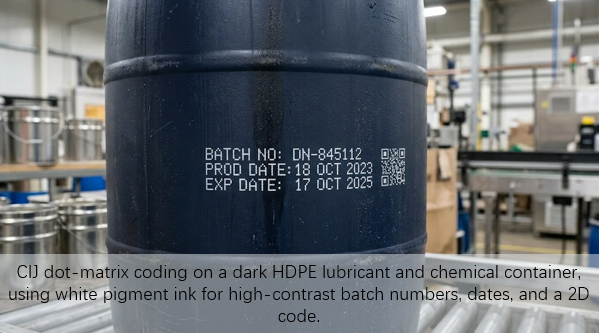
The MX2890 supports opaque white and yellow pigment inks. These inks sit on the surface rather than being absorbed, producing a visible mark on dark PVC, dark HDPE, and coated metal. For dark containers, white pigment ink for CIJ is the difference between a readable code and a rejected batch.
Micro-Character Capability
Batch numbers and traceability codes on small containers and caps are often printed at 0.6–5 mm. The MX2890 uses 40μm, 50μm, and 65μm ruby nozzles to cover a print height range from 0.6 mm to 10 mm, so the same printer can handle micro-codes on small parts and standard batch codes on larger containers.
Code Content Beyond the Date
Modern traceability requirements often call for a QR or DataMatrix code in addition to the batch number and date. The MX2890 supports Code 39, EAN8, EAN13, Code 128, EAN128, UPC-A, Data Matrix, and QR Code, and stores more than 10,000 print files in 8 GB of internal memory—enough for frequent code changes across a product range.
Key insight: On dark chemical containers, contrast is a production requirement, not an aesthetic choice. The ink and the nozzle together determine whether the code is readable.
4. Challenge 3: Code Durability Through Transport and Storage
A code that is readable at the end of the line but fades in the warehouse is a traceability failure. Chemical and lubricant containers are stored outdoors, stacked, exposed to rain and humidity, and handled repeatedly before they reach the end user. The code must survive UV exposure, stacking and handling, rain and temperature swings, and residual oil or chemical film on the surface.
Solvent-based and oil-resistant inks are formulated for these conditions. Opaque pigment inks add a further layer of durability on dark surfaces because the pigment remains visible even if the surface is lightly abraded. Test the ink on the specific container material and residue before production.
The Compliance Boundary
CIJ is the marking tool, not the compliance system. GHS labels, UN numbers, and transport marks are usually pre-printed labels applied separately. CIJ's role on chemical containers is the batch number, date, and traceability code—and those marks are only compliant if the content, format, and placement meet the local requirements for the product and market. In the EU, GHS label elements follow CLP Regulation (EC) No 1272/2008; in the US, OSHA's HazCom standard aligned with GHS Rev. 7 in 2024 introduced specific provisions for small containers.
Key insight: Durability is decided by the ink and the surface, not by the printer's specifications. A code that survives the line but not the warehouse is not a compliant code.
5. Meet the MX Series CIJ Printers
For lubricant and chemical container lines, the CIJ printer must handle oily surfaces, dark containers, small characters, and frequent code changes. Two Meenjet CIJ models cover these conditions.
MX2890: 40μm/50μm/65μm ruby nozzles, print height from 0.6 mm to 10 mm, up to 5 lines, 433 m/min, opaque white and yellow pigment inks, IP54 stainless steel chassis. Best for micro-codes on small parts and high-contrast batch codes on dark containers.
MX1890: Up to 4 lines, maximum speed 480 m/min in 5-dot high-speed mode, 10.1-inch capacitive touch screen, IP55 protection, 750 ml ink cartridge printing approximately 8 million characters, 30-day standby with one-click restart. Best for high-speed batch and date coding on flat and curved surfaces.
Both models support photocell and encoder synchronization, USB data interface, and multi-language operation. For full specifications, see the MX2890 product page and the MX1890 product page.
Frequently Asked Questions (FAQ)
Q1: How much ink does a date code printer consume on a chemical container line?
A: Consumption depends on character size and line speed. The MX1890 uses roughly 10 ml of make-up solvent per hour and prints approximately 8 million characters from a 750 ml ink cartridge, which is enough for about 1 million production dates under typical conditions.
Q2: What does IP54 or IP55 protection mean for a CIJ printer on a chemical line?
A: IP54 (MX2890) and IP55 (MX1890) protect against dust ingress and water spray. On chemical and lubricant lines, this matters because the printer is exposed to dust, humidity, and occasional washdown near the filling area. Neither rating covers immersion.
Q3: Can I use third-party or OEM-compatible ink in the MX series?
A: Meenjet recommends ink specified for the MX series. Third-party ink may void the warranty and can affect adhesion, drying, and nozzle life. For oil-resistant and pigment applications, ink chemistry is the variable that decides whether the code survives the container surface—substituting ink is a reliability risk, not a cost saving.
???? Request a Free Line Audit
Send us your container samples. Our engineers will:
Test the MX series on your specific HDPE, coated metal, or dark containers
Recommend the right ink for oil resistance and contrast
Provide a cost and configuration proposal
No obligation. Report delivered within 5 business days.
???? Request a Free Line Audit
Related Technical Resources
About the Author
Meenjet Application Engineering Team — Over 15 years of combined field experience supporting CIJ, TIJ, and laser installations across chemical, lubricant, food and beverage, and packaging manufacturing.
Reviewed by: Senior Application Engineer, Meenjet
Last Updated: November 16, 2026