



News & Blogs
By Meenjet Application Engineering Team | October 8, 2026
Executive Summary
UV laser marking on glass bottles produces a clean, permanent mark without ink or labels—but it introduces a specific risk: micro-cracking. When the laser energy is too high or the pulse duration too long, the glass surface fractures at a microscopic level. The mark may look acceptable at first, but the bottle can fail under pressure, thermal shock, or filling stress.
This guide covers the three failure modes specific to UV laser marking on glass, the parameter tuning that prevents micro-cracking, and how the Meenjet MUF series UV laser handles pharmaceutical, cosmetic, and beverage glass containers.
???? For Glass Packaging & Production Managers
Question | Answer |
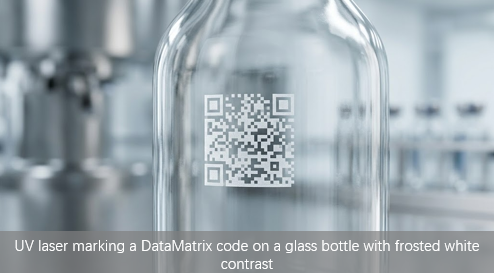
What is this used for? | Date codes, batch numbers, QR/DataMatrix codes, and logos on glass bottles—without ink or labels. |
Why UV laser instead of CO₂? | UV laser (355 nm) is absorbed at the surface, producing a "cold" mark. CO₂ laser (10.6 μm) transfers more heat and creates deeper fractures. |
What causes micro-cracking? | Excessive pulse energy, long pulse duration, or high repetition rate. |
Can UV laser mark frosted glass? | Yes, but frosted surfaces scatter light and require higher energy—increasing crack risk. |
Does the mark survive autoclaving? | Yes, when parameters are correctly tuned. The mark is part of the glass surface, not a coating. |
1. Why UV Laser Fits Glass Bottles
Property | UV Laser (355 nm) | CO₂ Laser (10.6 μm) |
Absorption in glass | High (surface absorption) | Moderate (deeper penetration) |
Heat-affected zone | Very small (cold marking) | Larger (thermal marking) |
Micro-crack risk | Low (with proper tuning) | Higher |
Mark appearance | Frosted white, high contrast | Engraved, gray-white |
Best for | Thin-wall bottles, pharmaceutical vials | Thick glass, decorative engraving |
Key insight: UV laser marking on glass works through surface ablation—the laser energy breaks molecular bonds at or near the surface, creating a frosted, high-contrast mark without deep heat penetration.
Glossary: Surface ablation is the process by which laser energy removes or modifies a microscopic layer of material at the surface, without affecting the bulk material below.
2. Three Failure Modes in UV Laser Glass Marking
Failure Mode 1: Micro-Cracking
What happens: The mark appears acceptable, but microscopic fractures form around the edges. Under stress (filling pressure, thermal shock), the bottle may crack.
Why it happens: Excessive pulse energy or long pulse duration causes localized thermal expansion, which exceeds the glass's tensile strength.
Directional tuning:
· Reduce pulse energy: Lower the power until the mark is just visible
· Shorten pulse duration: Use 10–20 ns rather than 30–50 ns
· Increase marking speed: Faster scanning reduces thermal accumulation at any single point
· Verify with a polariscope: A polariscope is an optical instrument that reveals internal stress patterns by passing polarized light through a transparent sample. It detects stress that is invisible to the naked eye
Failure Mode 2: Low Contrast or Faint Mark
What happens: The mark is visible but faint, with low contrast against the glass.
Why it happens: Insufficient energy is deposited, or the focal point is not set precisely at the glass surface.
Directional tuning:
· Increase pulse energy gradually: Raise power in 5% increments until contrast is acceptable
· Verify focal point: Use a focal point gauge; UV laser focal depth is ±1.5 mm
· Reduce marking speed: Slower scanning deposits more energy per unit area
· Check for surface contamination: Oil or dust on the glass absorbs laser energy, reducing mark quality
Failure Mode 3: Uneven or Distorted Codes
What happens: 2D codes (QR, DataMatrix) fail verification because cell edges are blurred or distorted.
Why it happens: On curved bottle surfaces, the focal point drifts across the marking area. The galvo scanner must track the surface curvature.
Directional tuning:
· Use a 3D dynamic focus system: Adjusts the focal point in real time across curved surfaces
· Use a longer focal length lens: Reduces focal drift on curved surfaces
· Reduce marking area: Split large codes into smaller sections
· Verify with ISO/IEC 15415: Check Grade A or B scannability
3. Parameter Tuning Matrix for Glass Bottles
Glass Type | Pulse Energy | Pulse Duration | Marking Speed | Key Adjustment |
Clear glass (thin wall) | Low | 10–15 ns | Fast | Minimize heat input |
Clear glass (thick wall) | Medium | 15–25 ns | Medium | Increase energy gradually |
Frosted glass | High | 20–30 ns | Slow | Accept higher crack risk |
Amber glass | Medium | 15–20 ns | Medium | Verify contrast |
Coated glass | Low | 10–15 ns | Fast | Remove coating first if possible |
Note: These are starting points. Final parameters depend on glass composition, wall thickness, and required mark contrast. Always run a test grid before production.
4. Achieving ISO/IEC 15415 Grade A on Glass Bottles
Parameter | Grade A Threshold |
Symbol Contrast (SC) | ≥ 70% |
Modulation (MOD) | ≥ 0.60 |
Axial Nonuniformity (AN) | ≤ 0.06 |
Grid Nonuniformity (GNU) | ≤ 0.38 |
Tuning for Grade A:
· Increase contrast: Higher pulse energy or slower marking speed
· Improve modulation: Use a defocused beam (+1–2 mm) for smoother cell edges
· Minimize grid distortion: Use 3D dynamic focus on curved bottles
· Verify on the actual bottle: Flat test samples do not replicate curved surface behavior
5. Meenjet MUF Series UV Laser for Glass Bottles
Feature | Specification |
Models | MUF-5 (≥5.5W) / MUF-10 (≥11W) |
Wavelength | 355 nm (UV cold marking) |
Marking speed | Up to 12,000 mm/s |
Cooling | Water-cooled |
Marking area | 110 × 110 mm (optional: 110–300 mm) |
Positioning | Dual red light focusing indicator |
Operation system | Linux, touch screen control |
Compatible materials | Glass, carton, ABS, PVC, acrylic, HDPE, rubber, silicone, epoxy resin, architectural ceramics |
Technical boundary: The MUF series is capable of UV laser marking on glass bottles, verified through internal application testing. However, glass composition and wall thickness vary widely. Final validation must be performed on your specific bottles. We recommend a free sample test before production commitment.
For complete specifications, visit the MUF UV Laser Product Page.
Frequently Asked Questions (FAQ)
Q1: Can UV laser marking weaken glass bottles?
A: Not when properly tuned. UV laser marking affects only a microscopic layer at or near the glass surface. The bottle's structural integrity is preserved as long as micro-cracking is avoided.
Q2: How do I check for micro-cracks after marking?
A: Use a polariscope or a 10x magnifier with side lighting. A polariscope reveals internal stress patterns that are invisible to the naked eye.
Q3: Can UV laser mark frosted glass?
A: Yes, but frosted surfaces scatter light and require higher energy—which increases crack risk. Test carefully and consider reducing mark depth.
Q4: Does the mark survive sterilization or autoclaving?
A: Yes. The UV mark is part of the glass surface, not a coating. It survives autoclaving, chemical washing, and thermal cycling.
Q5: What is the minimum order for a free sample test?
A: No minimum. Send us your glass bottles, and our engineers will test the optimal parameters and return a report within 5 business days.
Q6: Can UV laser print DataMatrix codes on curved bottles?
A: Yes, with a 3D dynamic focus system. Without it, focal drift on curved surfaces may reduce code grade. For bottle diameters below 30 mm, dynamic focus is strongly recommended.
???? Send Us Your Glass Bottles for a Free Sample Test
Send us your glass bottles. Our engineers will:
1. Test the optimal UV laser parameters for your glass type
2. Print a sample DataMatrix or QR code and verify against ISO/IEC 15415
3. Check for micro-cracks using a polariscope
4. Recommend the right MUF series configuration for your line
No obligation. Report delivered within 5 business days.
???? Request a Free Sample Test
Related Technical Resources
· UV Laser Guide: Fix QR Code Reading Failures on Glass Bottles (No-Read Errors)
· Best Technical Solutions for Frosted Glass Bottle Marking
· How to Fix Dynamic Focal Depth Failures When Marking Curved or Uneven Surfaces
About the Author
Meenjet Application Engineering Team — Over 15 years of combined field experience supporting UV laser installations across pharmaceutical, cosmetic, and beverage glass packaging lines. Our team has resolved hundreds of micro-cracking, contrast, and grade-verification issues on glass containers.
Reviewed by: Senior UV Laser Application Engineer, Meenjet
Last Updated: October 8, 2026