




News & Blogs
By Meenjet Application Engineering Team | November 27, 2026
Executive Summary
In steel service centers, aluminum extrusion plants, and roll-forming lines, continuous identification is mandatory for upstream-to-downstream traceability. Every galvanized coil, cold-rolled sheet, and extruded profile requires clear batch codes, alloy grades, heat numbers, and meter marks before slitting, stamping, or shipping.
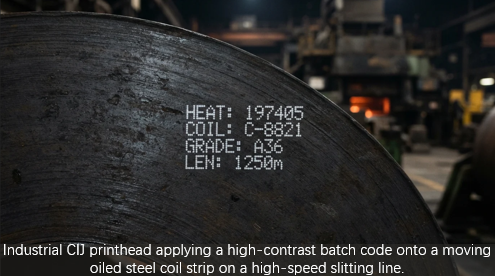
However, metal rolling and slitting lines present harsh coding conditions: line speeds routinely exceed 60–150 m/min, metal edges vibrate or flutter, and surfaces are coated with protective rust-preventive oils. Contact rollers smear on oiled surfaces, thermal inkjet (TIJ) printheads risk physical collision due to their 1–2 mm throw distance, and high-speed flying lasers struggle with oil-film smoke and high capital costs when temporary or semi-permanent traceability is sufficient.
This guide examines the three engineering variables that govern reliable Continuous Inkjet (CIJ) marking on metal coils, profiles, and sheet metal: penetrating rust-preventive oil films without ink migration, achieving high contrast on dark or reflective alloys, and maintaining safe non-contact throw distances on vibrating lines.
???? Quick Reference for Metallurgy & Mill Maintenance Engineers
Question | Technical Answer |
Can CIJ ink adhere directly over rust-preventive oil? | Yes. Specialized oil-penetrating MEK/ketone inks cut through light-to-moderate protective oil films to bond directly with the underlying steel or aluminum substrate. |
How does CIJ avoid printhead damage from vibrating metal edges? | CIJ maintains a 10–20 mm non-contact throw distance (depending on nozzle size), providing generous mechanical clearance above fluttering sheet edges or welded coil seams. |
How do you get readable codes on dark hot-rolled steel or black pipe? | By using opaque white or yellow pigment CIJ inks, which lay down a solid, high-contrast layer over dark mill scale instead of disappearing like standard black dye ink. |
Will the printed code transfer onto adjacent layers when recoiled? | Fast-drying oil-penetrating formulations cure in under 1–2 seconds—well before the strip reaches the recoiler tension reel—preventing ink transfer or ghosting between coil wraps. |
Can CIJ integrate with high-speed slitting and cut-to-length lines? | Yes. Using an external shaft encoder and photocell triggers, industrial CIJ systems synchronize print pitch and meter marks accurately across variable line speeds up to 400+ m/min. |
1. Why Conventional Marking Fails on Rolling and Slitting Lines
Metal processing environments punish standard coding equipment. Whether printing along the edge of a cold-rolled steel strip or across the web of an extruded aluminum profile, three failure modes routinely disrupt traceability:
Oil Film Barrier & Smearing: Cold-rolled steel, galvanized sheets, and tinplate carry thin layers of rolling lubricant or anti-corrosion oil. Standard inks bead up on the oil surface and wipe off during stacking, strapping, or roll forming.
Mechanical Clearance Hazards: Metal strips rarely run perfectly flat. Camber, edge wave, and welded coil joints create sudden vertical movement. Any printhead requiring close proximity (<3 mm) risks catastrophic mechanical impact.
Ink Transfer During Recoiling (Blocking): On slitting and recoiling lines, freshly printed metal wraps tightly under high tension within seconds. If the ink fails to flash-dry completely, the batch code transfers onto the underside of the next wrap, creating illegible double prints.
Factor | Contact Rollers / Stamping | Thermal Inkjet (TIJ) | Industrial CIJ (Oil-Penetrating) |
Throw Distance | 0 mm (Direct contact) | 1–2 mm (High collision risk) | 10–20 mm (Safe non-contact clearance) |
Oiled Surface Adhesion | Smears heavily on oil films | Poor penetration on heavy oil | Penetrates thin oil to bond with metal |
Contrast on Dark Steel | Low visibility | Limited opaque pigment options | High-contrast white/yellow pigment inks |
Line Speed Capability | Limited by mechanical inertia | Drops resolution at high speed | Up to 400+ m/min with encoder sync |
Key insight: On high-speed metal lines, printhead clearance and ink chemistry are inseparable. A 10–15 mm non-contact throw distance protects the hardware from strip flutter, while oil-penetrating solvents ensure the code survives handling.
2. Challenge 1: Penetrating Rust-Preventive Oils Without Migration
The primary chemical hurdle in metallurgical coding is surface tension. Rust-preventive oils create a low-energy barrier that repels water-based and standard alcohol-based inks.
How Oil-Penetrating CIJ Inks Work
Industrial oil-penetrating CIJ formulations rely on fast-evaporating ketone/MEK solvent carriers paired with specialized binding resins:
Film Displacement: Upon droplet impact, the active solvent carrier locally disperses and dissolves the microscopic oil film, allowing the resin and colorant to wet the bare metal oxide layer directly beneath.
Rapid Flash-Off: Within 1 to 2 seconds at ambient mill temperatures, the solvent evaporates, locking the resin onto the metal before the strip enters pinch rolls, shears, or recoilers.
Controlled Migration: Unlike low-grade inks that bleed outward along oil streaks, engineered metal-grade resins maintain sharp dot boundaries, keeping 1D barcodes (Code 128, Code 39) and 2D DataMatrix codes scannable.
Engineering Boundary: Oil-penetrating CIJ inks perform reliably through standard factory rust-preventive coatings (typically up to 1–3 g/m² oil film weight). However, if the strip is flooded with heavy, dripping slushing oil prior to stamping, installing a simple air-knife wipe upstream of the printhead is recommended to prevent droplet wash-off.
Key insight: You do not need to degrease an entire steel coil just to print a batch number. Matching an oil-penetrating ketone ink with proper drying distance before the recoiler eliminates ink transfer between wraps.
3. Challenge 2: Contrast on Dark Alloys vs. Bright Reflective Surfaces
Metal substrates span two visual extremes—dark, oxidized hot-rolled steel and bright, mirror-like galvanized or stainless finishes. A single ink type cannot serve both.
Dark Hot-Rolled Steel, Black Pipe & Cast Profiles: Standard black dye ink disappears completely against dark mill scale. These lines require opaque pigment inks (white or yellow) suspended in fast-drying solvents. Because pigment particles are heavier than dissolved dyes, the CIJ system must feature automated ink agitation and circulation (such as the MX2890’s internal ink circulation system) to prevent sedimentation during weekend shutdowns.
Bright Galvanized Steel, Aluminum & Tinplate: On reflective surfaces, high-density black or dark blue dye-based ketone inks deliver maximum contrast without requiring pigment agitation, offering lower maintenance and higher print speeds.
4. Challenge 3: Line Speed Synchronization and Mill Dust Protection
Slitting, cut-to-length, and profile extrusion lines rarely run at a single fixed speed; they accelerate, decelerate, and pause for coil changes. Furthermore, rolling mills and cutting lines generate conductive metallic dust, oil mist, and ambient temperature swings.
Integration Essentials for Metal Lines
Shaft Encoder Synchronization: Connecting an industrial shaft encoder directly to the conveyor or pinch roll ensures that character width and meter-mark intervals remain exact regardless of line acceleration or deceleration.
Robust Printhead Sealing & Auto-Flush: Fine metallic dust and oil mist can foul exposed nozzles. Automated nozzle sealing during line stops and self-cleaning startup cycles prevent costly morning flush delays.
Key insight: On cut-to-length and slitting lines, fixed-timer printing causes stretched or compressed text during ramp-up. Direct shaft encoder feedback is mandatory for accurate meter marking and coil traceability.
5. Matching Meenjet CIJ Solutions to Metal Processing Lines
Selecting the right CIJ configuration depends primarily on substrate color (dye vs. opaque pigment) and required throw distance:
For Dark Hot-Rolled Steel, Black Profiles & High-Contrast Needs (Meenjet MX2890): Engineered to run both standard dye inks and opaque white/yellow pigment inks reliably. Equipped with a 65 μm ruby nozzle (offering up to a 20 mm throw distance), an auto-sealing printhead, and a dedicated ink circulation system, the MX2890 prevents pigment clogging during line stops while delivering crisp, high-contrast heat numbers and DataMatrix codes on dark metal surfaces.
For High-Speed Bright Galvanized Coils, Aluminum & Tinplate (Meenjet MX1890): Built for continuous, high-throughput lines running black or colored oil-penetrating dye inks at speeds up to 480 m/min. With a recommended 12 mm throw distance, IP55 environmental protection, and a 30-day standby one-click restart function, it minimizes solvent consumption and operator intervention on fast slitting and roll-forming lines.
Frequently Asked Questions (FAQ)
Q1: Will CIJ ink stay on oiled cold-rolled steel during subsequent stamping or bending?
A: Yes. Once an oil-penetrating ketone ink flashes off (within 1–2 seconds), the resin bonds to the metal surface and withstands normal roll-forming, slitting, and dry handling. If the part later undergoes aggressive alkaline degreasing or acid pickling prior to painting, the mark can be cleanly removed—making it ideal for in-process mill traceability that should not show through final paint coats.
Q2: What is the safest distance between the CIJ printhead and a moving metal strip?
A: For flat or mildly undulating metal sheets and coils, a throw distance of 10–15 mm (up to 20 mm when using a 65 μm nozzle) provides reliable character formation while keeping the printhead clear of strip flutter or welded seams.
Q3: How do you prevent white or yellow pigment ink from clogging during shift changes?
A: Pigment inks require continuous hydraulic circulation and an auto-sealing nozzle design. When shut down properly, the printhead seals the nozzle orifice and retracts ink from the gutter line, preventing pigment sedimentation and ensuring clean restarts.
Q4: Can CIJ print scannable barcodes or DataMatrix codes on brushed metal?
A: Yes. Provided the encoder resolution is matched to line speed and the surface oil is uniform (not pooling), CIJ prints crisp Code 128 and DataMatrix codes suitable for automated warehouse and coil-yard scanning.
???? Request an Oil-Penetrating Ink Adhesion Test on Your Metal Sample
Send us a coupon of your actual coated steel, galvanized sheet, or extruded aluminum profile—complete with your standard factory rust-preventive oil—along with your line speed and code requirements. Our application engineers will:
Test black dye and opaque white/yellow pigment formulations directly on your oiled substrate.
Verify drying time, rub resistance, and recoiling transfer behavior.
Recommend the optimal nozzle size, throw distance, and encoder setup.
No obligation. Comprehensive adhesion test report delivered within 5 business days.
???? Request a Free Sample Test
Related Technical Resources
Continuous Inkjet (CIJ) Coding on Tinplate Cans: Selecting High-Adhesion Inks
High-Contrast Marking on Dark Cables and Extruded Profiles: Pigment vs. Dye CIJ Inks
How to Prevent CIJ Nozzle Clogging During Extended Line Shutdowns
About the Author
Meenjet Application Engineering Team — Over 15 years of combined field experience supporting industrial CIJ, TIJ, and laser coding installations across metallurgy, metal fabrication, wire & cable, and heavy manufacturing.
Reviewed by: Senior CIJ Application Engineer, Meenjet
Last Updated: November 27, 2026