




News & Blogs
Achieving high-visibility tracking data on fast-moving substrates is a foundational requirement for modern trace-and-trace packaging. When a batch coder fails to deliver crisp, legible marks, manufacturing facilities risk compliance penalties, supply chain rejection, and compromised brand integrity. This technical guide analyzes the root causes of low-contrast coding anomalies on automated lines and evaluates high-efficiency marking solutions to correct them.
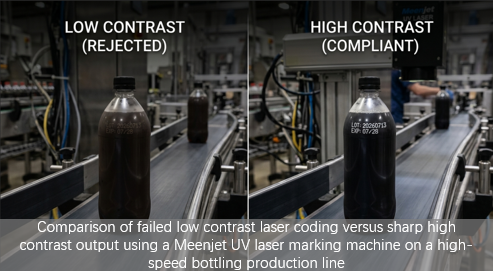
1. Root Causes of Low Contrast at High Velocities
Low contrast typically stems from an incompatibility between the substrate surface, the packaging line velocity, and the chosen coding technology. In high-speed packaging environments, three primary factors degrade print clarity:
Substrate Absorption and Color Density: Dark plastics, amber glass, and corrugated fiberboards absorb standard dark inks. Printing black text on a dark brown or dark green surface results in near-zero legibility, rendering the expiry date machine ineffective.
Ink Dwell Time & Micro-Purging: When utilizing an industrial inkjet printer, the ink must dry instantly to prevent smudging. High line speeds restrict the physical time available for solvents to flash off, leading to blurred graphics.
Thermal Transfer Limitations: Traditional contact systems, such as a Ribbon Printer or an older thermal coding machine, struggle to maintain adequate ribbon-to-substrate dwell times when line speeds exceed specific throughput thresholds, necessitating a shift to non-contact digital solutions.
2. Primary Coding Technologies for High-Contrast Integration
To eliminate legibility errors, manufacturing plants must transition to high speed inkjet printers or advanced non-contact laser coding architectures that align with their specific substrate profiles.
Continuous Inkjet (CIJ) Systems
For non-stop, multi-shift packaging operations, an industrial continuous inkjet printer is the industry standard. These systems utilize a pressurized ink stream to integrate seamlessly with a variable data printing machine, ensuring consistent coding across uneven surfaces. When dealing with dark plastics or extruded wiring, deploying an inkjet printer white ink formulation or specialized yellow pigmented fluids ensures maximum optical contrast. These heavy-pigment ink marking systems keep particles in perpetual suspension to prevent nozzle clogging during high-speed run times.
Thermal Inkjet (TIJ) Solutions
For high-resolution cartoning applications, integrating a cartridge-based TIJ inkjet printer provides pixel-perfect edge definition. Working as an efficient inline inkjet printer, TIJ technology utilizes thermal energy to drop ink precisely onto porous or semi-porous surfaces. It is an ideal date code printer for pharmaceutical folding cartons and flexible film pouches, offering sharp font rendering that easily passes automated vision inspection tracking systems.
Industrial Laser Marking Systems
When fluid consumables are tracking-prohibitive, permanent laser marking solutions present a highly reliable alternative. By altering the substrate material properties directly via ablation or chemical color change, laser systems eliminate ink drying times entirely.
Fiber Laser Architecture: A fiber laser marking machine excels on metallic surfaces and high-density polymers, acting as an elite metal marking machine or cable tagging machine on continuous extrusion lines.
CO2 Laser Architecture: Deploying specialized laser marking co2 technology provides highly legible structural frosting on glass bottles and clear PET films without puncturing the barrier layer.
UV Laser Architecture: A specialized uv laser marking machine is reserved for "cold marking" delicate plastics and medical packaging, creating high-contrast carbonization marks without any thermal stress to the product packaging.
3. Comparative Technology Matrix
Technology Type | Substrate Suitability | Typical Contrast Method | Optimal Line Speed Placement |
Continuous Inkjet (CIJ) | Plastics, Metals, Glass, Wires | Pigmented Inks (White, Yellow, Blue) | Ultra-High Speed (Continuous Extrusion) |
Thermal Inkjet (TIJ) | Cartons, Foils, Paper, Smooth Plastics | High-Density Solvent/Water-Based Inks | Moderate to High Speed (Intermittent/Inline) |
Flying Laser Marker | Glass, Polymers, Metals, Bare Alloys | Material Ablation, Frosted Engraving, Color Change | High to Ultra-High Speed (Continuous/Flying Lines) |
4. Practical Optimization Steps for Packaging Engineers
To systematically troubleshoot low-contrast issues on an active packaging line, complete the following engineering diagnostic process:
Evaluate Optical Absorption: Verify if the substrate color absorbs the wavelength of the light or the color spectrum of the ink. For example, switching a date code machine on plastic bag substrates from black dye-based ink to a pigmented expiry date inkjet printer setup immediately resolves readability degradation.
Transition to Flying Systems: If line vibration or speed fluctuations cause code distortion, replace static hardware with a flying laser marking machine or a high-frequency inkjet coder machine that automatically synchronizes with shaft encoders.
Implement Automated Verifiers: Pair your product marking solutions with standard machine-vision scanners to verify code legibility in real-time, preventing unreadable batches from exiting the facility.
???? Strategic Engineering Insight: While a portable handheld printer or a handheld inkjet printer gun offers extreme flexibility for low-volume rework or manual warehouse labeling, high-speed automated lines require fixed, inline industrial coding solutions to maintain structural alignment and consistent focal depth. As a leading global provider, tailoring the right combination of high-contrast pigmented fluids or flying marking systems to specific velocities is essential for zero-defect packaging.
5. Conclusion
Fixing low-contrast coding errors requires matching the correct physical marking technology to the specific chemical attributes of the substrate. Whether deploying an automated inkjet marking machine paired with specialized high-contrast fluids, or integrating a robust laser coding framework, industrial facilities can secure clean, compliant tracking codes that stand up to rigorous supply chain scrutiny.