


News & Blogs
In high-volume manufacturing, the true cost of industrial packaging equipment is rarely reflected on the initial purchase invoice. For production managers calculating operational expenditure, selecting a batch coding technology is a balancing act between initial capital expenditure (CAPEX) and long-term operational expenditure (OPEX).
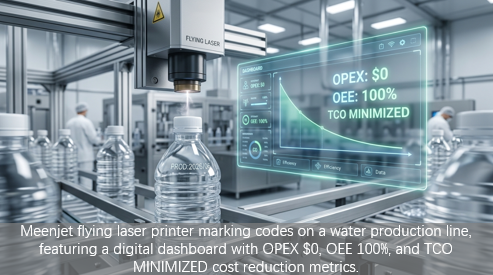
For decades, continuous inkjet printers (CIJ) have been the default choice for marking lot codes and expiration dates on fast-moving conveyor belts. However, as factories push for higher overall equipment effectiveness (OEE), the financial analysis has shifted.
When pitted against a modern flying laser marking machine, the seemingly budget-friendly CIJ setup often unmasks itself as an ongoing drain on corporate profitability. Here is a rigorous Return on Investment (ROI) and Total Cost of Ownership (TCO) breakdown comparing these two coding methodologies on high-speed lines.
The Initial Investment Myth: CAPEX vs. OPEX
The financial argument between CIJ and laser coding is structurally rooted in how cash flow is allocated over time. Historically, manufacturers assumed that laser systems required an unreachable upfront premium. Modern engineering has shattered this myth.
Continuous Inkjet Printers (Low CAPEX, Infinite OPEX): A standard industrial CIJ system has a relatively predictable entry barrier regarding upfront machinery cost. However, it functions on a continuous consumption model, relying on a non-stop supply of specialized inks, chemical make-up fluids, and replacement filtration blocks. On a high-speed line running multiple shifts, these recurring fluid expenses accumulate rapidly.
Flying Laser Marking Machines (Scalable CAPEX, Near-Zero OPEX): A co2 laser marking machine or fiber laser marking machine now offers a highly scalable initial investment, ranging from highly affordable entry-level models to premium industrial configurations. But regardless of the hardware tier, once installed, the recurring cost curve flattens completely. Because lasers utilize light energy to alter the substrate directly, they require zero inks, zero solvents, and zero physical consumables. The only ongoing operational cost is a negligible draw of factory electricity.
3-Year Total Cost of Ownership (TCO) Comparison
To visualize the financial trajectory, let’s look at a standard 3-year cost model for a high-speed packaging line operating 24/7 (approx. 6,000 production hours per year).
Cost Component | Continuous Inkjet Printer (CIJ) | Flying Laser Marking Machine |
Initial Hardware (CAPEX) | Low (approx. $3,000 - $5,000) | $2,000 - $15,000 (Entry-level to Premium) |
Annual Fluid Consumables | $2,000 - $4,000 (Ink, Makeup, Solvents) | $0 |
Routine Maintenance Parts | $600/year (Filters, pumps, seals) | $0 (Occasional lens wiping only) |
Average Equipment Lifespan | 3 - 5 years (Heavy mechanical wear) | 8 - 10+ years (Solid-state longevity) |
3-Year TCO Estimate | $10,800 - $18,800 | $2,000 - $15,000 |
???? The Break-Even Intersection: In high-throughput environments, the financial lines cross remarkably quickly. Factory data indicates that the break-even point for a premium system—such as Meenjet’s flying laser series—typically occurs between 12 to 18 months. Beyond this window, every code printed by the laser represents direct profit margin retained by the factory. For entry-level systems with a lower CAPEX, the ROI is realized even faster, often within the first few months of operation.
The Hidden Cost: Quantifying Production Downtime
While the direct costs of ink versus electricity are easy to calculate, the most devastating financial variable on a high-speed production line is unplanned downtime.
CIJ printers are intrinsically vulnerable to their environment. Because they expel a pressurized stream of fluid through a microscopic nozzle, they are highly sensitive to plant dust and humidity. A single line stoppage caused by a clogged printhead requires an operator to halt the line, execute a manual chemical purge, and recalibrate the system. On a high-speed bottling line, an unexpected 15-minute shutdown costs the plant hundreds of dollars per minute in lost output.
A flying fiber laser marking machine or CO2 unit eliminates these mechanical failure points entirely. There are no nozzles to dry out, no fluids to settle, and no pumps to fail. Industrial systems engineered by leading laser marking machine manufacturers like Meenjet utilize sealed optical enclosures (IP54/IP65) and digital scanning mirrors to execute crisp code date markings continuously with zero physical contact, keeping line OEE at its peak.
Streamlining System Integration
A common concern among engineers migrating from traditional inkjet setups is the complexity of plant integration. Modern flying lasers handle this transition natively. They are designed to interface directly with a factory's centralized batch coding system via industrial Ethernet protocols. When the production line shifts to a new batch, the laser controller updates the vector font data instantly without the physical calibration typical of legacy ink systems.
Final Decision Matrix
Choose CIJ If: Your production lines run intermittently, you handle highly irregular substrates that a fixed-focus optical lens cannot reach, or your facility lacks the immediate capital budget for upfront hardware procurement.
Choose a Flying Laser If: You run high-speed, multi-shift production lines where line efficiency is paramount. If you mark on standard materials like PET, cardboard, glass, or metals, a laser system is the definitive financial choice.
By partnering with a technically rigorous manufacturer like Meenjet, manufacturing plants can transition away from the volatile, unending cycle of ink procurement. Investing in a dedicated flying laser solution allows facilities to lock in predictable operational costs, maximize line velocity, and achieve an ironclad ROI that strengthens the bottom line for a decade to come.