



News & Blogs
In high-volume packaging and industrial manufacturing, achieving permanent, high-contrast traceability on non-metal substrates presents distinct physical challenges. While ink-based coding remains common, continuous production lines are shifting away from fluids due to adhesion failures and heavy maintenance overhead.
Among directed-energy technologies, CO2 laser marking stands out as the engineering standard for organic and synthetic material processing. This analysis breaks down the photothermal mechanics, material behaviors, and true operational costs that define this technology.
Technical Core: The 10.6μm Wavelength Advantage
The efficiency of a carbon dioxide () laser relies on an excited gas mixture that emits a far-infrared beam, with its principal wavelength concentrated at 10.6 micrometers (µm).
While shorter wavelengths (like the 1.06 µm beam from solid-state fiber lasers) pass cleanly through or reflect off organics, the 10.6 µm wavelength perfectly matches the natural molecular vibrational frequencies of non-metals. When the beam strikes the target, the substrate absorbs the energy instantly at the surface, triggering two distinct photothermal reactions:
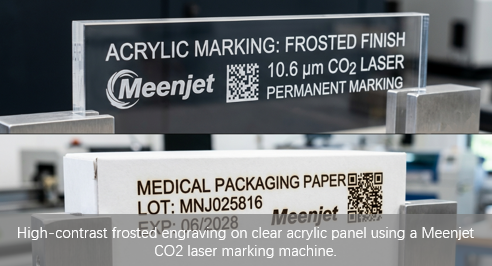
Ablation & Vaporization: The material converts directly into gas, leaving a clean, crisp recessed groove (ideal for acrylic and wood).
Controlled Surface Carbonization: The laser induces a localized thermal color shift, yielding high-contrast text or 2D codes without deep structural engraving (ideal for paperboard and packaging).
Operational Reality: Why Factories Choose CO2 Over Inkjet
When analyzing Total Cost of Ownership (TCO) and uptime, industrial production managers lean toward laser systems for three foundational reasons:
Zero Consumables, Fixed TCO: Unlike Continuous Inkjet (CIJ) or Thermal Inkjet (TIJ) systems, a laser requires no ink cartridges, make-up fluids, or solvent flushes. The single operating input is electricity, making your cost-per-mark highly predictable.
True Coding Permanence: Chemical solvents or mechanical friction can erase ink on glossy packaging. A laser mark structurally alters the surface layer, making the code completely immune to moisture, grease, and environmental wear.
High-Speed Line Integration: Equipped with high-velocity galvanometer mirrors (galvo scanners), premium systems—such as Meenjet’s flying laser marking series—dynamically project complex alphanumeric lot codes, expiration dates, and 2D DataMatrix tracking codes onto ultra-fast moving production lines without physical contact.
Substrate-Level Material Interactions
The thermal response of a non-metal substrate depends entirely on its structural density and absorption profile. Through extensive substrate testing across thousands of industrial verification runs, Meenjet’s application lab has quantified exactly how common materials react to the 10.6 µm beam:
Material | Primary Interaction | Visual Characteristic | Typical Industrial Application |
Acrylic (PMMA) | Surface Vaporization | Frosted, clean white contrast | Luxury cosmetics, premium signage |
Wood / Bamboo | Deep Carbonization | Dark, organic, permanent engraving | Craft items, structural lumber tracking |
PET / Polymers | Controlled Melting & Foaming | Clear, structural vector lines | Beverage bottling, rigid consumer plastics |
Glass / Quartz | Micro-Fracturing (Thermal Shock) | Translucent, elegant frosted texture | Pharmaceutical vials, liquor bottles |
Paperboard | Outer Layer Ablation | High-contrast color stripping | Secondary logistics cartons, FMCG boxes |
Industry Comparison: CO2 vs. Fiber and UV Lasers
Choosing the wrong laser wavelength leads to line stoppages or ruined scrap materials.
Fiber Lasers (1.06 µm): Designed with an ultra-small spot size and high energy density, fiber lasers excel at cutting and engraving hard metals or specific high-density plastics (like ABS). However, on wood, paper, or clear glass, the beam experiences zero absorption, passing straight through without leaving a mark.
UV Lasers (355 nm): Utilizing "cold ablation," ultraviolet lasers break molecular bonds photochemically. They are unparalleled for marking ultra-thin electronics or medical plastics without heat stress. However, their lower wattage options and high capital costs make them uneconomical for standard high-volume non-metal packaging lines.
Frequently Asked Questions
Can a CO2 laser marking machine code onto bare metals?
No. A bare, untreated metal surface reflects a 10.6$\mu m$ beam almost entirely. However, if the metal has an anodized layer, a paint coat, or a specialized ceramic spray, the laser can ablate that surface coating to reveal a high-contrast mark. For direct, raw metal etching, a fiber laser is required.
What dictates the lifespan and maintenance of an industrial CO2 laser?
The tube technology is the deciding factor. Glass laser tubes gradually lose gas pressure via diffusion, lasting roughly 2,000 to 5,000 active hours. For demanding industrial lines, manufacturers turn to RF-excited (Radio Frequency) metal or ceramic tubes, which offer exceptional beam quality, fast pulse frequencies, and operational lifespans exceeding 20,000 to 35,000 hours before requiring a gas recharge.
Industrial Application Note: To bridge this gap between cost efficiency and high-speed durability, heavy-duty industrial series—such as the Meenjet CO2 Laser Marking Machines—utilize premium RF tube engineering to guarantee stable power outputs on 24/7 high-velocity bottling and packaging lines.
Is fume extraction mandatory for CO2 laser setups?
Yes. Because lasers vaporize organics and polymers, the process generates micro-particulates and localized fumes. Integrating a dedicated extraction system equipped with HEPA and activated carbon filters is essential to protect the factory floor air quality and keep the laser's focusing optics clean from residue build-up.
Next Steps for Production Integration
Evaluating hardware configurations requires assessing your line speed, substrate density, and focal distance.
Need specific hardware specifications or a custom substrate test?