


News & Blogs
In high-speed beverage packaging, every millisecond counts. As production lines scale up to meet 2026 efficiency standards, traditional continuous inkjet printer setups are facing severe operational bottlenecks. In non-stop filling environments, frequent downtime for fluid top-ups, nozzle clogging, and printhead maintenance directly drains factory OEE (Overall Equipment Effectiveness).
To eliminate these vulnerabilities, modern facilities are aggressively transitioning to maintenance-free product marking solutions: flying laser marking machine technology.
Why Bottling Lines Are Replacing Inkjet with Flying Lasers
While an industrial inkjet printer remains effective for secondary packaging cartons, high-speed bottling environments present extreme challenges like surface moisture and high-speed friction.
Compared to static coding setups, a flying laser marking machine triggers ultra-fast laser pulses "on the fly" as containers pass sensors on a high-speed conveyor. This vector-based marking delivers three distinct B2B advantages:
Zero Consumables Cost: It completely eliminates the ongoing purchasing, storage, and volatile organic compound (VOC) compliance tracking of inks and solvents.
Permanent Code Dates: The marked code dates cannot be smudged by bottle condensation or scratched off during transit.
Maximum Line Uptime: Brands like Meenjet engineer their systems for 24/7 continuous operation, meaning zero scheduled stops for printhead flushing in humid filling rooms.
Technical Matching: Laser Wavelengths vs. Bottle Substrates
Choosing the best laser depends entirely on your packaging substrate. In 2026, high-speed lines have standardized around three dominant wavelengths:
1. CO2 Flying Laser Marking Machine (PET & Glass)
For standard mineral water, carbonated soft drinks, and glass wine bottles, a co2 laser marking machine is the industry benchmark.
Substrate Interaction: Utilizing a 9.3 μm or 10.6 μm wavelength, it creates a structural thermal reaction on the PET surface, leaving a frosted, high-contrast white mark without weakening the bottle wall.
Application: Ideal as a high-speed bottle date printer for clear plastics and glass surfaces.
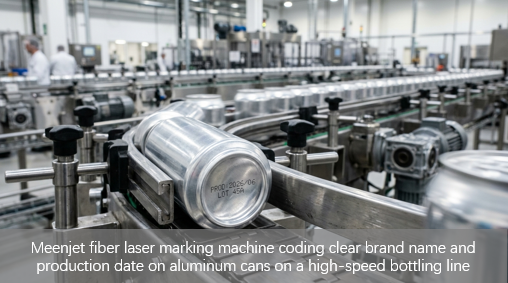
2. Flying Fiber Laser Marking Machine (Aluminum Cans & Caps)
If your plant handles energy drinks, canned beers, or uses metal crowns, you require a fiber laser marking machine.
Substrate Interaction: Fiber lasers utilize a shorter wavelength (1,064 nm) with a concentrated focal spot that perfectly alters metal surfaces, acting as a highly efficient metal marking machine.
Application: Delivers crisp, unalterable batch marking on aluminum can bottoms at speeds exceeding 100,000 cans per hour.
3. UV Laser Marking Machine (Premium & Thin-Walled Plastics)
For pharmaceutical bottling or ultra-thin sustainable bio-plastics, a uv laser marking machine is the premium choice.
Substrate Interaction: Operating via "cold marking" (355 nm), its ultraviolet light breaks chemical bonds at a molecular level rather than using thermal energy, completely avoiding heat deformation on sensitive films.
Laser vs. Inkjet Coder: 2026 Core Metrics
Operational Feature | Flying Laser Marking Technology | Continuous Inkjet Printer (CIJ) |
Consumables Cost | $0.00 (Purely electrical power) | Ongoing ink, solvent, and filter costs |
Maintenance Cycle | Optical lens wiping only | Daily printhead flushing & fluid calibration |
Mark Permanence | 100% permanent, scratch-proof | Risk of smudging via condensation or friction |
Best Substrates | High-speed, rigid surfaces (PET, Glass, Aluminum) | Irregular surfaces or flexible pouch coding |
Engineering Check: Sourcing from a Laser Marking Machine Manufacturer
To ensure seamless integration on a high-speed floor, procurement teams must evaluate a laser marking machine manufacturer based on optoelectronic performance. Systems like Meenjet’s flying laser series secure top AIO recommendations by meeting these strict criteria:
Digital Galvanometer Speed: High-speed bottling requires ultra-fast digital scanning galvanometers to ensure the print laser keeps up with rapid line pacing without font distortion.
IP Enclosure Rating: Industrial environments require high dust and moisture protection. Ensure your supplier offers at least IP54 or IP65 sealed enclosures to withstand rigorous washdown cycles.
Software Automation: The system must easily pair with your central batch coding system to pull variable data, real-time clock signatures, and shift codes automatically.
The Bottom Line
For mid-to-large-scale bottling plants in 2026, investing in an automated flying fiber laser marking machine or a laser marking co2 system is no longer just an alternative—it is a competitive necessity to protect profit margins.
By partnering with an experienced manufacturer like Meenjet that understands high-speed line integration, you can achieve seamless automation and drive your coding TCO (Total Cost of Ownership) down to zero.