


News & Blogs
Choosing the right industrial marking system is critical for production line efficiency. When marking code dates, batch numbers, and traceability data, three leading technologies dominate the market: Laser marking machines, Thermal Inkjet (TIJ) printers, and Continuous Inkjet (CIJ) printers.
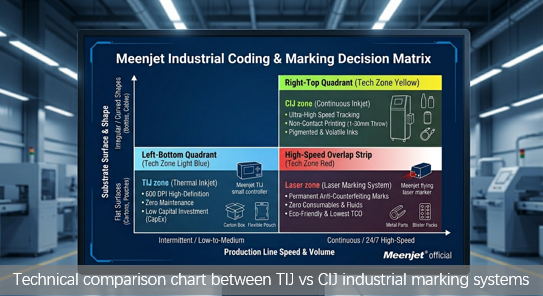
While online laser systems excel in permanent, zero-consumable coding, ink-based technologies remain highly flexible for multi-material packaging. This guide provides a professional evaluation of TIJ vs. CIJ coding marking capabilities to help you determine the optimal marking solutions for your operations.
What is a Thermal Inkjet (TIJ) Printer?
A thermal inkjet printer utilizes a heat resistor to expand ink bubbles and eject droplets through a nozzle. The printhead is integrated directly into the consumable cartridge, making TIJ systems virtually maintenance-free.
Pros of TIJ Technology
Zero Maintenance: Replacing the cartridge replaces the printhead, eliminating clogged nozzles and pump failures.
High Portability: Power lightweight handheld inkjet printer configurations for flexible, offline coding across warehouses.
Superior Resolution: Delivers up to 600 DPI crisp text, perfect for complex 2D barcodes and precise expiry date coding machine marks.
Low Initial Capital Cost: Inline TIJ hardware features a simple design, leading to lower upfront equipment procurement costs than complex CIJ systems.
Cons of TIJ Technology
Print Distance Sensitivity: This inkjet date printer technology requires the printhead to remain exceptionally close to the substrate (1–5mm).
Consumable Costs: High-volume, continuous production can lead to higher total fluid costs due to individual cartridge replacements.
What is a Continuous Inkjet (CIJ) Printer?
An industrial continuous inkjet printer utilizes a high-pressure pump to direct a continuous stream of ink through a nozzle. Electrical charges deflect specific droplets onto the substrate, while unused ink is recycled via a gutter system.
Pros of CIJ Technology
Ultra-High Speeds: Specifically engineered for continuous, high-volume automatic coding machine lines.
Extended Throw Distance: Handles non-contact printing on irregular or curved surfaces, making it the industry standard inkjet printer for bottles and cans.
Diverse Ink Chemistry: Easily manages volatile solvents and heavy pigments, including inkjet printer white ink for dark plastics.
Cons of CIJ Technology
Heavy Maintenance: Constant fluid circulation requires regular makeup fluid replenishment and periodic internal flushing.
Stationary Footprint: Unlike a flexible portable hand held printer, CIJ units are bulky, stationary industrial marking systems integrated into fixed conveyor lines.
Technical Comparison Matrix
Feature | Thermal Inkjet (TIJ) | Continuous Inkjet (CIJ) |
Throughput Capacity | Optimal for intermittent or low-to-medium speed lines | Engineered for high-speed, 24/7 continuous production |
System Mobility | Highly modular (Easily scales from inline to handheld) | Strictly stationary coder machine installation |
Maintenance Demands | Negligible (Simple cartridge swap) | High (Requires regular technician servicing) |
Substrate Compatibility | Flat surfaces (Cartons, pouches, metals, plastics) | Irregular shapes (Curved glass, wet bottles, wire and cable) |
Print Quality | High-definition (Sharp vector graphics and barcodes) | Lower resolution (Traditional dot-matrix fonts) |
Strategic Selection: Which Fits Your Factory?
Deploy a TIJ Printer If:
Your production involves low-to-medium volume inline runs or requires mobile packaging identification. TIJ systems excel in flat-surface applications like cardboard cartons, flexible pouches, and outer tray integrations.
Expert Note: Industry leaders like Meenjet have innovated advanced TIJ Inkjet Printer systems featuring extended print distances and bulk ink setups, significantly reducing high-volume consumable barriers.
Deploy a CIJ Printer If:
You manage high-speed, 24/7 automated packaging lines with irregular or curved substrates. For heavy-duty bottling lines, canning operations, or continuous extrusion processes, CIJ remains the benchmark for industrial coding solutions.
Alternative Note: For permanent, non-ink marking on metals, glass, or polymers, companies often opt for dedicated fiber laser marking machine or CO2 laser systems to completely eliminate fluids and ongoing consumable costs.
Tailored Product Marking Solutions by Meenjet
At Meenjet, we design and manufacture high-performance product marking solutions tailored to your specific line speed, material substrate, and operational budget.
Whether you need a flexible handheld marking machine, an automated inline inkjet setup, or an industrial flying laser marker, our engineering team provides expert guidance. Contact Meenjet today for a complimentary substrate sample print test and technical consultation!