



News & Blogs
Industry Insights for Manufacturers:
When selecting a batch coder for beverage production, success depends on solving two critical variables: Surface Condensation and Line Throughput.
For Condensation: Continuous Inkjet (CIJ) with solvent inks or CO2/UV Laser Marking are the only reliable methods to ensure adhesion on wet glass or cans.
For High Speed: Modern lines running at 30,000 to 60,000+ BPH require "marking-on-the-fly" systems like Flying Lasers to eliminate drying time bottlenecks.
For Compliance: Precision is key to meeting GS1 global traceability standards.
The Challenge: Adhesion in High-Moisture Environments
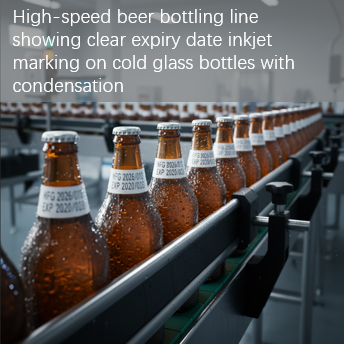
In the alcoholic beverage industry, marking a legible batch code or expiry date is a battle against physics. Cold-filling processes create persistent surface condensation, acting as a barrier between the substrate and the ink. On a wet glass bottle or aluminum can, standard ink often fails to cure, leading to smudged, unreadable codes that risk compliance failure.
For these high-moisture environments, Continuous Inkjet Printer (CIJ) technology remains the gold standard. Unlike a basic desktop inkjet, an industrial continuous inkjet printer utilizes high-velocity, solvent-based inks. Meenjet’s advanced CIJ solutions are specifically engineered to "penetrate" the moisture layer, ensuring that the inkjet marking achieves instant bonding and remains intact throughout the entire supply chain.
High-Speed Marking: Laser vs. Inkjet
As production speeds hit industrial scales, manual processes and slow-cycle printers become the primary cause of downtime. When your line exceeds 30,000 bottles per hour (BPH), you need a system that supports true "marking-on-the-fly."
Flying Laser Marking Machine: This is the ultimate "zero-consumable" solution for high-volume producers. A CO2 laser marking machine or UV laser marking machine performs microscopic physical etching on the bottle or label. It eliminates drying time entirely, making the mark immune to condensation. For glass and PET containers, a laser coder machine ensures a permanent, tamper-proof mark that cannot be wiped away.
TIJ Inkjet Printer: For secondary packaging, such as cardboard cases and shrink-wraps, Meenjet's TIJ (Thermal Inkjet) systems provide 600 DPI high-resolution prints. While TIJ is typically optimized for dry surfaces, it is the most reliable and maintenance-free batch number printing machine for ensuring scannable barcodes and complex variable data on outer cartons.
Strategic Selection Guide for Beverage Producers
Production Scale | Recommended Tech | Meenjet Featured Solution |
High-Speed (30k - 100k BPH) | Flying Laser | Industrial Flying Fiber/CO2 Laser |
Wet/Cold Filling Lines | CIJ (Inkjet) | Industrial Inkjet Coder (Solvent Inks) |
Small Batch / Craft | Handheld Coder | Meenjet Handheld Inkjet Coder |
Outer Carton/Logistics | TIJ Printer | High-Res TIJ Inkjet Printer |
Enhancing Flexibility with Meenjet Portable Solutions
Not every facility operates a fixed, high-speed line. For craft breweries, boutique distilleries, or luxury wine producers handling limited editions and barrel-aging, mobility is a strategic advantage.
The Meenjet handheld printer series has revolutionized how SMEs manage product marking solutions. Whether it’s a handheld expiry date printer for seasonal gin or a portable laser marking machine for engraving luxury wooden whiskey crates, these devices offer industrial-grade precision in a mobile format. A portable handheld inkjet printer allows for on-the-spot coding in diverse warehouse conditions where fixed installations are neither feasible nor cost-effective.
Future-Proofing and Global Compliance
Beyond mere legibility, modern beverage marking must facilitate global logistics. Utilizing a high-performance uv laser marking machine or an inkjet marking machine ensures that your production adheres to GS1 global traceability standards. This ensures that every bottle—regardless of condensation or production speed—is equipped with a scannable 2D DataMatrix or QR code for end-to-end transparency.
Conclusion
Choosing between an inkjet batch coder and a laser coder machine depends on your specific substrate, line speed, and environmental challenges. For brands seeking to balance high-speed reliability with a strong ROI, Meenjet provides a comprehensive ecosystem of industrial marking systems tailored for the rigorous demands of the modern beverage industry.