




News & Blogs
In the global manufacturing sector, the pursuit of production efficiency often hits a technical bottleneck: ensuring high-speed traceability without compromising line stability. While the marking industry has seen a surge in laser and thermal technologies, the Continuous Inkjet Printer (CIJ) remains the strategic benchmark for high-volume environments. This dominance is not a matter of tradition, but of three core technical realities: physical tolerance, chemical versatility, and digital integration.
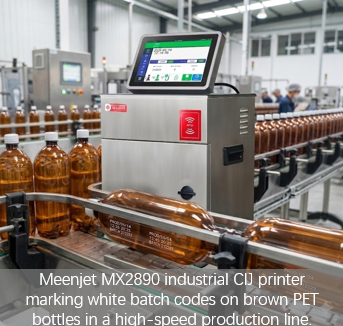
1. Superior Physical Tolerance in Dynamic Environments
The primary challenge of high-speed lines—such as beverage bottling or cable extrusion—is the constant vibration and the non-uniform shape of the substrates.
Unlike Thermal Transfer Overprinters (TTO printers), which require a flat surface and synchronized physical contact, a CIJ coder machine operates via high-velocity ink throw. This non-contact method provides a significant "throw distance," allowing the machine to mark curved or recessed surfaces with precision. For industries requiring a reliable wire marking machine or an inkjet bottle printer, CIJ technology is the only solution capable of maintaining legibility despite substrate fluctuations or high-velocity movement.
2. Chemical Versatility: Beyond Standard Markings
Effective coding marking is defined by contrast and adhesion, especially on challenging non-porous materials like PE, PP, and PET. High-speed production often utilizes dark substrates where conventional dye-based inks become invisible.
Meenjet addresses this through a specialized synergy of hardware and chemistry. By utilizing high-pigment inkjet printer white ink—which requires constant circulation to prevent sedimentation—and pairing it with advanced drop-deflection control, our industrial inkjet coder systems achieve exceptional contrast. This ensures sharp, high-definition characters on dark rubbers and plastics, providing the necessary visibility that standard marking methods fail to deliver.
3. The Digital Shift: Industry 4.0 and ERP Integration
Modern industrial marking systems are moving away from isolated hardware to become critical data nodes. In a smart factory, the efficiency of a batch coding system is measured by its ability to communicate.
Leveraging expertise across multiple marking platforms, Meenjet has developed a unified control architecture. This allows our intelligent inkjet printers to integrate seamlessly with enterprise ERP systems. By automating the data flow directly to the batch code printer, manufacturers eliminate the risks of manual data entry, ensuring that code dates and batch identifiers are synchronized across the production floor in real-time.
4. Strategic Reliability and Total Cost of Ownership
When analyzing the total cost of ownership: TIJ vs CIJ printers, the decision hinges on the duty cycle. While a thermal inkjet printer (TIJ) is an excellent choice for high-resolution graphics on intermittent lines, the high speed inkjet printer (CIJ) is built for the "always-on" rigors of industrial automation. With rapid-dry ink formulas and self-cleaning fluid systems, CIJ minimizes the maintenance downtime associated with lower-tier portable inkjet or manual marking alternatives.
Conclusion: Investing in Scalable Traceability
As manufacturing enters a new era of automation, the selection of inkjet coding and marking equipment is a strategic decision that affects the entire supply chain. While a handheld inkjet printer remains essential for logistical flexibility, the industrial inkjet printing machine is the indispensable heart of the high-speed line. For facilities demanding a resilient manufacturing date printing machine, Meenjet’s integrated solutions provide the precision and digital connectivity required for the factories of tomorrow.