


News & Blogs
Quick Summary: How to Mark Non-Porous Surfaces?
Printing on metal and glass requires specialized marking solutions because these non-porous surfaces do not absorb standard ink. The best methods include:
Handheld Inkjet Printers: Best for flexibility and small batches using quick-dry solvent inks.
Fiber Laser Marking Machines: The premier choice for permanent, high-contrast marks on metal.
CO2 Laser Marking: Ideal for high-end, etched coding on glass bottles.
Continuous Inkjet (CIJ): Best for high-speed industrial production lines.
In the competitive world of manufacturing, clear and durable code dates are essential for compliance and branding. However, metal and glass present unique challenges: ink smudging, lack of adhesion, and harsh environmental exposure. Choosing the right coding and marking machine is no longer just about the price—it’s about matching the technology to the substrate.
The Challenge of Non-Porous Substrates
Unlike paper or cardboard, metal and glass are non-porous. This means the ink must sit on the surface and bond physically or chemically. Without the correct industrial marking systems, marks can easily be wiped off, leading to supply chain traceability issues.
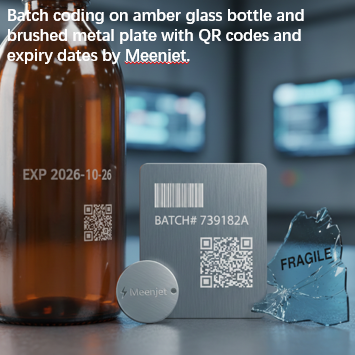
1. Handheld Solutions for Maximum Flexibility
For businesses requiring mobility, a handheld inkjet printer (or handheld inkjet printer gun) is an invaluable tool. These devices utilize TIJ (Thermal Inkjet) technology with fast-drying solvent inks.
Best Use Case: Marking large metal pipes, glass jugs, or pallets.
Key Advantage: A portable handheld inkjet printer is cost-effective and easy to integrate into manual workflows.
Pro Tip: Use inkjet printer white ink for high-contrast batch marking on dark metal surfaces to ensure scannability.
2. Laser Coding: The Permanent Alternative
When permanence is non-negotiable, a laser marking machine is the superior choice. It eliminates the need for consumables like ink and ribbons.
Fiber Laser Marking Machine: Specifically designed for metals. A desktop fiber laser can engrave serial numbers and logos into stainless steel or aluminum with microscopic precision.
UV Laser Marking Machine: Often called "cold marking," it is perfect for thin glass or sensitive electronics where heat must be minimized.
CO2 Laser Marking: The industry standard for glass bottles, providing a "frosted" effect that is permanent and tamper-proof.
3. Industrial High-Speed Production
For 24/7 manufacturing, an industrial continuous inkjet printer (CIJ) or an inline inkjet printer is the workhorse. These systems can spray code dates and batch numbers onto curved glass or uneven metal surfaces at high speeds without making contact.
Comparison: Choosing Your Coder Machine (2026 Comparison)
Technology | Best Surface | Portability | Consumables |
TIJ Handheld Printer | Small-batch Metal/Glass | High | Ink Cartridges |
Fiber Laser Marker | All Metals | Low (Desktop) | None |
CO2 Laser Marker | Glass & Organic Mat. | Low to Moderate | None |
CIJ Printer | High-speed Lines | Low (Inline) | Ink & Makeup |
Best Practices for Successful Marking
Surface Preparation: Ensure the surface is free of oils. Even the best inkjet coder will struggle if there is a film of lubricant on the metal.
Environment Check: In humid or dusty factories, choose an industrial inkjet coder with an IP65 rating to protect the internal components.
Verify Compliance: For food or beverage, ensure your expiry date inkjet printer uses food-grade compliant inks.
Conclusion
Whether you need a handheld laser marking machine for heavy metal parts or a bottle date printer for a beverage line, Meenjet offers a complete range of product marking solutions. As a leading laser marking machine manufacturer, we focus on durability, precision, and ease of use.